
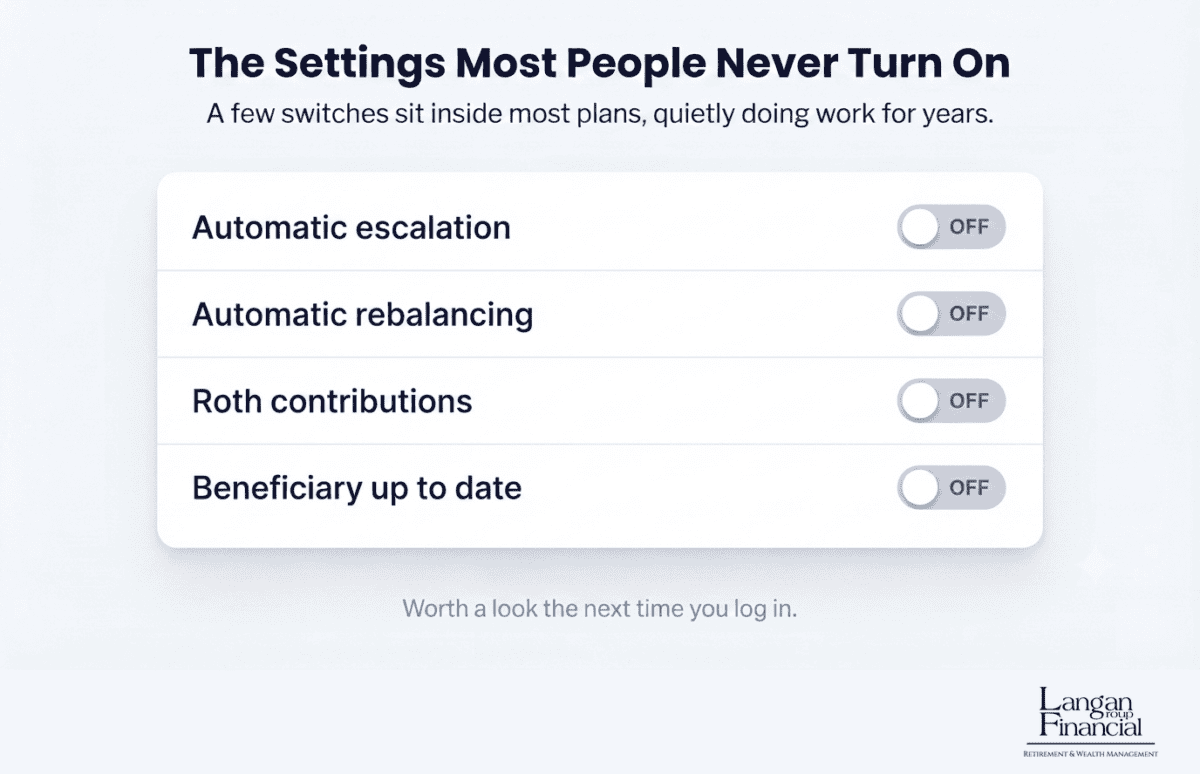
Most people set up their workplace retirement plan once. They pick a contribution rate during their first week on the job, choose an investment or accept the default, and then do not look again for years.
That is not carelessness. The plan works without attention, which is the whole point of it. But a handful of settings sit inside most plans that many people never turn on, and several of them do their work quietly for decades.
Here are the ones worth a look the next time you log in.
Automatic Escalation
This setting raises your contribution by a set amount each year without you doing anything. One percentage point a year is the common choice.
The reason it helps is simple. Deciding to save more is a decision most people put off. Deciding once that the rate goes up every year is a decision you make a single time.
The Timing Trick That Makes It Easier
Set the increase for the month your raise usually lands.
If your pay goes up in March and your contribution goes up in March, the money never appears in your take-home pay in the first place. You are saving more without feeling like you are living on less.
Plans that offer escalation generally let you pick the month. If yours does, this is a two-minute change.
What to Know Before You Turn It On
Escalation keeps going until it hits a cap you set or a cap the plan sets. Check what that cap is so it does not stop earlier than you expected, or keep climbing past what your budget allows.
You can turn it off or change it at any time. It is not a commitment.
If Your Plan Started Recently
A retirement law passed in 2022 requires most 401(k) and 403(b) plans created after December 29, 2022, to enroll new employees automatically and to raise the rate by at least one percentage point a year.
Plans that existed before that date are not required to do either. Neither are governmental plans, church plans, businesses with 10 or fewer employees, or businesses less than three years old.
So if your plan does not escalate on its own, that is normal. It usually just means the feature is optional and has to be switched on.
Automatic Rebalancing
Over time, the investments that grow fastest take up a larger share of your account. A mix that started at sixty percent stocks can drift well past that without you making a single change.
Automatic rebalancing periodically sells a little of what has grown and buys a little of what has not, returning the account to the mix you chose. Most plans offer it quarterly or annually.
This does not improve returns and it is not meant to. What it does is keep your account from taking on more risk than you intended, which tends to matter most right before you need the money.
If you use a target date fund, this generally happens inside the fund already. Turning on a second layer of rebalancing on top of it is usually unnecessary.
Your Beneficiary Designation
This is the one that matters most and gets checked least.
The beneficiary form on a retirement account generally controls where the money goes. It overrides your will. A form completed the week you were hired in 1998 still controls that account today, whatever your estate documents say.
Log in and read what it actually says rather than what you remember choosing. If the account was opened before a marriage, a divorce, a birth, or a death in the family, this is worth handling this week rather than adding to a list.
Also check the contingent beneficiary. That is the person who inherits if your primary beneficiary is no longer living. Many forms have a primary name and nothing after it.
Whether Your Plan Offers a Roth Account
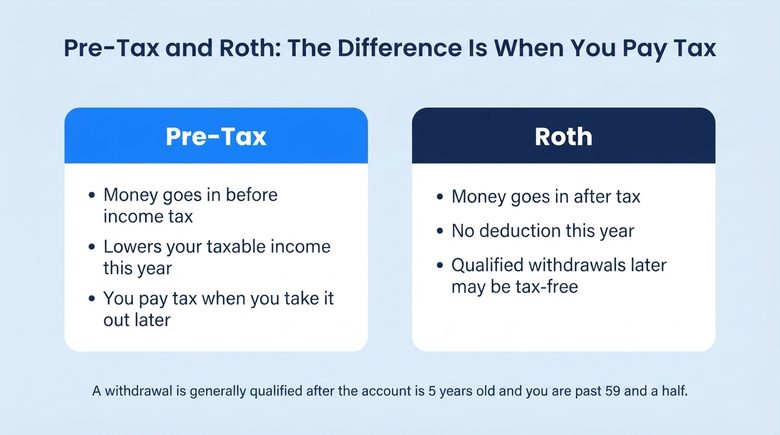
Many plans now let you split your contributions between pre-tax and Roth. Pre-tax lowers your taxable income now and is taxed when you take it out. Roth is taxed now, and qualified withdrawals later may come out tax free.
Two reasons to check this even if you have no plans to change anything.
First, having money in both kinds of accounts gives you more control over your taxable income in retirement, since you can choose which account to draw from in a given year.
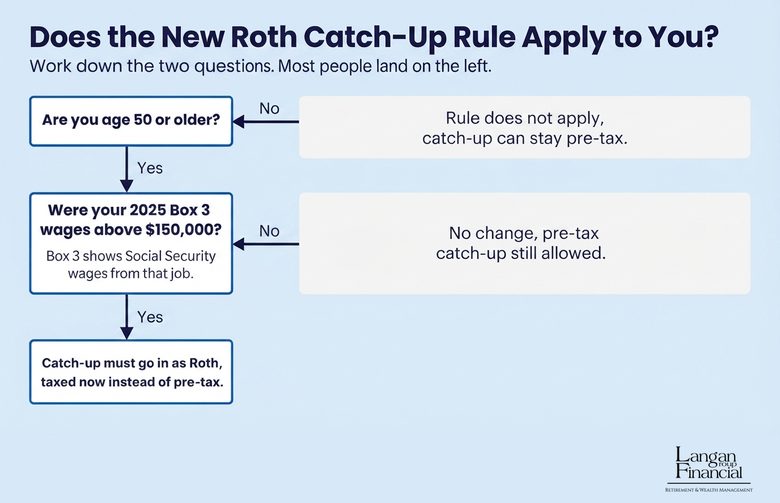
Second, and more urgently, there is a rule that took full effect this year. If you are 50 or older and your Social Security wages from one employer were above $150,000 last year, your catch-up contributions generally have to go into a Roth account. If your plan does not offer one, you may not be able to make catch-up contributions at all until it does.
That rule and the current limits are covered in 2026 Retirement Plan Contribution Limits and the New Catch-Up Rules.
How Front-Loading Your 401(k) Can Cost You Employer Match
Most people know their employer matches something. Fewer know how it is calculated, and the method can matter.
The Per-Pay-Period Trap
Some plans match per pay period. If you contribute heavily early in the year and hit the annual limit in September, there may be no contribution left for the plan to match in the final months.
Some plans include a true-up, which is a year-end correction that pays the match you would have received if your contributions had been spread evenly. Many do not.
If your plan has no true-up and you tend to front-load, spreading contributions across the full year may keep more of the match available. Your plan administrator can tell you which method applies.
Newer Features Your Plan May Have Added
The 2022 retirement law created several optional features. Plans may offer them or not, and many are still deciding. None of these are required.
Student loan matching. Some plans now treat your qualified student loan payments as if they were retirement contributions for matching purposes. If you are paying loans instead of contributing, this can mean receiving a match you would otherwise miss.
Emergency savings inside the plan. Some plans allow a small separate savings account, funded with after-tax dollars and available for unexpected costs, generally without the early withdrawal tax that applies to retirement money.
Roth employer contributions. Some plans let you elect to receive the employer match as Roth money instead of pre-tax. It is taxable to you in the year received, so this is worth a conversation before electing it.
These are worth asking about rather than assuming. Plan documents are being updated through the end of 2026, so a feature that was unavailable last year may exist now.
One Change to Your Statements This Year
Beginning in 2026, retirement plans are generally required to provide at least one paper benefit statement each year unless you have specifically chosen to receive everything electronically.
So a statement may arrive in the mail that has not arrived in years. It is worth opening. That document is often the simplest place to confirm your contribution rate, your investment mix, and in some cases the beneficiary on file.
If You Only Do One Thing
If the full list feels like a lot, start with the beneficiary designation. It takes the least time, it is the one most likely to be out of date, and it is the one with the largest consequences if it is wrong.
The reason is simple. That form generally controls where the money goes, and it overrides your will. Everything else on this page affects how your savings grow. The beneficiary form affects who receives them. Confirm that one, and you have handled the setting that matters most.
A Ten-Minute Login
If you do nothing else, these five answers cover most of it.
1. What percentage of pay am I contributing, and what dollar figure does that produce this year?
2. Is automatic escalation available, and is it on?
3. Who is named as my beneficiary, and who is named after that?
4. Does my plan offer a Roth account?
5. How is the employer match calculated, and is there a true-up?
Write down anything you cannot find. Those become the questions for one phone call.
Review Your Plan With Langan Financial Group
Sorting out which of these settings apply to you, and what to do about each, is the part our team helps with most. Bring a recent statement and we will go through your plan together: what you are contributing, how the match works, what the settings are set to now, and who is named on the account. There is no rush, and the consultation is complimentary and carries no obligation.
Schedule a Free ConsultationOr call 717-288-1880
Common Questions
What is automatic escalation in a 401(k)?
It is a setting that raises your contribution rate by a set amount each year without further action from you. One percentage point per year is common. You can change it or turn it off at any time.
Does my employer have to offer automatic escalation?
No. Most 401(k) and 403(b) plans created after December 29, 2022, are required to enroll employees automatically and escalate contributions. Plans that existed before that date are not, and several categories of employer are exempt.
Does a beneficiary form override a will?
Generally yes. The beneficiary designation on a retirement account usually controls where that account goes, regardless of what your will says. This is why an outdated form can direct money somewhere you would not choose.
Can front-loading my 401(k) cost me employer match?
It can, depending on how your plan calculates the match. If the plan matches per pay period and has no year-end true-up, hitting the annual limit early may leave months with no contribution left to match.
Why did I get a paper retirement statement this year?
Beginning in 2026, plans are generally required to send at least one paper benefit statement each year unless you have elected to receive all communications electronically.
How do I find my 401(k) plan settings?
Most plans have an online portal run by the recordkeeper, which is the company that administers the plan. You log in with your own credentials, and the settings for contribution rate, escalation, investments, and beneficiary are usually under an account or profile menu. If you cannot find something, your plan administrator or your employer’s human resources contact can point you to it or answer directly.
Which 401(k) setting matters most?
For most people the beneficiary designation matters most, because it controls who receives the account and it overrides a will. It is also the setting most likely to be out of date. After that, capturing the full employer match and setting a contribution rate you can sustain are the settings that tend to have the largest effect over time.
Sources
SECURE 2.0 Act of 2022, Sections 101, 110, 115, 127, 338, and 604
Internal Revenue Service and U.S. Department of the Treasury, Proposed Regulations on Automatic Enrollment, January 2025
Internal Revenue Service, Notice 2024-2, Miscellaneous Changes Under the SECURE 2.0 Act
Internal Revenue Service, Notice 2024-63, Guidance on Matching Qualified Student Loan Payments
Internal Revenue Service, Retirement Topics: Catch-Up Contributions
Internal Revenue Service, Notice 2025-67, 2026 Amounts Relating to Retirement Plans and IRAs
U.S. Department of Labor, Employee Benefits Security Administration, Benefit Statement Requirements
About the Financial Author

Alexander Langan, J.D., is the Chief Investment Officer at Langan Financial Group. In this role, he manages investment portfolios, acts as a fiduciary for group retirement plans and consults with clients regarding their financial goals, risk tolerance and asset allocation.
With a focus on ERISA Law, Alex graduated cum laude from Widener Commonwealth Law School. He then clerked for the Supreme Court of Pennsylvania and worked in the Legal Office of the Pennsylvania Office of the Budget, where he assisted in directing and advising policy determinations on state and federal tax, administrative law, and contractual issues.
Alex is also passionate about giving back to the community and has helped establish The Foundation of Enhancing Communities’ Emerging Philanthropist Program, volunteers at his church, and serves as a board member of Samara: The Center of Individual & Family Growth. Outside of work and volunteering, Alex enjoys his time with his wife Sarah and their three children, Rory, Patrick, and Ava.
About Langan Financial Group
For everything you’ve built.
Your savings. Your business. Your family’s future. Each deserves thoughtful planning that starts with what matters to you.
Langan Financial Group provides financial planning and investment management for individuals, families, and business owners. With offices in Camp Hill and York, Pennsylvania, we serve clients throughout Central Pennsylvania.
We help you work through questions about retirement income, investment decisions, Social Security, and how taxes may affect your financial plan. Our approach starts with understanding your goals, your financial picture, and your comfort with investment risk. From there, we help you evaluate your options and develop a plan that can evolve as your life changes.
We also help businesses and organizations evaluate workplace retirement plans and understand their responsibilities as plan sponsors.
Disclosures
The information in this material is not intended as tax or legal advice. Please consult legal or tax professionals for specific information regarding your individual situation. The opinions expressed and material provided are for general information.