
Investment Planning Guide
Answering investment planning FAQs and helping you identify the right investment advisor
Investment Planning Testimonials
My investments have done well. I have full confidence in this group. My family now invests with them. They have gone beyond the call of duty in caring for my family.
They didn't know this: When my husband died, I had an outside advisor review my investments.
His advice? Stay with success.
My husband and I, in addition to three other family members, have been advised financially by Bob and team for years.
We've always experienced friendliness, professionalism, and compassion when dealing with the Langan Financial Group.
They continue to advise us in maintaining a balanced and profitable portfolio.
A note about this testimonial: The individuals providing the testimonials above are current clients of Langan Financial and were not compensated for providing their testimonials. The testimonials reflect their individual experiences and are not representative of the experience of all clients.
Investment Planning
Investment planning can be a time consuming process when you take into consideration an individual's unique situation, investment goals, and the overwhelming amount of options.
Below, we will help explain:
- What is an investment advisor
- How to choose an investment advisor
- How to find an investment advisor
- What is the investment planning process
When deciding to create an investment plan, it is vital you work with an investment manager who is not limited to cookie cutter solutions or a few investment products.
You do not want to be a number stuffed into a plan that was not designed with your specific needs in mind.
You want an investment advisor that understands investment planning concepts and utilizing best practices to create a customized strategic plan to help you achieve your investment goals.
What Does an
Investment Advisor Do?
An investment advisor, also known as an investment manager, is a compensated individual who makes investment recommendations or conducts securities analysis for a person.
To do this, the individual must be registered with the Securities and Exchange Commission or the State regulator.
Investment advisors manage a client or organization's assets and can help with conducting trades on behalf of the individual.
This includes:
- Building an investment portfolio
- Tracking investment fund performances
- Selling and purchasing investments
How to Choose a Registered Investment Advisor
Check the Firm’s Registration and Your Advisor’s Background
Before choosing a registered investment advisor, research both the advisory firm and the individual who will work with you.
Registered investment advisory firms are registered with either the Securities and Exchange Commission (SEC) or state securities regulators. Individual professionals serving as investment adviser representatives are subject to applicable state registration requirements; they are not individually registered with the SEC in that capacity.
You can use the free Investment Adviser Public Disclosure database to check registration information and review available background records for advisory firms and their representatives.
When researching a firm, review its Form ADV and, when available, Form CRS for information about:
- Services, fees, and account minimums
- Investment approaches and risks
- Conflicts of interest and business affiliations
- Disclosed disciplinary history
For the individual advisor, review available registration, employment, and disciplinary records. You can also request their Form ADV Part 2B brochure supplement, which describes their education, business experience, and other relevant background information.
If the advisor currently works—or previously worked—as a broker, check FINRA’s BrokerCheck for available brokerage registrations, securities exams, employment history, and reported disclosures, including customer disputes and regulatory actions. A reported allegation does not necessarily establish wrongdoing.
Registration does not imply SEC or state approval, endorsement, or a particular level of skill or training. Use these records alongside questions about the advisor’s experience, services, fees, and fit with your financial goals.
How to Find An
Investment Advisor
How to Find an Investment Advisor
Finding an investment advisor near you starts with understanding both the financial firm and the person you would work with. Beyond location, consider whether their experience, services, and communication style fit your financial needs.
Start With Your Financial Goals
Identify what you want help with, such as retirement planning, investment management, tax planning, or preparing to sell a business. Look for an advisor who regularly works with people facing similar financial decisions.
Ask what services are included, whether the firm has an account minimum, and how the advisor would coordinate with your accountant or attorney.
Ask About Client Experiences
Recommendations from friends, family, and professional contacts can help you identify advisors to consider. Rather than asking only whether someone likes their advisor, ask about:
-
How clearly recommendations are explained
-
How quickly the team responds to questions
-
How often meetings and updates occur
-
Whether fees and services match expectations
Someone else’s experience can provide helpful context, but their financial needs may differ from yours.
Read Online Reviews With Perspective
Google and other review platforms may offer insight into communication, responsiveness, and service. Look for recurring themes across multiple reviews instead of relying on a single comment or star rating.
Reviews may not represent every client’s experience and do not establish investment performance or whether an advisor is appropriate for you.
Investing Planning Process
Langan Financial Group takes a holistic approach to your investment needs. We focus on aligning your tactics with your financials goals so no part of your financial plan is working against you.
We strive to collaboratively create low cost, diversified portfolios that can be either active management or passive management according to your personal and financial risk tolerance.
We will collaborate with you to structure your portfolios to target either build wealth or for retirement income planning.
Start Investment Planning
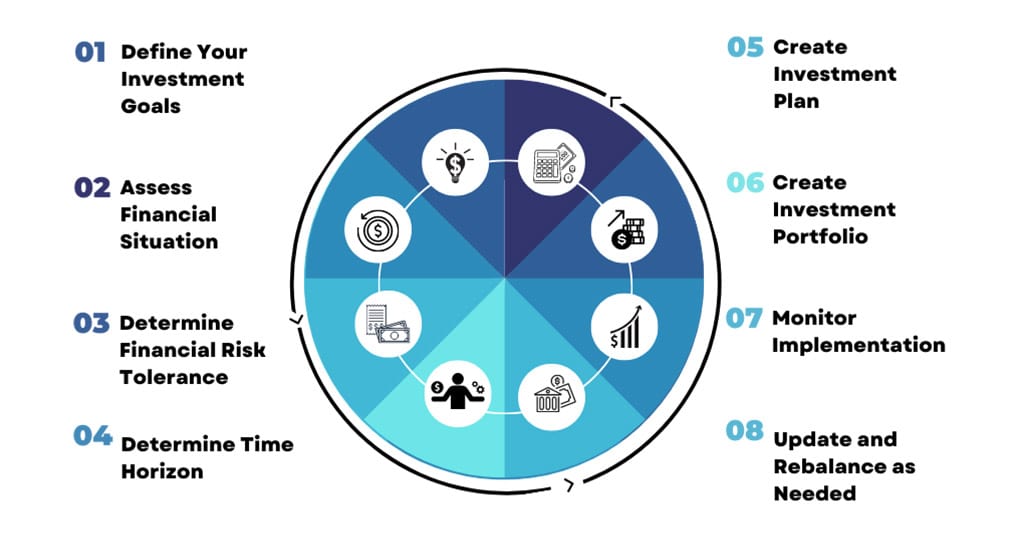
1. Define Your Investment Goals
Defining your goals is vital to understanding where you want to be. If we do not know what your goals are, we can not create a plan to get you there.
By understanding your investment goals, we can align all the financial tactics together to more efficiently reach your objectives. We want to overcome your financial obstacles, not create more.
2. Assess Financial Situation
Assessing your financial situation allows us to create a Financial Gap Analysis.
This analyzes the difference between your current financial situation is from your investment goals. This includes looking at your current tax bracket to determine if there are any options for tax saving investments. We can also help with inheritance tax planning needs.
Our comprehensive financial dive allows us to start working backwards to identify the financial tactics and steps needed to achieve your objectives.
3. Determine Financial Risk Tolerance
Now that we have the Financial Gap Analysis created, we need to start working on the financial tactics.
Depending on your financial risk tolerance will determine how aggressive or conservative we will be in setting up your plan. This will directly impact the tactics used as well as the investment funds available within the portfolio.
4. Determine Time Horizon
Understanding when you would like to achieve your financial goals is imperative in creating your plan.
If you are 20 years old starting to invest for retirement for age 65 or you are looking to use the investments to purchase a house in 10 years, your tactics will change greatly.
Determining your time horizon will be combined with your risk tolerance to ensure every step is aligned with your comfort.
5. Create Investment Plan
Now that the Financial Gap Analysis is created with you risk tolerance and time horizon, we will work backwards from your goals to create your investment strategy.
This customized financial plan will break down the step by step financial tactics needed to help you achieve your goals within your time frame.
6. Create Investment Portfolio
Within the plan will host a customized investment portfolio for you. It is vital all of these components are aligned and working together towards your plan within your investment portfolio.
If these characteristics are not working together, it is possible portions of your plan will inhibit each other.
This will create unnecessary financial obstacles within your plan, making it even more difficult to achieve your investment goals.
7. Monitor Implementation
The next vital part is monitoring the implementation. We utilize a proprietary Financial Early Warning System.
A Financial Early Warning System is a customized system according to your investment plan that alerts us when issues are starting to rise. We take a proactive approach and try to capture any potential issues as early as possible.
8. Update and Rebalance as Needed
Once issues are identified by the Financial Early Warning System, we revisit the investment plan to determine how the red flags will impact your strategy.
We alert our clients to the issues and provide suggested tactical changes. We focus on a proactive approach, doing our utmost best to ensure our clients' financial needs are taken care of.
We do not want to wait for something to happen and have to react to a bad scenario. Rather we prefer to monitor key signs alerting us any upcoming potential issues.
Get started today
Contact Us Today

Chat with a Registered Investment Advisor
If you have any financial planning questions or concerns, please feel free to contact us for a free consultation.
You can reach us at 717-288-1880 or visit our contact us page to send an inquiry.
FREE Benchmark Comparison Services
Financial Advisor Locations:
Camp Hill, PA Financial Planning Office
York, Pa Financial Planning Office
Harrisburg, PA Financial Planners
Communities Served:
Langan Financial Group, LLC ("Langan Financial Group" or "LFG") is an SEC registered investment adviser. SEC registration does not constitute an endorsement of the firm by the Commission nor does it indicate that the adviser has attained a particular level of skill or ability. LFG may only transact business in those states in which it is registered, or qualifies for an exemption or exclusion from registration requirements.
You can review our registration and disciplinary history on the SEC's Investment Adviser Public Disclosure (IAPD) website and, for brokerage registrations, on FINRA's BrokerCheck. This website is for general information only. It is not legal, accounting, or tax advice. Please talk with your own legal or tax professional about your situation. Important information about our firm is on our Disclosures page.
© Langan Financial Group
Harrisburg, PA Office
Address: 1863 Center St, Camp Hill, Pa 17011
Phone: 717-288-1880
York, PA Office
Address: 3405 Board Rd, Suite 200, York, Pa 17406
Phone: 717-773-4085