
Two people can retire with the same amount of money, spend the same each year, and live the same number of years. One can still pay far more in taxes than the other. The difference is often just the withdrawal order, the sequence they took their money out in.
Here is why. You likely have money in more than one kind of account: a regular savings or brokerage account, a traditional 401(k) or IRA, and maybe a Roth. Each is taxed differently when you withdraw from it. Pull from them in the wrong order and you can push yourself into a higher tax bracket, raise your Medicare premiums, and make more of your Social Security taxable, sometimes for years.
Pull from them in a smart order and you may keep more of your own money. This is one of the few things in retirement you can actually control, and it is the question this article answers: which account should you draw from first?
“Will My Advisor Just Handle This for Me?”
Some do. But many advisors focus on growing your investments, not on the tax order you spend them down in. That is a separate skill, and it often involves your tax preparer too. The two do not always talk to each other.
According to Corebridge Financial research from June 2026, only about 14 percent of retirees reported having a detailed strategy for managing their required withdrawals. If no one has walked you through your withdrawal order, you are in the majority, and it is a fair thing to ask about.
The Common Answer, and Why It Is Not Always Right
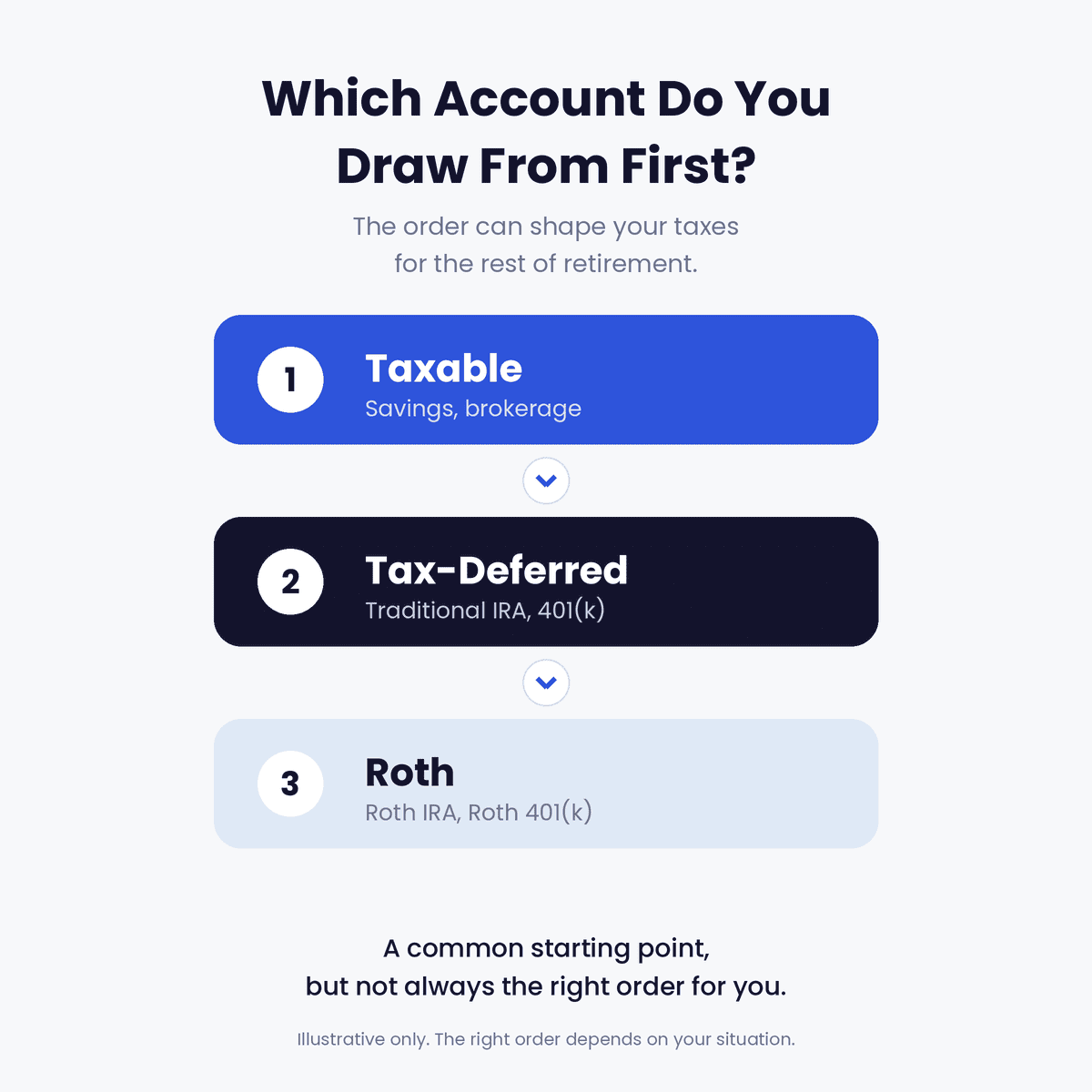
The traditional rule of thumb goes like this. Spend your taxable accounts first, such as savings and brokerage. Then your tax-deferred accounts, such as a traditional 401(k) or IRA. Save your Roth for last, since it grows tax free.
The logic is sound as a starting point. It lets your tax-advantaged accounts keep growing as long as possible, and it is a reasonable default for many households.
But it is a default, not a rule. For some families, following it without question leads to a problem that shows up years later.
The Tax Bomb Nobody Mentions
If you leave a large traditional IRA or 401(k) untouched for years, it keeps growing. That sounds good until age 73 or 75, when required withdrawals begin.
By then the account may be very large. The required amount can push you into a higher tax bracket. It can raise your Medicare premiums. It can make more of your Social Security taxable. All at once, and for the rest of your life.
Drawing some from the traditional account earlier, even when you did not have to, can spread that tax over more years at lower rates. This is the case against following the common order too strictly. Coordinating the timing is part of retirement income planning.
What Changes the Answer

The right order depends on your situation. Here are the factors that most often change it.
Your Tax Bracket This Year
You might be in a low tax bracket now. This often happens early in retirement, before Social Security and required withdrawals begin. If so, that may be the time to take more from the traditional account, not less. You are using up the low brackets while you can.
The Size of Your Traditional Accounts
The larger your traditional IRA and 401(k) balances, the more the future required withdrawals matter, since they are calculated from that balance. A very large balance is a signal to look harder at whether drawing some down earlier fits your plan.
Whether You Want to Leave an Inheritance
Roth accounts pass to heirs tax free and without the same withdrawal pressure. This is one place withdrawal order and estate planning meet. Traditional accounts do not. If trust and legacy planning matters to you, that can change which account you preserve.
Your Health and Longevity Outlook
Someone who expects a long retirement plans differently from someone managing a health condition. The sequencing question is personal, and this is one reason it is.
A Better Way to Think About It

Rather than a fixed order, many families do better with a blended approach. In a given year, they take a little from more than one type of account to keep their taxable income in a target range.
The goal is not to pay the least tax this year. It is to pay the least tax over your whole retirement, which sometimes means paying a little more now to avoid a lot more later.
That is a different way of thinking, and it is hard to do with a rule of thumb. It usually takes running the numbers for your specific situation, the kind of work that goes into tax-efficient investing.
Bring Your Accounts to Langan Financial Group
The right withdrawal order depends on your brackets, your balances, and what you want for the years ahead. Those are the questions our team helps families work through. Bring a recent statement from each account, and we will look at the sequence together, at whatever pace is useful. The consultation is complimentary and carries no obligation.
Schedule a Free ConsultationOr call 717-288-1880
The years before required withdrawals begin are their own kind of opportunity. See The Quiet Planning Window Between Retirement and Age 73.
Common Questions
What order should I withdraw from my retirement accounts?
A common starting point is to draw from taxable accounts first, then tax-deferred accounts like a traditional IRA or 401(k), and Roth accounts last. This is a reasonable default, but the right order for you depends on your tax bracket, your account balances, and your goals. For some families, drawing from tax-deferred accounts earlier can lower lifetime taxes.
Why not just save my traditional IRA for last?
Leaving a large traditional IRA untouched lets it grow, but required minimum distributions begin at age 73 or 75. A very large balance can force big required withdrawals later. Those can push you into a higher bracket, raise Medicare premiums, and make more of your Social Security taxable. Drawing some down earlier can spread that tax over more years.
Do Roth accounts have required withdrawals?
Roth IRAs have no required minimum distributions during the original owner’s lifetime. Beginning in 2024, Roth 401(k) accounts also no longer require distributions during the owner’s lifetime. This is part of why Roth accounts are often preserved longer.
Is there one right withdrawal strategy?
No. Withdrawal sequencing depends on your individual tax situation, account balances, health outlook, and estate goals. A strategy that fits one household may be wrong for another. This is an area where running the numbers for your specific situation is valuable.
Sources
Corebridge Financial, Retirement Readiness Research, June 2026
Internal Revenue Service, Publication 590-B, Distributions from Individual Retirement Arrangements
Internal Revenue Service, Retirement Topics: Required Minimum Distributions
SECURE 2.0 Act of 2022, Sections 107 and 325
Internal Revenue Service, Notice 2025-67, 2026 Amounts Relating to Retirement Plans and IRAs
Congressional Research Service, Required Minimum Distribution Rules, IF12750
Social Security Administration, Income Taxes and Your Social Security Benefit
About the Financial Author

Alexander Langan, J.D., is the Chief Investment Officer at Langan Financial Group. In this role, he manages investment portfolios, acts as a fiduciary for group retirement plans and consults with clients regarding their financial goals, risk tolerance and asset allocation.
With a focus on ERISA Law, Alex graduated cum laude from Widener Commonwealth Law School. He then clerked for the Supreme Court of Pennsylvania and worked in the Legal Office of the Pennsylvania Office of the Budget, where he assisted in directing and advising policy determinations on state and federal tax, administrative law, and contractual issues.
Alex is also passionate about giving back to the community and has helped establish The Foundation of Enhancing Communities’ Emerging Philanthropist Program, volunteers at his church, and serves as a board member of Samara: The Center of Individual & Family Growth. Outside of work and volunteering, Alex enjoys his time with his wife Sarah and their three children, Rory, Patrick, and Ava.
About Langan Financial Group
For everything you’ve built.
Your savings. Your business. Your family’s future. Each deserves thoughtful planning that starts with what matters to you.
Langan Financial Group provides financial planning and investment management for individuals, families, and business owners. With offices in Camp Hill and York, Pennsylvania, we serve clients throughout Central Pennsylvania.
We help you work through questions about retirement income, investment decisions, Social Security, and how taxes may affect your financial plan. Our approach starts with understanding your goals, your financial picture, and your comfort with investment risk. From there, we help you evaluate your options and develop a plan that can evolve as your life changes.
We also help businesses and organizations evaluate workplace retirement plans and understand their responsibilities as plan sponsors.
Disclosures
The information in this material is not intended as tax or legal advice. Please consult legal or tax professionals for specific information regarding your individual situation. The opinions expressed and material provided are for general information.