
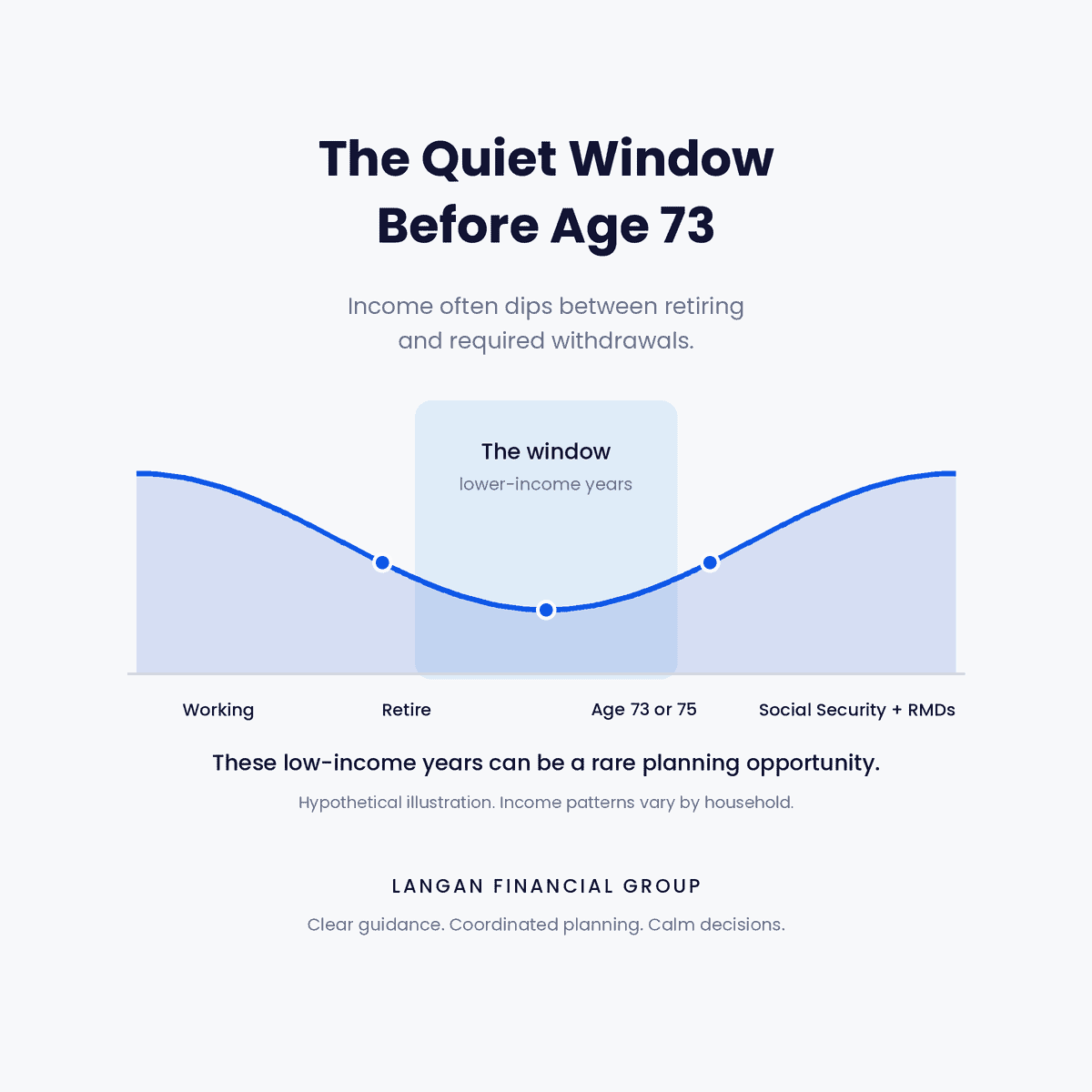

Picture a few years where your income drops lower than it has been in decades, and where that low income is quietly an opportunity worth thousands of dollars. For many people, those years arrive and leave without anyone noticing. That is the story of the gap years.
They are the stretch between when you stop working, often in your early or middle sixties, and when the government requires you to start withdrawing from your retirement accounts at age 73 or 75. In between, the paycheck has stopped, Social Security may not have started, and required withdrawals have not begun. Your taxable income can sit lower than it will ever be again.
Why should you care? Because a low-income year is the cheapest time to do certain things: move money out of a traditional account, convert some to a Roth, or take investment gains, all at a lower tax rate than you may pay later. Miss these years and that same money can come out later at a higher cost. The window closes on its own, and it does not reopen.
“Wouldn’t My Advisor Tell Me About This?”
Not always. Acting on the gap years takes coordination between your investment accounts and your tax return, and those are often handled by different people who do not compare notes. The window can pass quietly while everyone assumes someone else is watching it.
Corebridge Financial reported in June 2026 that only about 14 percent of retirees had a detailed strategy for managing their required withdrawals, the very thing these years help you get ahead of. It is worth asking whether anyone is looking at yours.
Why the Window Exists
Think about the income picture for many people in their late sixties. They have stopped working, so the paycheck is gone. They may have delayed Social Security to let it grow. Required withdrawals have not started yet.
For a few years, taxable income can sit in a lower bracket. It is lower than it was during peak earning years, and lower than it will be once everything switches on. This is not true for everyone, but it is common enough to be worth checking.
A Window, Not a Guarantee
Not every household has this gap. Someone with a pension, large taxable investments, or an early start to Social Security may not see much of a dip at all.
The only way to know whether the window exists for you is to look at your projected income year by year. When it does exist, it tends to be one of the most useful planning periods in retirement.
What Some Families Do With It

When the window exists, families use it in a few common ways. None of these are right for everyone, and each depends on your specific situation.
Roth Conversions
A Roth conversion means moving money from a traditional IRA to a Roth IRA. You pay the tax on it now. In a low-income year, that tax may be at a lower rate than you would pay later.
The money then grows tax free. It also lowers the traditional balance that would otherwise drive large required withdrawals down the road. Converting during the window, at lower rates, is one of the main reasons the window matters.
Realizing Capital Gains at Low Rates
For some households in the window, long-term capital gains may be taxed at a low rate, and in certain brackets at zero. Selling appreciated investments during those years can reset the cost basis at little or no tax cost. This is one reason investment planning and tax planning work best together.
Drawing Down Traditional Accounts Early
The companion article on withdrawal order covers this too. Taking some money from a traditional IRA or 401(k) during low-income years, even when you do not have to, can help. It spreads the tax over more years and softens the required withdrawals later.
The Catch That Makes It Complicated

The window is not free of tradeoffs. Filling up low brackets during these years interacts with other things, and those interactions are why this is worth doing carefully rather than casually.
Medicare premiums. Income two years ago determines your Medicare premiums today. A large Roth conversion at 65 can raise your Part B premium at 67. This is worth planning around, not avoiding, but it needs to be in view.
Affordable Care Act subsidies. Say you retire before 65 and buy health coverage through the marketplace. Extra income from a conversion can reduce your subsidy. The timing matters.
Social Security taxation. Once you are drawing Social Security, added income can increase how much of the benefit is taxed. The window is most flexible before benefits begin. Coordinating these pieces is the heart of retirement income planning.
Why Timing Is Everything Here
This window does not reopen. Once required withdrawals begin at 73 or 75, your income floor rises and the low-bracket room disappears. The years before that are a one-time opportunity for many families.
The people who benefit most tend to look at it early. Often that is several years before required withdrawals begin. They use the window on purpose rather than letting it pass.
Map Your Window With Langan Financial Group
The years before required withdrawals begin can be some of the most valuable in a retirement plan, but only if you know the window is there and how much room you have. Our team helps families look at their projected income year by year and decide what, if anything, to do with the gap. The consultation is complimentary and carries no obligation.
Schedule a Free ConsultationOr call 717-288-1880
This window works hand in hand with the order you draw from your accounts. See Which Retirement Account to Draw From First.
Common Questions
What are the gap years in retirement?
The gap years are the stretch between when you retire, often in your sixties, and when required minimum distributions begin at age 73 or 75. During these years income is often lower, which can create planning opportunities that close once required withdrawals start.
What is a Roth conversion and why do it during the gap years?
A Roth conversion moves money from a traditional IRA to a Roth IRA, and you pay income tax on the amount converted. Doing this during a low-income year may mean paying tax at a lower rate than later. The converted money then grows tax free and reduces future required withdrawals. Keeping more of it in the family is a goal of estate planning. Whether it makes sense depends on your tax situation.
When do required minimum distributions begin?
Required minimum distributions begin at age 73 for those born from 1951 through 1959, and at age 75 for those born in 1960 or later, under the SECURE 2.0 Act. Your first distribution can be delayed until April 1 of the year after you reach that age, though delaying can mean two distributions in one year.
Does a Roth conversion affect my Medicare premiums?
It can. Medicare premiums are based on your income from two years earlier, so a large conversion at 65 could raise your Part B premium at 67. This is a reason to plan conversions carefully, sizing them with the Medicare thresholds in view, rather than a reason to avoid them.
What happens if I miss the gap-year window?
The window closes once required withdrawals begin and your income floor rises. You do not lose access to Roth conversions or other moves, but the low-bracket room that made them efficient may be gone. This is why looking at the window several years ahead is valuable.
Sources
Corebridge Financial, Retirement Readiness Research, June 2026
Internal Revenue Service, Publication 590-B, Distributions from Individual Retirement Arrangements
SECURE 2.0 Act of 2022, Section 107
Internal Revenue Service, Roth IRA Conversions
Centers for Medicare and Medicaid Services, Medicare Part B Premiums and IRMAA
Internal Revenue Service, Notice 2025-67, 2026 Amounts Relating to Retirement Plans and IRAs
Congressional Research Service, Required Minimum Distribution Rules, IF12750
About the Financial Author

Alexander Langan, J.D., is the Chief Investment Officer at Langan Financial Group. In this role, he manages investment portfolios, acts as a fiduciary for group retirement plans and consults with clients regarding their financial goals, risk tolerance and asset allocation.
With a focus on ERISA Law, Alex graduated cum laude from Widener Commonwealth Law School. He then clerked for the Supreme Court of Pennsylvania and worked in the Legal Office of the Pennsylvania Office of the Budget, where he assisted in directing and advising policy determinations on state and federal tax, administrative law, and contractual issues.
Alex is also passionate about giving back to the community and has helped establish The Foundation of Enhancing Communities’ Emerging Philanthropist Program, volunteers at his church, and serves as a board member of Samara: The Center of Individual & Family Growth. Outside of work and volunteering, Alex enjoys his time with his wife Sarah and their three children, Rory, Patrick, and Ava.
About Langan Financial Group
For everything you’ve built.
Your savings. Your business. Your family’s future. Each deserves thoughtful planning that starts with what matters to you.
Langan Financial Group provides financial planning and investment management for individuals, families, and business owners. With offices in Camp Hill and York, Pennsylvania, we serve clients throughout Central Pennsylvania.
We help you work through questions about retirement income, investment decisions, Social Security, and how taxes may affect your financial plan. Our approach starts with understanding your goals, your financial picture, and your comfort with investment risk. From there, we help you evaluate your options and develop a plan that can evolve as your life changes.
We also help businesses and organizations evaluate workplace retirement plans and understand their responsibilities as plan sponsors.
Disclosures
The information in this material is not intended as tax or legal advice. Please consult legal or tax professionals for specific information regarding your individual situation. The opinions expressed and material provided are for general information.