
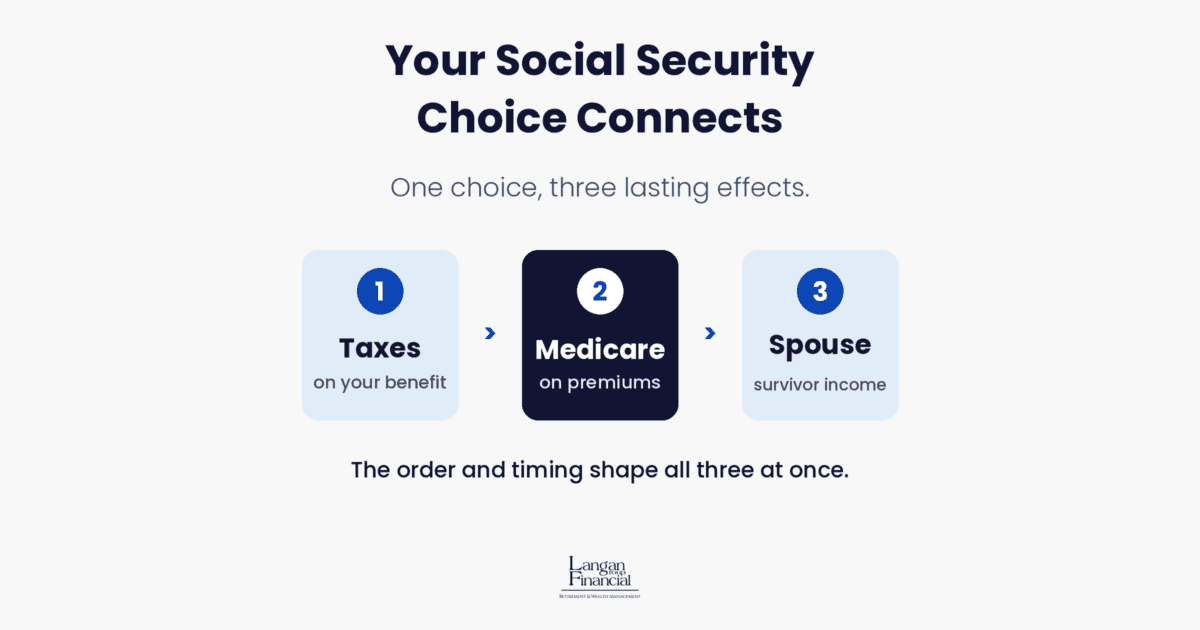

Most people think of their Social Security choice as a decision on its own. You pick an age, you file, the checks arrive. But when you claim quietly reaches into three other parts of your money. Your Social Security and Medicare decisions, in particular, are more connected than most people expect. It affects your tax bill, your Medicare cost, and the income your spouse may live on someday. Miss those links and you can make a choice that looks fine on its own but costs you elsewhere.
Here is why this matters to you. These three effects are not small print. They can add up to thousands of dollars a year. They last for life. And once you file, the choice that set them is hard to undo. Knowing the links before you claim is how you avoid a costly surprise later.
“Wouldn’t Someone Have Warned Me About This?”
Not necessarily. The connection between Social Security, taxes, and Medicare falls in the gap between professionals. Your benefits come from one place, your taxes from another, your Medicare from a third. You may handle each one correctly on its own, while no one watches how they interact.
That gap is exactly where avoidable mistakes live. The pieces below are the ones most often missed, and each one is worth a conversation before you file.
Connection One: Taxes on Your Benefits

Many people are surprised to learn that Social Security benefits can be taxed at all. They can. Depending on your other income, up to 85 percent of your benefit may be subject to federal income tax. This is one place your Social Security choice shows up directly.
How It Works
The government looks at a number it calls combined income. That is your other income, plus any tax-free interest, plus half of your benefit. As that number rises past set levels, tax reaches more of your benefit. First up to 50 percent, then up to 85 percent.
The catch is that Congress set these income levels decades ago and never adjusted them for inflation. A threshold written in the 1980s still reads the same today. So each year, as incomes rise with inflation, more households cross the line, even though the rule never changed.
Why Your Claiming Choice Matters Here
If you claim early and also draw from a traditional IRA or 401(k), those withdrawals count toward the income that makes your benefits taxable. Claiming and account withdrawals stack on top of each other. Coordinating the two, sometimes coordinating your retirement income, can keep more of your benefit out of taxable territory.
Connection Two: Your Medicare Premiums
Medicare premiums are not the same for everyone. Higher-income retirees pay more, through an addition to their premiums that rises in steps as income goes up.
The Two-Year Lookback
Here is the part that catches people. This is where Social Security and Medicare link directly. Medicare bases your premium on your income from two years earlier. Your premium at 67 reflects your income at 65. So a decision that raises your income in your mid sixties, including how you claim and tax-efficient withdrawals, can raise your Medicare premiums two years later.
Why This Connects to Claiming
When you claim Social Security affects your income in exactly the years that determine your future Medicare premiums. A large withdrawal or a poorly timed claim can push you over an income line. That can raise your premiums, sometimes for just one dollar of extra income. Planning the timing on purpose can help you avoid stepping over those lines by accident.
Connection Three: Your Spouse’s Future Income
This is the connection people miss most, and for married couples it is often the most important one of all.
The Survivor Rule
When one spouse dies, the survivor does not keep both Social Security benefits. They keep the larger of the two. The smaller benefit simply ends. For many couples, that means the household loses a meaningful share of its Social Security income at the very moment it also loses a person.
What This Means for Claiming
Because the survivor keeps the larger benefit, the higher earner’s claiming decision echoes far beyond their own lifetime. If the higher earner delays and grows their benefit, they may be raising the floor their spouse lives on for years after they are gone. If they claim early and lock in a smaller benefit, they may be lowering it.
This is why, for many married couples, the decision about when the higher earner claims is really a decision about survivor and estate planning. It is one of the clearest examples of why claiming is a household choice, not an individual one.
The Widow’s Tax Trap
There is a further wrinkle worth knowing. When one spouse dies, the survivor usually files taxes as a single person the next year. And the income levels that trigger tax on Social Security are lower for single filers than for couples.
So a surviving spouse can end up with less total income but a higher tax rate on it. Planning ahead, including how and when you claim benefits, is one way couples can soften this for whoever is left.
The Common Thread

Every one of these connections comes back to the same idea. Your Social Security choice does not stand alone. Social Security does not sit in a box by itself. It moves with your taxes, your Medicare, and your spouse’s future, and the choice of when to claim pulls all of them at once.
This matters whether you are still working or already retired. If you are approaching retirement, these connections are a reason to plan the claiming decision before you file. If you have already claimed, they are a reason to check that your income, taxes, and Medicare are being coordinated now, since those pieces can still be adjusted even after your benefit has started.
That is not a reason to feel overwhelmed. It is a reason to look at the whole picture together, once, before the decision is locked in, rather than discovering the connections one surprise at a time.
Coordinate the Whole Decision With Langan Financial Group
Social Security, taxes, Medicare, and survivor planning are connected, and the claiming decision touches all of them. Our team helps families see how the pieces fit before they file anything. Bring your benefits estimate and a recent statement from your accounts, and we will look at the full picture together. The consultation is complimentary and carries no obligation.
Schedule a Free ConsultationOr call 717-288-1880
For the claiming decision itself, and why the break-even age is only the starting point, see When to Claim Social Security: Why Break-Even Math Is Only Part of the Picture.
Common Questions
Are Social Security benefits taxable?
They can be. It depends on your combined income. That is your other income, plus tax-free interest, plus half of your benefit. As it rises, up to 85 percent of your benefit may be taxed. The income thresholds that trigger this are not adjusted for inflation, so they affect more households each year.
How does Social Security affect my Medicare premiums?
Medicare premiums for higher-income retirees rise in steps based on income from two years earlier. Because claiming Social Security and drawing from retirement accounts both affect your income, they can raise your Medicare premiums two years later. Timing these decisions together can help you avoid crossing an income threshold by accident.
What happens to Social Security when a spouse dies?
The surviving spouse generally keeps the larger of the two benefits, not both. The smaller benefit ends. This is why the higher earner’s claiming decision matters for the survivor: delaying and growing that benefit can raise the income the surviving spouse receives for life.
What is the widow’s tax trap?
After a spouse dies, the survivor usually files as single. The income limits that trigger tax on Social Security are lower for single filers than for couples. A survivor can end up with less income but taxed at a higher rate. Planning ahead can help couples reduce this effect.
Why should I coordinate Social Security with my other financial decisions?
Because claiming touches your taxes, your Medicare, and your spouse’s future income all at once. And the choice is hard to undo once made. It helps to look at these connections together, before you file. That way you avoid surprises that are hard to reverse later.
Sources
Social Security Administration, Survivors Benefits
Internal Revenue Service, Publication 915, Taxation of Social Security Benefits
Centers for Medicare and Medicaid Services, Medicare Part B Premiums and IRMAA
Social Security Administration, Benefits Planner: Income Taxes and Your Social Security Benefit
Congressional Research Service, Social Security: Taxation of Benefits
Internal Revenue Service, Filing Status After the Death of a Spouse
About the Financial Author

Alexander Langan, J.D., is the Chief Investment Officer at Langan Financial Group. In this role, he manages investment portfolios, acts as a fiduciary for group retirement plans and consults with clients regarding their financial goals, risk tolerance and asset allocation.
With a focus on ERISA Law, Alex graduated cum laude from Widener Commonwealth Law School. He then clerked for the Supreme Court of Pennsylvania and worked in the Legal Office of the Pennsylvania Office of the Budget, where he assisted in directing and advising policy determinations on state and federal tax, administrative law, and contractual issues.
Alex is also passionate about giving back to the community and has helped establish The Foundation of Enhancing Communities’ Emerging Philanthropist Program, volunteers at his church, and serves as a board member of Samara: The Center of Individual & Family Growth. Outside of work and volunteering, Alex enjoys his time with his wife Sarah and their three children, Rory, Patrick, and Ava.
About Langan Financial Group
For everything you’ve built.
Your savings. Your business. Your family’s future. Each deserves thoughtful planning that starts with what matters to you.
Langan Financial Group provides financial planning and investment management for individuals, families, and business owners. With offices in Camp Hill and York, Pennsylvania, we serve clients throughout Central Pennsylvania.
We help you work through questions about retirement income, investment decisions, Social Security, and how taxes may affect your financial plan. Our approach starts with understanding your goals, your financial picture, and your comfort with investment risk. From there, we help you evaluate your options and develop a plan that can evolve as your life changes.
We also help businesses and organizations evaluate workplace retirement plans and understand their responsibilities as plan sponsors.
Disclosures
The information in this material is not intended as tax or legal advice. Please consult legal or tax professionals for specific information regarding your individual situation. The opinions expressed and material provided are for general information.