
TAX STRATEGIES
By Alex Langan, JD, Chief Investment Officer
Langan Financial Group · 7 min read
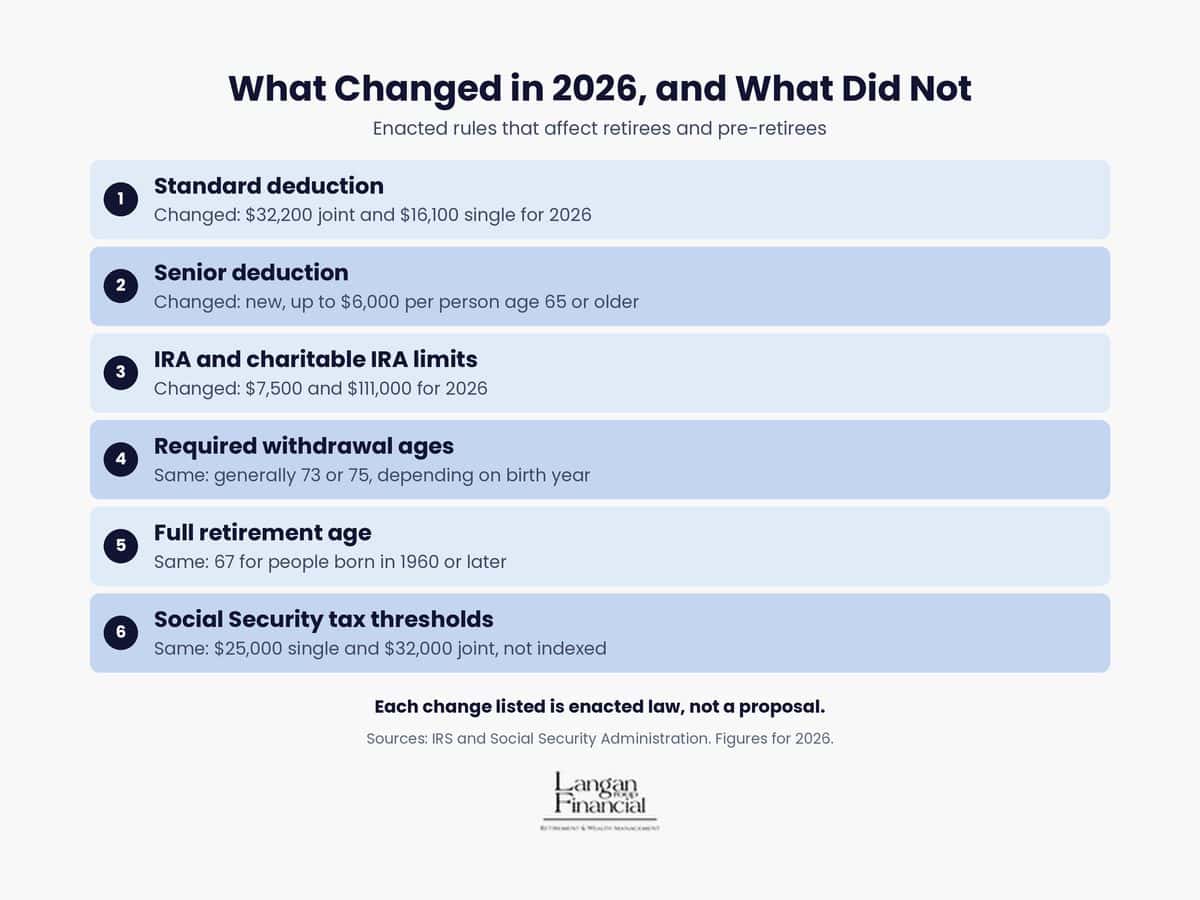
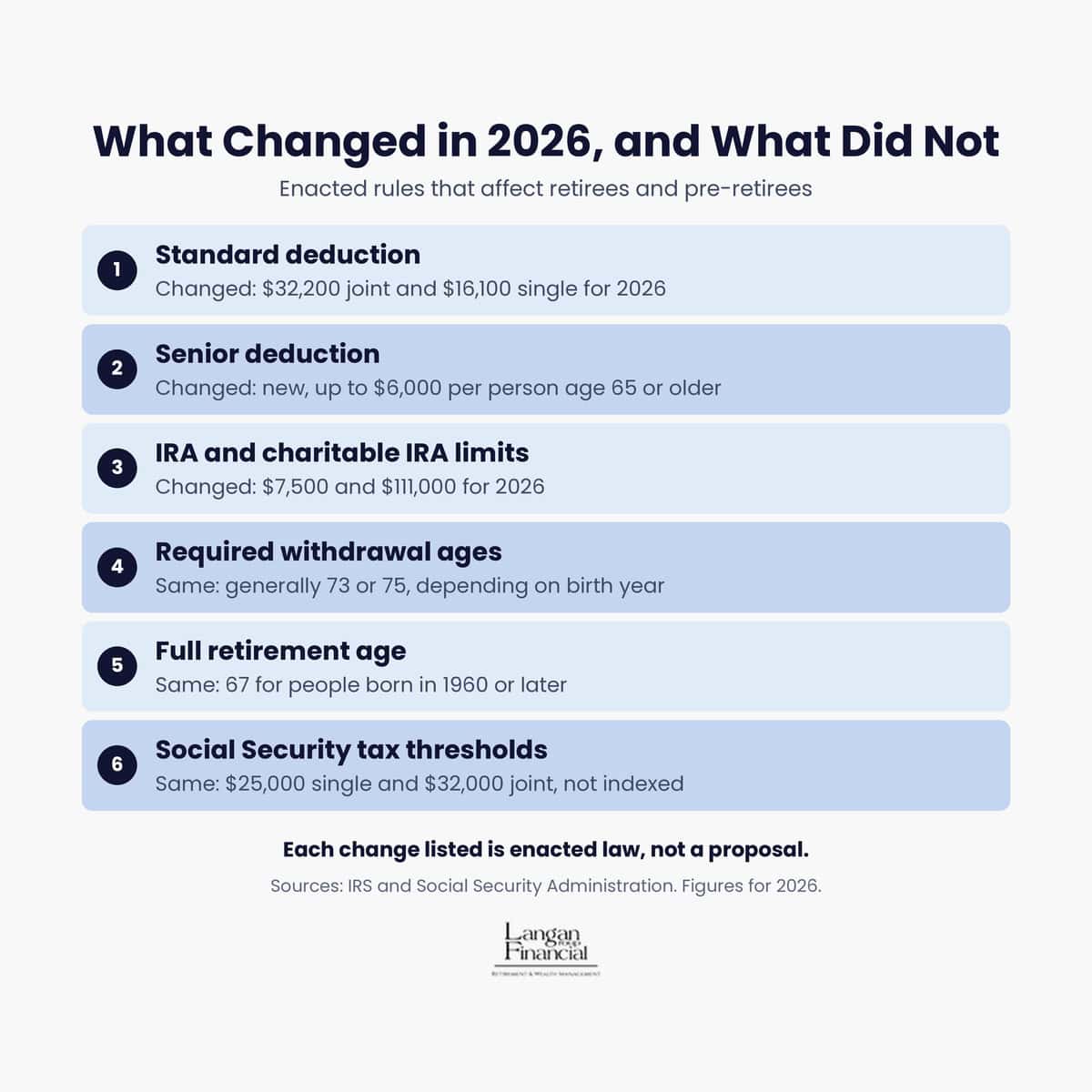
Retirement rule changes in 2026 raised the standard deduction, added a senior deduction, and lifted several account limits. Other rules stayed the same, including the ages for required withdrawals, full retirement age, and the income levels where Social Security becomes taxable. Knowing which rules changed and which did not helps you separate a headline from a change to your own plan.
This article covers enacted law, with one pending bill noted separately. For how the yearly COLA works, see how to read your Social Security COLA notice.
Still working: the higher contribution limits and the new Roth catch-up rule may matter more to you this year.
Already retired: the senior deduction and the COLA are the changes likely to show up on your tax return and in your deposit.
Which Tax Rules Changed in 2026?
The standard deduction for 2026 is $32,200 for married couples filing jointly and $16,100 for single filers. The tax brackets also moved up with inflation. For example, the 12% bracket now covers taxable income up to $100,800 for married couples filing jointly and $50,400 for single filers.
People age 65 or older still receive the additional standard deduction that has long applied to older taxpayers. The new senior deduction, described next, is a separate deduction on top of it.
How Does the New Senior Deduction Work?
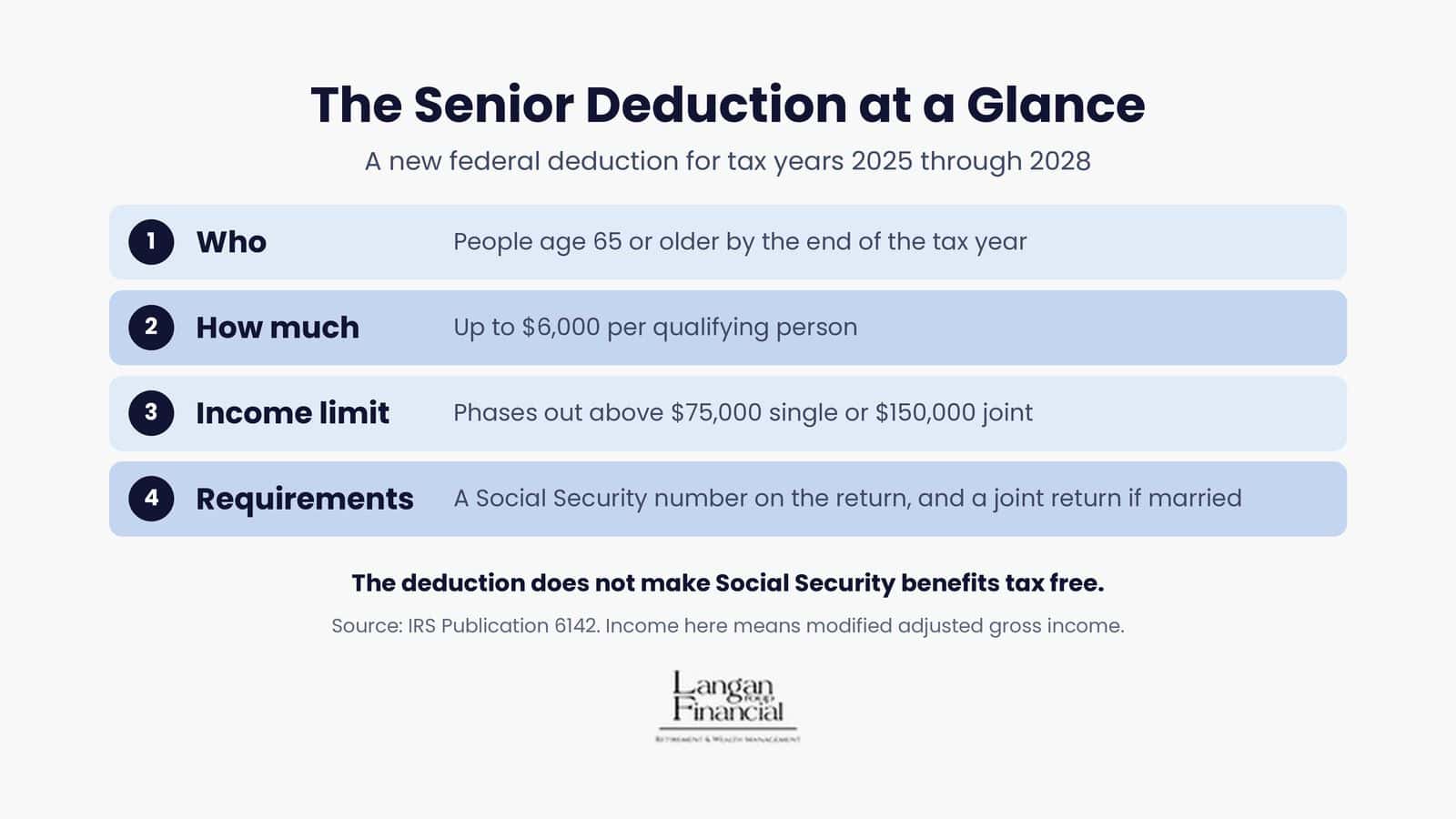
The senior deduction allows up to $6,000 per person age 65 or older by the end of the tax year, for tax years 2025 through 2028. A married couple where both spouses qualify can deduct up to $12,000.
The deduction phases out by 6% of income above $75,000 for single filers or $150,000 for joint filers. In practical terms, each $1,000 of income above the threshold reduces the deduction by $60. Income here means modified adjusted gross income, an income figure based on the adjusted gross income on your tax return.
The return needs a Social Security number for each qualifying person, and married couples need to file jointly. The deduction is available whether you itemize or take the standard deduction.
The senior deduction came from the law often called the One Big Beautiful Bill Act, signed in July 2025.
Which Account Limits Changed in 2026?
- Workplace plans. The employee contribution limit for 401(k), 403(b), and 457(b) plans is $24,500 for 2026.
- Catch-up contributions. People age 50 or older can add up to $8,000 to a workplace plan. People age 60 through 63 can add up to $11,250 instead.
- The new Roth catch-up rule. Starting in 2026, the rule applies to people whose prior-year Social Security wages from that employer were more than $150,000. Social Security wages appear in box 3 of Form W-2. Workers in this group generally need to make catch-up contributions as Roth contributions, with after-tax dollars. If the plan does not offer a Roth option, workers in this group generally are not able to make catch-up contributions.
- IRA contributions. The limit is $7,500, plus a catch-up amount of $1,100 for people age 50 or older.
- Direct IRA-to-charity transfers. The yearly limit for these transfers, also called qualified charitable distributions, is $111,000 per person for 2026.
What Changed for Social Security and Medicare?
The 2026 COLA raised benefits 2.8%, starting with December 2025 benefits paid in January 2026. In October 2026, Social Security announced a 3.6% COLA for 2027.
For Medicare drug coverage, the out-of-pocket cap for covered Part D drugs is $2,100 in 2026. Medicare has set that cap at $2,400 for 2027.
Separately, the Social Security Fairness Act was signed in January 2025. The law ended the Windfall Elimination Provision and the Government Pension Offset. The two rules reduced benefits for some people with pensions from work not covered by Social Security. The change applies to benefits payable for months after December 2023.
Which Rules Stayed the Same?
- Required withdrawal ages. Required minimum distributions generally start at age 73 for people born from 1951 through 1959, and at age 75 for people born in 1960 or later.
- Full retirement age. Full retirement age is 67 for people born in 1960 or later.
- Taxation of Social Security. Up to 50% of benefits can be taxable once combined income passes $25,000 for single filers or $32,000 for joint filers. Up to 85% can be taxable above $34,000 single or $44,000 joint. Combined income is your adjusted gross income, plus tax-exempt interest, plus half of your Social Security benefits. The four thresholds are not indexed for inflation.
- Charitable transfer age. Direct IRA-to-charity transfers remain available starting at age 70 and a half.
The years before required withdrawals begin can be a planning window, which we cover in the quiet planning window between retirement and age 73. For how benefits connect to taxes, see how Social Security and Medicare connect to your taxes.
What Is Pending but Not Yet Law?
Congress has passed the Claiming Age Clarity Act, and the bill now goes to the President to sign. If signed, Social Security would rename three claiming ages. Age 62 would become the “minimum monthly benefit age.” Full retirement age would become the “standard monthly benefit age.” Age 70 would become the “maximum monthly benefit age.”
The bill changes names, not benefits. Claiming ages and benefit amounts stay the same. If signed, Social Security would have until January 1, 2027, or 12 months after signing, whichever is later, to update its letters and website.
What Is Already Set for 2027?
A few figures for next year are already known. Social Security benefits rise 3.6% for 2027, and the Part D out-of-pocket cap rises to $2,400. The senior deduction continues through tax year 2028. Other limits, such as the 2027 standard deduction and contribution limits, are generally announced by the IRS each fall.
Why Can Headlines About Retirement Rule Changes Mislead?
The senior deduction is sometimes described as ending tax on Social Security. The deduction does not end that tax. The senior deduction can lower taxable income for people who qualify, while the rules for taxing benefits stayed the same.
Proposals also appear in the news long before they become law, if they ever do. We looked at how past reforms treated people near retirement in how past Social Security reforms treated people near retirement.
What Should You Review Before the Year Ends?
- Check your age on December 31. The senior deduction depends on being 65 or older by the end of the tax year.
- Look at your income near the phase-out. If your income is close to $75,000 single or $150,000 joint, the timing of a withdrawal or sale can change the deduction.
- Review your workplace contributions. If you are 50 or older, check whether your plan offers Roth catch-up contributions and whether the new rule applies to you.
- Bring the list to your next review. Several of these moves have a December 31 deadline, which we cover in year-end tax planning for retirees.
Common Questions
What retirement rules changed in 2026?
The standard deduction rose, and a new senior deduction became available for tax years 2025 through 2028. The limits for workplace plans, IRAs, and direct IRA-to-charity transfers also increased.
Does the senior deduction make Social Security tax free?
No. The deduction can lower taxable income for people who qualify. Up to 85% of benefits can still be taxable at higher incomes, under the same thresholds as before.
Who qualifies for the senior deduction?
People age 65 or older by the end of the tax year, with a Social Security number on the return. Married couples need to file jointly, and the deduction phases out at higher incomes.
What is the new Roth catch-up rule?
The rule starts in 2026 and applies to people whose prior-year Social Security wages from an employer were more than $150,000. Workers in this group generally need to make catch-up contributions to that employer plan as Roth contributions.
Did the required minimum distribution age change in 2026?
No. Required minimum distributions generally start at age 73 for people born from 1951 through 1959 and at 75 for people born in 1960 or later.
Did full retirement age change?
No. Full retirement age is 67 for people born in 1960 or later. A bill awaiting the President’s signature would rename it the standard monthly benefit age without changing the age. Get The Confident Retirement Brief each Wednesday. Subscribe to the newsletter. If you would like to talk through how this fits your own plan, our team is here to help. Schedule a consultation.
Sources
- Internal Revenue Service, IR-2025-103, Tax inflation adjustments for tax year 2026
- Internal Revenue Service, Publication 6142, Additional Deduction for Seniors
- Internal Revenue Service, Notice 2025-67
- Internal Revenue Service, Publication 915, Social Security and Equivalent Railroad Retirement Benefits
- Internal Revenue Service, Retirement topics: Required minimum distributions
- Social Security Administration, Latest Cost-of-Living Adjustment
- Social Security Administration, Legislative Bulletin, Social Security Fairness Act
- Centers for Medicare and Medicaid Services, Announcement of Calendar Year 2027 Part C and Part D Payment Policies
- Congress.gov, H.R. 5284, Claiming Age Clarity Act
This article is provided for informational and educational purposes only and does not constitute investment advice, financial planning advice, tax advice, legal advice, or insurance advice. Langan Financial Group does not sell Medicare plans and is not connected with or endorsed by the federal government or the Medicare program. All investing involves risk, including potential loss of principal. Past performance is not a guarantee of future results. Individual results will vary based on specific financial circumstances. Medicare rules, premiums, deductibles, plan terms, and enrollment dates are set by law and by each plan, and can change. Figures shown are those published for the years named. Please consult a qualified financial, tax, or legal professional, and medicare.gov or 1-800-MEDICARE for coverage questions, before making decisions. Securities offered through PKS Securities, Inc., a Broker-Dealer, Member FINRA/SIPC. Advisory services offered through Langan Financial Group, LLC, a Registered Investment Adviser. Registration does not imply a certain level of skill or training. Langan Financial Group does not prepare or file tax returns. Tax consequences should be reviewed with your tax professional. Tax rules and figures are current as of the date of publication and can change.
Alex Langan is a licensed attorney. Langan Financial Group is not a law firm. Neither he nor the firm provides legal advice or practices law for the firm or its clients, and no attorney-client relationship is created.
STILL HAVE QUESTIONS?
See How These Decisions Fit Together in Your Own Plan
A twenty-minute conversation can help you understand your options.
Or call 717-288-1880