


Planning for your child’s or grandchild’s education remains one of the most impactful financial gifts you can provide. But with college costs continuing their relentless climb—and recent legislative changes expanding your options—the strategy landscape has evolved significantly.
Updates to 529 plans, combined with expanded definitions of qualified expenses and new Roth IRA rollover provisions, have fundamentally altered the risk-reward equation. Let’s examine both 529 savings plans and prepaid tuition options through this updated lens.
Understanding 529 Plans: More Flexible Than Ever
A 529 plan functions as a tax-advantaged investment account where your contributions grow tax-free and withdrawals remain tax-free when used for qualified education expenses. But the definition of “qualified” has expanded considerably beyond traditional college costs.
What Actually Qualifies as Education Expenses?
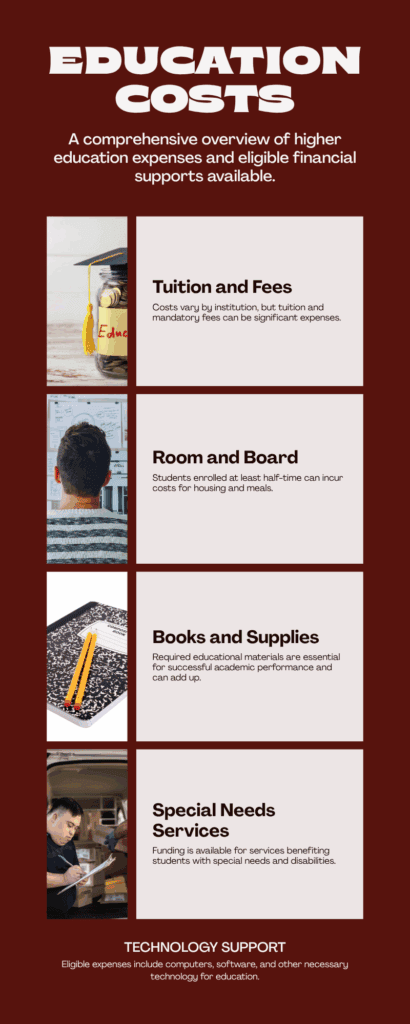
K-12 Education:
- Tuition and certain other qualified expenses at public, private, or religious elementary and secondary schools, such as books, curriculum materials, tutoring, and standardized test fees (up to $20,000 annually per beneficiary for federal tax purposes, beginning in 2026). State tax treatment may differ.
Higher Education Costs:
- Tuition and mandatory fees at eligible institutions
- Room and board for students enrolled at least half-time
- Required books, supplies, and equipment
- Special needs services for special needs beneficiaries
Technology and Equipment:
- Computers, related equipment, and software used for educational purposes
- Internet access and related services during enrollment years
- Printers and other peripheral devices designed for computer use
- Educational software (but not equipment primarily for entertainment)
Student Loan Payments:
- Up to $10,000 lifetime limit per beneficiary for qualified student loan repayments
- Includes loans for the beneficiary or their siblings
Apprenticeship Programs:
- Fees, books, supplies, and equipment for registered apprenticeship programs
The Game-Changing Addition: Roth IRA Rollovers
Starting in 2024, unused 529 funds gained a new option that can help reduce concerns about overfunding. Under specific conditions, you can roll up to $35,000 (lifetime limit) from a 529 plan into the beneficiary’s Roth IRA without penalties or taxes.
Key Requirements:
- The 529 plan must have been open for at least 15 years
- Only contributions made at least 5 years prior can be rolled over
- Annual rollover amounts limited by the Roth IRA contribution limit ($7,500 in 2026), reduced by any other IRA contributions made that year
- The beneficiary must own the receiving Roth IRA
- Normal Roth income limits don’t apply to these rollovers
Strategic Impact: This provision transforms 529 plans from education-only accounts into flexible wealth-building vehicles that can support both education and retirement goals.
Prepaid Tuition Plans: Guaranteed Protection with Trade-offs
Prepaid plans allow you to purchase future tuition at today’s prices, providing inflation protection specifically for tuition costs at participating institutions.
How They Work:
- Purchase tuition “credits” or “units” based on current pricing
- Credits cover the same percentage of tuition regardless of future increases
- Typically limited to in-state public institutions
- May offer refund options for non-participating schools
Benefits:
- Inflation hedge: Protection against tuition increases that often exceed general inflation
- No market risk: Returns tied to tuition inflation, not investment performance
- Predictable outcomes: Know exactly what percentage of tuition you’re covering
Limitations:
- School restrictions: Usually limited to in-state public colleges
- Incomplete coverage: Typically covers tuition only, not room, board, or other expenses
- Portability challenges: Reduced value if used at non-participating institutions
- Residency requirements: Many plans require contributor or beneficiary state residency
Strategic Analysis: Which Option Fits Your Goals?
| Factor | 529 Savings Plans | Prepaid Tuition Plans |
|---|---|---|
| Flexibility | Maximum school choice | Limited to participating schools |
| Expense Coverage | All qualified expenses | Tuition only |
| Market Risk | Yes (with growth potential) | No (guaranteed tuition coverage) |
| Portability | Full nationwide use | Reduced value out-of-state |
| Roth Option | $35,000 lifetime rollover | Not available |
Choose 529 Savings Plans If:
- Flexibility matters: You want maximum school choice and expense coverage
- Growth potential appeals: You’re comfortable with market risk for higher potential returns
- Comprehensive planning: You want to cover all college costs, not just tuition
- Roth rollover potential: You see value in the retirement savings backup option
Choose Prepaid Plans If:
- Risk aversion: You prefer guaranteed outcomes over market volatility
- State loyalty: You’re confident about in-state public school attendance
- Tuition focus: You plan to handle other expenses through different savings
- Inflation concern: You want specific protection against tuition increases
The Hybrid Approach: Best of Both Worlds
Many sophisticated savers combine both strategies:
Example Structure:
- Prepaid plan covering 50-75% of anticipated tuition costs
- 529 savings plan for remaining tuition, room, board, and other expenses
- Provides inflation protection while maintaining flexibility and growth potential
Example Application: The Rodriguez Strategy
Maria and Thomas have 8-year-old twins in Texas. Their approach:
Prepaid Component:
- Purchased 3 years of tuition through Texas’s prepaid plan
- Cost: $45,000 total ($22,500 per child)
- Covers most tuition at University of Texas system schools
529 Savings Component:
- Monthly contributions: $400 per child ($9,600 annually)
- Target: Cover remaining tuition, room, board, and graduate school
- Backup: Roth rollover option reduces overfunding risk
Their reasoning: The prepaid portion provides tuition security while the 529 component offers growth potential and flexibility. If the children choose different paths, they can redirect strategies accordingly.
Financial Impact Analysis: Updated Numbers
The expanded 529 benefits significantly improve the risk-reward calculation:
- Previous concern: “What if we save too much and pay penalties?”
- Current reality: Excess funds can become tax-free retirement savings
Example scenario: $100,000 in unused 529 funds
- Old system: 10% penalty plus taxes on earnings
- New system: $35,000 can transfer to Roth IRA penalty-free, remainder available for other family members’ education
This change makes aggressive 529 funding much more attractive, especially for families with multiple potential beneficiaries.
State-Specific Considerations
Tax Benefits Vary by State:
- Some states offer deductions for any 529 plan contributions
- Others require using their specific state plan
- Several states provide tax credits instead of deductions
Examples of generous state benefits:
| State | Benefit Type | Annual Limit | Additional Features |
|---|---|---|---|
| New York | Tax Deduction | $20,000 (married) | Full state income deduction |
| Indiana | Tax Credit | $5,000 | 20% credit on contributions |
| Colorado | Tax Deduction | No limit | Full contribution deduction |
Research your state’s specific incentives. They can reduce your state income taxes on contributions.
Advanced Planning Strategies
Gift Tax Optimization
529 plans offer unique gift tax advantages:
- Annual exclusion: $19,000 per person, per beneficiary in 2026
- Five-year averaging: Contribute up to $95,000 at once ($190,000 for married couples) without gift tax consequences, by electing to spread the gift over five years
- Estate planning benefit: Removes assets from your estate while maintaining control
Multi-Generational Approach
Consider funding multiple generations simultaneously:
- Grandparents fund 529s for grandchildren
- Parents focus on maximizing employer 401(k) matches
- Creates tax-efficient wealth transfer while building education funds
Scholarship Coordination
If beneficiaries receive scholarships:
- Can withdraw equivalent amounts penalty-free (earnings still taxable)
- Remaining funds available for graduate school
- Excess funds eligible for Roth rollover
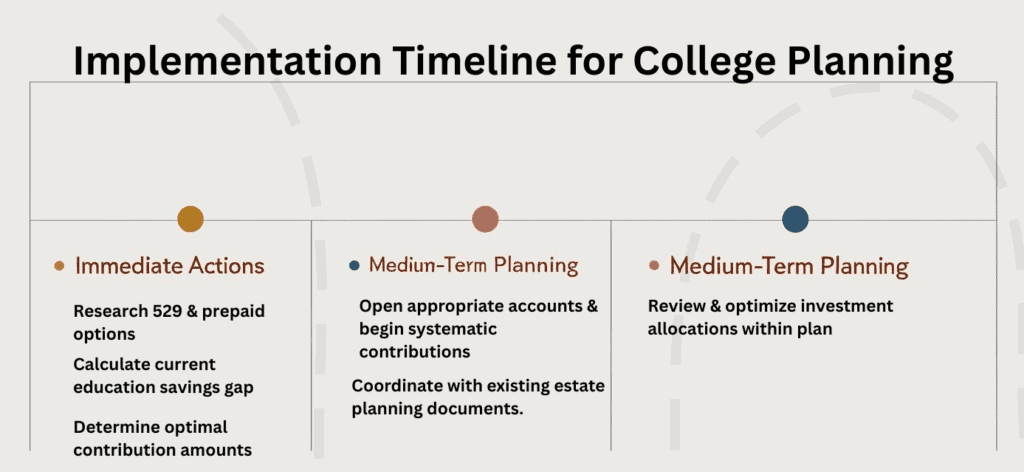
Implementation Timeline and Action Steps
Immediate Actions (Next 30 Days):
- Research your state’s 529 and prepaid options
- Calculate current education savings gap
- Determine optimal contribution amounts based on other financial priorities
Medium-term Planning (3-6 Months):
- Open appropriate accounts and begin systematic contributions
- Coordinate with existing estate planning documents
- Review and optimize investment allocations within plans
Ongoing Management:
- Annual contribution reviews to maximize tax benefits
- Rebalance investments as education timeline approaches
- Monitor for legislative changes affecting plan benefits
Common Implementation Mistakes to Avoid
For 529 Plans:
- Overly conservative investments for young beneficiaries
- Ignoring state tax benefits when choosing plans
- Failing to coordinate with overall financial planning
For Prepaid Plans:
- Not understanding transfer policies for out-of-state schools
- Overlooking inflation in non-tuition expenses
- Assuming all state schools participate equally
For Both:
- Starting too late to maximize compound growth
- Not considering multiple beneficiaries within the same family
- Ignoring financial aid implications (though generally minimal)
Looking Forward: The New Education Savings Paradigm
The combination of expanded 529 qualified expenses and Roth rollover options has created a new paradigm for education savings. These accounts now function as flexible family wealth-building tools rather than single-purpose education funds.
Key shift: Instead of asking “What if we save too much?” families can now ask “How can we optimize long-term wealth building while ensuring education funding?”
This philosophical change makes aggressive education savings much more attractive, especially for families who value financial flexibility and multi-generational wealth transfer.
Whether you choose 529 savings plans, prepaid tuition, or a combination of both, start with your family’s specific circumstances and values. The “perfect” strategy is one you’ll fund consistently while sleeping well at night, knowing you’re providing educational opportunities without compromising other financial priorities.
The expanded options available today ensure that money saved for education will find productive uses, whether funding a college degree, supporting career training, or providing a head start on retirement savings. That’s a powerful foundation for any family’s financial future.
About the Financial Planning Author

Alexander Langan, J.D., serves as the Chief Investment Officer at Langan Financial Group. In this role, he manages investment portfolios, acts as a fiduciary for group retirement plans, and consults with clients regarding their financial goals, risk tolerance, and asset allocation.
With a focus on ERISA Law, Alex graduated cum laude from Widener Commonwealth Law School. He then clerked for the Supreme Court of Pennsylvania and worked in the Legal Office of the Pennsylvania Office of the Budget, where he assisted in directing and advising policy determinations on state and federal tax, administrative law, and contractual issues.
Alex is also passionate about giving back to the community, and has participated in The Foundation of Enhancing Communities’ Emerging Philanthropist Program, volunteers at his church, and serves as a board member of Samara: The Center of Individual & Family Growth. Outside of work and volunteering, Alex enjoys his time with his wife Sarah, and their three children, Rory, Patrick, and Ava.
About Langan Financial Group: Financial Advisors
For everything you’ve built.
Your savings. Your business. Your family’s future. Each deserves thoughtful planning that starts with what matters to you.
Langan Financial Group provides financial planning and investment management for individuals, families, and business owners. With offices in Camp Hill and York, Pennsylvania, we serve clients throughout Central Pennsylvania.
We help you work through questions about retirement income, investment decisions, Social Security, and how taxes may affect your financial plan. Our approach starts with understanding your goals, your financial picture, and your comfort with investment risk. From there, we help you evaluate your options and develop a plan that can evolve as your life changes.
We also help businesses and organizations evaluate workplace retirement plans and understand their responsibilities as plan sponsors.
Disclosure
The content is developed from sources believed to be providing accurate information. The information in this material is not intended as tax or legal advice.
Please consult legal or tax professionals for specific information regarding your individual situation.
The opinions expressed and material provided are for general information, and should not be considered a solicitation for the purchase or sale of any security.