If you’re in your late 50s or 60s, you’ve probably noticed something: the world feels more fragile than it has in decades.
The U.S. national debt crossed $38 trillion in October 2025. Wars are grinding on in Ukraine and the Middle East with no end in sight. The Trump administration is rolling out tariffs that economists warn could spike prices on everything from cars to electronics. And investors like Ray Dalio—who called the 2008 crisis—are openly warning that the global order we’ve known for 80 years is breaking down.
Meanwhile, your portfolio statement shows strong balances. The market’s been on a historic run. On paper, everything looks fine.
But here’s what we’re seeing in client portfolios: investments that look perfect today are often dangerously exposed to what could happen next. And for someone nearing retirement, timing is everything.
Why This Combination Is Different
It’s not just one thing. It’s how these risks stack up together:
Valuation risk: The S&P 500’s price-to-earnings ratio is near levels we last saw in 2000 and 2007—right before major corrections.
Concentration risk: Seven tech stocks (Apple, Microsoft, Nvidia, Amazon, Meta, Tesla, Alphabet) now make up nearly 30% of the index. When they stumble, everything stumbles. If you own an S&P 500 fund, you probably have more exposure to AI and tech than you realize.
Debt risk: At $38 trillion, our national debt-to-GDP ratio is over 120%—higher than any peacetime period in U.S. history. That limits how much the government can respond to the next crisis.
Tariff risk: New trade barriers could reignite inflation just as the Fed thought it was under control. That means potential rate hikes right when retirees need income.
Geopolitical risk: Two active wars, potential Taiwan tensions, and fracturing global alliances create the kind of uncertainty that tanks markets fast.
No one can predict when—or if—these dominoes fall. But the last time we saw this many red flags at once was 2007. And we know how that turned out.
The Hidden Danger Most People Miss
Here’s the part that keeps us up at night: it’s not just about whether the market drops. It’s about when it drops relative to when you retire.
Let’s say you have $1 million and need $50,000 a year. If the market drops 30% in your first two years of retirement, you’re forced to sell shares at low prices just to pay your bills. That leaves fewer shares to recover when the market bounces back. The damage is permanent.
We’ve seen clients with the exact same portfolio and the exact same withdrawal rate—but one retired in 2007 and one retired in 2010. Same money, same plan. The 2007 retiree ran short by age 78. The 2010 retiree still had money at 85.
Three years of timing made a seven-year difference in how long their money lasted.
That’s the sequence of returns risk. And it’s the single biggest threat to early retirees right now.
Hypothetical Example
A couple came to us, both 63. They had $1.8 million, mostly in growth stocks and index funds. It had done great—up 40% in two years. They were ready to retire.
When we ran the numbers, we found a problem: if a 2008-style drop happened in their first three retirement years, they’d run out of money by age 81. Not because they didn’t have enough. Because of when they’d be forced to sell.
We made five straightforward adjustments. Same money, different structure. Now if that same drop happens, they’re covered into their mid-90s—and they’re collecting a reliable income regardless of what stocks do.
Here’s what we did.
5 Moves to Protect Your Nest Egg Right Now
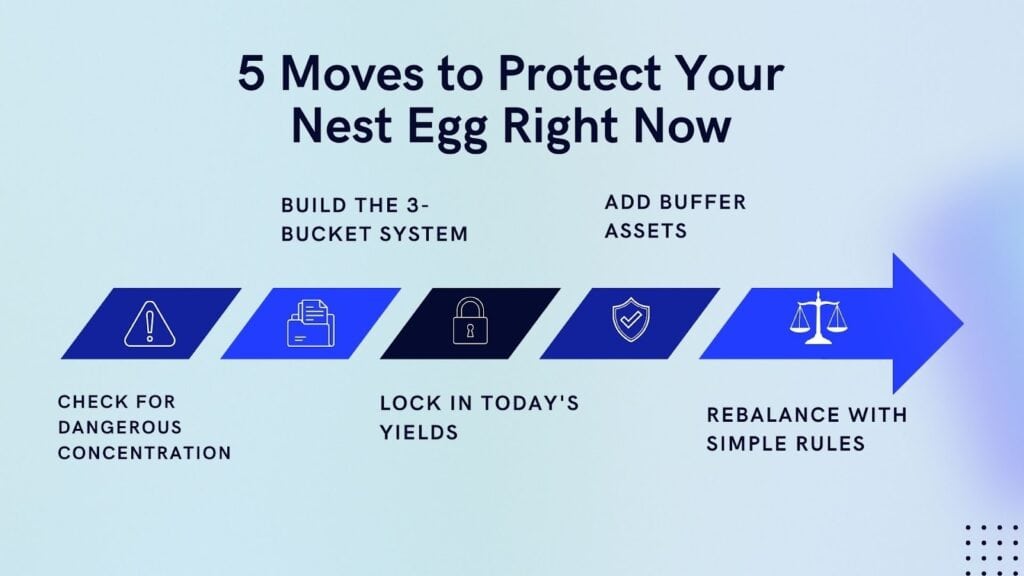
1. Check for Dangerous Concentration
Look at your top 10 holdings. If Apple, Microsoft, and Nvidia make up more than 30% of your portfolio, you’re overexposed. We saw this exact setup get crushed in 2000 and 2022.
Move some into value stocks (companies trading below their actual worth), dividend payers (steady income even if prices drop), and more balanced funds. Keep any single sector under 20% of your total.
2. Build the 3-Bucket System
This approach can help you avoid selling stocks at a bad time:
Bucket 1 (Cash Now): 3-5 years of living expenses in lower-risk options. That might include short-term Treasuries, CDs, or money market funds, whose yields change with interest rates. If you need $60,000 a year, keep $180,000-$300,000 here.
Bucket 2 (Income Soon): The next 5-10 years in a balanced mix—some bonds, some dividend stocks, some REITs. This refills Bucket 1 every year.
Bucket 3 (Growth Later): Everything else stays invested for long-term growth. Because you won’t need this money for 10+ years, you may have more time to recover from short-term drops.
When stocks have a good year, you refill Bucket 1 from gains. When stocks tank, you live off Buckets 1 and 2 and never sell low. That’s how you beat sequence risk.
3. Lock In Today’s Yields
Treasury and bond yields around 4.25% are the best we’ve seen in 15 years. Build a bond ladder so you get predictable monthly income:
- Buy bonds maturing in 1, 2, 3, 4, and 5 years
- As each matures, buy a new 5-year bond
- You get steady income and rates are locked in
That $300,000 in Bucket 1 earning 4.25% pays you $12,750 a year without touching principal. That’s real money you can count on no matter what the market does.
4. Add Buffer Assets
These don’t replace stocks—they steady the ride:
- REITs (10-15%): Real estate income that often holds up when stocks drop
- Gold or TIPS (5-10%): Protection if inflation spikes from tariffs or debt concerns
- International stocks (10-15%): When the U.S. struggles, other markets sometimes don’t
The couple I mentioned earlier added 12% in REITs and 8% in TIPS. In the next correction, those pieces should soften the blow by 15-20%.
5. Rebalance With Simple Rules
Once a year, or whenever any bucket shifts 10% from target, rebalance. Sell what’s high, buy what’s low. It’s automatic, emotion-free, and it forces you to take profits.
If stocks rip another 20%, you’re selling some at the top. If they crash, you’re buying low. Over time, this adds 0.5-1% to annual returns just from smart timing.
What This Actually Looks Like
That couple with $1.8 million? Here’s their new structure:
- Bucket 1: $240,000 in Treasuries and CDs (4 years of expenses)
- Bucket 2: $540,000 in balanced funds and dividend stocks
- Bucket 3: $1,020,000 in growth stocks, REITs, and international
They’re collecting $6,500/month in bond and dividend income. They don’t touch growth stocks unless there’s a huge run-up. And they sleep better knowing a crash won’t force them to sell at the bottom.
Why Now?
Because the window to make these moves is shrinking. Once a correction starts, it’s too late—you’re locked in. The time to adjust is when you still have gains to protect.
We work with clients every day who wish they’d made these changes in 2007, or early 2020, or before the 2022 drop. The ones who acted early? They’re fine. The ones who waited? They’re still catching up.
You can’t control headlines. You can’t control when the market drops. But you can control whether your portfolio is built for what’s coming.
Download: The Retirement Readiness Stress Test
A simple worksheet that shows:
- How exposed you are to concentration risk right now
- Your exact 3-bucket breakdown using today’s yields
- What a 2008-style drop would do to your timeline
- Rebalancing triggers you can set once and forget
About the Financial Planning Author

Alexander Langan, J.D., serves as the Chief Investment Officer at Langan Financial Group. In this role, he manages investment portfolios, acts as a fiduciary for group retirement plans, and consults with clients regarding their financial goals, risk tolerance, and asset allocation.
With a focus on ERISA Law, Alex graduated cum laude from Widener Commonwealth Law School. He then clerked for the Supreme Court of Pennsylvania and worked in the Legal Office of the Pennsylvania Office of the Budget, where he assisted in directing and advising policy determinations on state and federal tax, administrative law, and contractual issues.
Alex is also passionate about giving back to the community, and has participated in The Foundation of Enhancing Communities’ Emerging Philanthropist Program, volunteers at his church, and serves as a board member of Samara: The Center of Individual & Family Growth. Outside of work and volunteering, Alex enjoys his time with his wife Sarah, and their three children, Rory, Patrick, and Ava.
About Langan Financial Group: Financial Advisors
For everything you’ve built.
Your savings. Your business. Your family’s future. Each deserves thoughtful planning that starts with what matters to you.
Langan Financial Group provides financial planning and investment management for individuals, families, and business owners. With offices in Camp Hill and York, Pennsylvania, we serve clients throughout Central Pennsylvania.
We help you work through questions about retirement income, investment decisions, Social Security, and how taxes may affect your financial plan. Our approach starts with understanding your goals, your financial picture, and your comfort with investment risk. From there, we help you evaluate your options and develop a plan that can evolve as your life changes.
We also help businesses and organizations evaluate workplace retirement plans and understand their responsibilities as plan sponsors.
Disclosure
The content is developed from sources believed to be providing accurate information. The information in this material is not intended as tax or legal advice.
Please consult legal, financial, or tax professionals for specific information regarding your individual situation.
The opinions expressed and material provided are for general information, and should not be considered a solicitation for the purchase or sale of any security.