
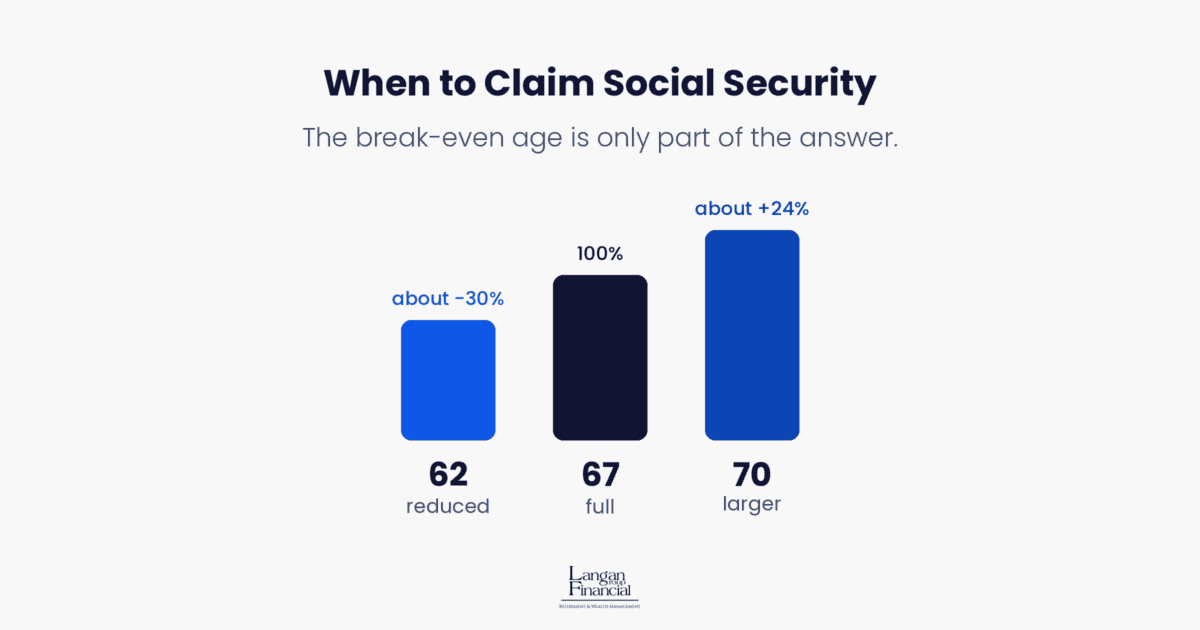

There is one number most people reach for when deciding when to claim Social Security: the break-even age. It is the age at which waiting to claim pays off, compared to claiming early. The math feels clean, and it feels like the whole answer. It is not.
Here is the problem with stopping there. The break-even calculation treats your claiming decision as a bet on how long you will live. Claim early and you get smaller checks sooner. Wait and you get larger checks later, but you have to live past the break-even age to come out ahead. Framed that way, it sounds like a gamble on your lifespan, and no one knows that number.
But your lifespan is only one piece. When you claim also changes your taxes and your Medicare premiums. If you are married, it changes the income your spouse may live on after you are gone. Those pieces do not show up in a break-even chart, and for many households they matter more than the break-even age itself. This article is about the rest of the picture.
“Won’t My Advisor Just Tell Me the Best Age?”
Claiming is not one decision. It is a knot of decisions about longevity, taxes, Medicare, and survivor income, and different people handle the pieces, and they do not always compare notes. Your benefits estimate comes from Social Security, your tax picture from your preparer, and your household plan from somewhere else, if anywhere.
That is why claiming is one of the most common things people get wrong without realizing it. The choice is hard to undo once made, so it is worth looking at the whole picture before you file, not after.
What the Break-Even Age Actually Tells You
The question of when to claim Social Security usually starts here. Start with what the number does get right. Claiming before your full retirement age permanently reduces your monthly benefit. Waiting past it grows your benefit instead.
If your full retirement age is 67, claiming at 62 means a benefit about 30 percent smaller, for life. Waiting past 67 adds about 8 percent for each year you delay, up to age 70. After 70, the increases stop, so there is no reason to wait longer.
The break-even age is simply the point where the larger delayed checks add up to more than the smaller early checks would have. It is real, and it is useful. It is just not the finish line.
The Pieces the Chart Leaves Out

Taxes on Your Benefits
Depending on your other income, the government can tax up to 85 percent of your benefit. Congress set the income levels that trigger this in the 1980s and 1990s. They were never adjusted for inflation, so they catch more households every year.
When you claim interacts with this directly. Claiming early, while you are also retirement income planning, can stack income and push more of your benefit into taxable territory. Waiting, and drawing down other accounts first, can sometimes keep more of your benefit tax free later. The claiming decision and the tax decision are the same decision.
Medicare Premiums
Medicare bases your premiums on your income from two years earlier. A higher income in your mid sixties can raise your premiums at 67, whether that income came from claiming, from account withdrawals, or from both. Coordinating when you claim with when you draw from other accounts can help you avoid surprise premium increases.
Your Spouse’s Future Income
This is the piece the break-even chart misses most completely, and for married couples it is often the most important. We cover it in full below.
For Married Couples, Claiming Is a Household Decision

When one spouse dies, the surviving spouse generally keeps the larger of the two Social Security benefits, not both. The smaller one goes away.
That single rule changes everything. If the higher earner delays claiming and grows their benefit, they are not just raising their own check. They may be raising the amount their spouse could receive for the rest of their life if they are the one left behind. For a couple with a meaningful gap in earnings, delaying the higher earner’s benefit is often less about that earner and more about protecting the survivor.
A break-even calculation run on one person alone cannot see this. It treats a married person as a single life, when the real question is how two benefits protect two people across two lifespans.
What If You Change Your Mind After You File
Social Security is often called a permanent decision. That is nearly true, but not quite. There are two narrow ways to change course, and both have real limits.
Withdrawing Your Application
The first is a withdrawal of your application. If you act within 12 months of filing, you can withdraw your claim, and Social Security treats it as though you never filed. You can do this only once in your lifetime. And you must repay every dollar you and your family received, including any amounts withheld for Medicare or taxes.
Suspending Your Benefit
The second is a voluntary suspension. Once you reach full retirement age, you can suspend your benefit and earn delayed credits of about 8 percent a year until age 70. You repay nothing, but any family benefits that draw on your record pause as well.
These options exist, but they carry real limits and can cost you. That is exactly why the claiming decision is worth getting right the first time, rather than counting on a reset later.
A Decision Worth Coordinating
There is no single claiming age that is right for everyone. The right choice depends on your health, your other income, tax-efficient investing, your marital situation, and estate planning.
What the break-even chart offers is one input. A fuller picture weighs that input against the others. That is the difference between claiming on a rule of thumb and claiming on a plan.
Look at the Whole Picture With Langan Financial Group
The right time to claim depends on more than a break-even age. It depends on your taxes, your Medicare, your spouse, and your other income, working together. Our team helps families look at all of it before the decision becomes permanent. Bring your Social Security estimate and a recent statement from your accounts, and we will walk through it with you. The consultation is complimentary and carries no obligation.
Schedule a Free ConsultationOr call 717-288-1880
Claiming interacts with taxes, Medicare, and survivor income in ways worth understanding before you file. See How Your Social Security Choice Touches Taxes, Medicare, and Your Spouse.
Common Questions
What is the break-even age for Social Security?
The break-even age is when the larger delayed checks finally add up to more than the smaller early checks would have. It is useful for understanding the tradeoff. But it does not account for taxes, Medicare premiums, or survivor benefits, which often matter as much or more.
How much does waiting to claim Social Security increase my benefit?
If your full retirement age is 67, claiming at 62 reduces your benefit by roughly 30 percent for life. Waiting past full retirement age adds about 8 percent per year up to age 70. After age 70, the benefit does not increase further, so there is generally no reason to wait longer.
Does claiming Social Security early affect my taxes?
It can. Depending on your total income, federal income tax can reach up to 85 percent of your benefit. Claiming while also drawing from retirement accounts can stack income and make more of your benefit taxable. Because the taxation thresholds are not adjusted for inflation, this affects more households each year.
How does my claiming decision affect my spouse?
When one spouse dies, the survivor generally keeps the larger of the two benefits, not both. So if the higher earner delays and grows their benefit, they may also be raising the amount their surviving spouse could receive for life. For married couples, claiming is a household decision, not an individual one.
Is there one best age to claim Social Security?
No. The right age depends on your health and longevity outlook, your other income and taxes, your Medicare situation, and whether you are married. A break-even age is one useful input, but the full decision weighs several factors together.
Sources
Social Security Administration — Cost-of-Living Adjustment and 2026 Benefit Amounts
U.S. Social Security Administration, Delayed Retirement Credits and Early Retirement Reduction
SSA guidance on Survivors Benefits
Internal Revenue Service, Publication 915, Taxation of Social Security Benefits
Centers for Medicare and Medicaid Services, Part B Premiums and IRMAA
Congressional Research Service, Social Security: Taxation of Benefits
About the Financial Author

Alexander Langan, J.D., is the Chief Investment Officer at Langan Financial Group. In this role, he manages investment portfolios, acts as a fiduciary for group retirement plans and consults with clients regarding their financial goals, risk tolerance and asset allocation.
With a focus on ERISA Law, Alex graduated cum laude from Widener Commonwealth Law School. He then clerked for the Supreme Court of Pennsylvania and worked in the Legal Office of the Pennsylvania Office of the Budget, where he assisted in directing and advising policy determinations on state and federal tax, administrative law, and contractual issues.
Alex is also passionate about giving back to the community and has helped establish The Foundation of Enhancing Communities’ Emerging Philanthropist Program, volunteers at his church, and serves as a board member of Samara: The Center of Individual & Family Growth. Outside of work and volunteering, Alex enjoys his time with his wife Sarah and their three children, Rory, Patrick, and Ava.
About Langan Financial Group
For everything you’ve built.
Your savings. Your business. Your family’s future. Each deserves thoughtful planning that starts with what matters to you.
Langan Financial Group provides financial planning and investment management for individuals, families, and business owners. With offices in Camp Hill and York, Pennsylvania, we serve clients throughout Central Pennsylvania.
We help you work through questions about retirement income, investment decisions, Social Security, and how taxes may affect your financial plan. Our approach starts with understanding your goals, your financial picture, and your comfort with investment risk. From there, we help you evaluate your options and develop a plan that can evolve as your life changes.
We also help businesses and organizations evaluate workplace retirement plans and understand their responsibilities as plan sponsors.
Disclosures
The information in this material is not intended as tax or legal advice. Please consult legal or tax professionals for specific information regarding your individual situation. The opinions expressed and material provided are for general information.