Introduction: The Social Security Tax Surprise
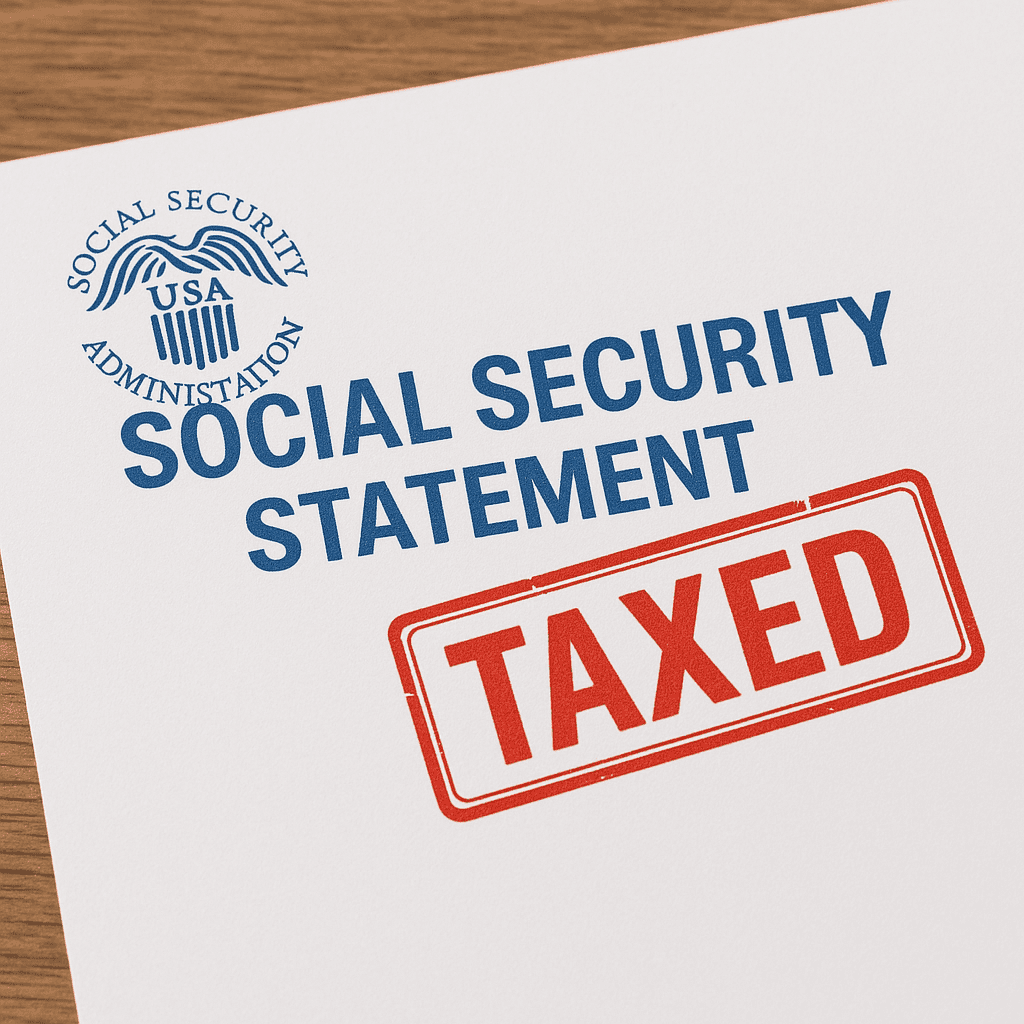
Many retirees are shocked to learn that their Social Security benefits may be taxed. They’ve spent decades paying into the system, assuming those checks would come tax-free.
But the truth is, depending on how much other income you have, you could owe taxes on up to 85% of your Social Security benefits.
Don’t worry—we’ll explain what that really means, how to reduce the taxes, and how a recent law (nicknamed the “Big Beautiful Bill”) could help you keep more of your money.
How Social Security Is Taxed Today (in Plain English)
You don’t always pay tax on your Social Security. It depends on how much other income you have.
If you have no other income, or just a little, you probably won’t pay any tax on your Social Security.
But if you have income from a job, retirement account, or investments, part of your Social Security might be taxed.
Here’s how it works:
- If your “combined income” (which means your Social Security plus other income) is over a certain limit, the IRS taxes some of your Social Security—up to 50% or even 85% of the benefit.
- This doesn’t mean you’re losing 85% of your Social Security. It just means that up to 85% of it counts as income on your tax return. You only pay tax on that portion—not the whole thing.
Think of it like this: if your Social Security is $20,000 a year, and 85% of it is taxable, that means $17,000 counts as income. If you’re in a 10% tax bracket, you might owe around $1,700 in taxes—not $17,000.
What the “Big Beautiful Bill” Does—and Doesn’t Do
Recently, a new law added extra help for seniors. It created a new $6,000 extra tax deduction for people 65 and older—or $12,000 for married couples.
This bigger deduction can lower your income enough that your Social Security doesn’t get taxed.
What It Doesn’t Do:
- It doesn’t eliminate Social Security taxes for everyone.
- It doesn’t make Social Security completely tax-free.
According to government estimates, nearly 90% of retirees may now owe no tax on their Social Security—but only because the bigger deduction cancels out the other income that would’ve made their benefits taxable.
This is a win—but it’s not a total fix.
What Could Go Wrong
Even with the bigger deduction, there are a few things to watch out for:
- The deduction phases out if your income is too high.
- If your income goes up later—say you sell a house or do a big IRA withdrawal—you could lose the deduction and owe taxes.
- The law expires in 2028 unless Congress renews it.
So while the law helps many retirees now, it’s smart to plan ahead in case it changes.

What You Can Do Now
- Check Your Income
- Look at your total income from Social Security, pensions, investments, and part-time work.
- Use the IRS “combined income” formula to estimate how much of your Social Security might be taxable.
- Use the New Deduction
- If you’re 65 or older, make sure you claim the $6,000 (or $12,000 for couples) deduction on your taxes.
- Consider Roth Conversions
- Moving money from a traditional IRA to a Roth IRA may raise your taxes now, but it can lower your future income, which helps you avoid Social Security taxes later.
- Work With a Tax Expert
- A tax planner can help you legally reduce how much income the IRS sees, so more of your Social Security stays in your pocket.
Quick Recap: When Is Social Security Taxed?
Here are the current IRS income limits:
- Single: If your combined income is less than $25,000, you probably pay no tax on Social Security.
- Married, filing jointly: Under $32,000, you’re likely in the clear.
If your income is above those numbers, up to 50% or 85% of your Social Security becomes taxable.
Don’t Let Taxes Ruin Your Retirement
Many people pay more tax than they need to—just because they didn’t know the rules.
With a little planning, you can reduce how much of your Social Security is taxed—or even avoid the tax entirely.
Remember:
- The new tax deduction helps.
- Planning early gives you more options.
- Smart moves today mean more income later.
Call to Action
Want to find out how much of your Social Security is at risk?
Schedule a Tax-Smart Retirement Review and learn how to lower taxes, protect your income, and enjoy your retirement with more peace of mind.
About the Financial Planning Author

Alexander Langan, J.D, CFBS, serves as the Chief Investment Officer at Langan Financial Group. In this role, he manages investment portfolios, acts as a fiduciary for group retirement plans, and consults with clients regarding their financial goals, risk tolerance, and asset allocation.
With a focus on ERISA Law, Alex graduated cum laude from Widener Commonwealth Law School. He then clerked for the Supreme Court of Pennsylvania and worked in the Legal Office of the Pennsylvania Office of the Budget, where he assisted in directing and advising policy determinations on state and federal tax, administrative law, and contractual issues.
Alex is also passionate about giving back to the community, and has participated in The Foundation of Enhancing Communities’ Emerging Philanthropist Program, volunteers at his church, and serves as a board member of Samara: The Center of Individual & Family Growth. Outside of work and volunteering, Alex enjoys his time with his wife Sarah, and their three children, Rory, Patrick, and Ava.
About Langan Financial Group: Financial Advisors
Langan Financial Group is an award-winning financial planning firm with offices in York, Pennsylvania and Harrisburg, Pa.
With over 100+ 5-star reviews, Langan Financial Group is an independent financial planning firm established in 1985, offering a broad range of financial planning services.
With an open architecture platform, our advisors have access to a diverse range of products, free from any sales quotas.
Our team of 11 financial experts, each with unique specialties, enhances our ability to focus on delivering value to our clients.
Disclosure
The content is developed from sources believed to be providing accurate information. The information in this material is not intended as tax or legal advice.
Please consult legal or tax professionals for specific information regarding your individual situation.
The opinions expressed and material provided are for general information, and should not be considered a solicitation for the purchase or sale of any security.
Securities offered through Cambridge Investment Research, Inc., a Broker/Dealer, Member FINRA/SIPC.
Investment Advisor Representative, Cambridge Investment Research Advisors, Inc. a Registered Investment Advisor. Cambridge and Langan Financial Group, LLC are not affiliated.
Cambridge does not offer tax or legal advice.