Two things changed this year for people saving in a workplace retirement plan. One gives some savers a larger window. The other takes away a tax break that many higher earners have used for years.
Both depend on your age and your pay. Neither one is hard to understand once the numbers are in front of you.
What You Can Put In This Year
These are the 2026 limits for money that comes out of your paycheck. They come from IRS Notice 2025-67.
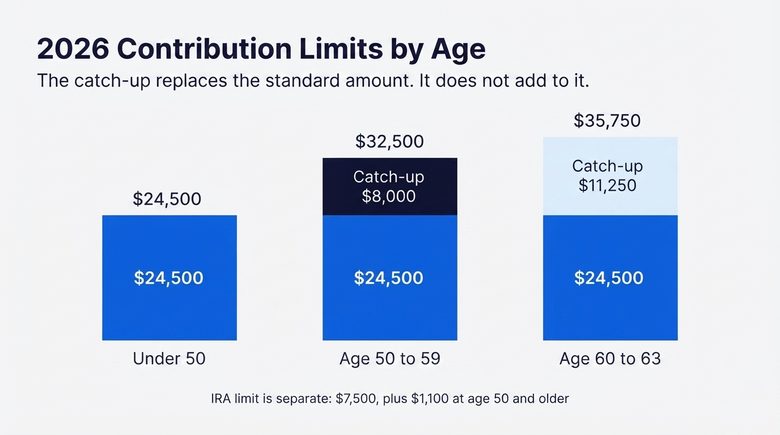
2026 WORKPLACE PLAN LIMITS
Standard contribution: $24,500
Age 50 and older, add: $8,000 (total $32,500)
Ages 60 through 63, add instead: $11,250 (total $35,750)
Traditional or Roth IRA: $7,500
IRA, age 50 and older, add: $1,100 (total $8,600)
These apply to 401(k), 403(b), most governmental 457(b) plans, and the federal Thrift Savings Plan. SIMPLE plans use different numbers, covered below.
There is also a cap on everything that goes into your account in a year, including what your employer adds. For 2026 that number is $72,000.
One point that trips people up. The limits above are what you may put in. They are not a target, and they are not advice. Whether contributing the maximum makes sense depends on your income, your other savings, your debts, and what else you need money for this year.
The Catch-Up Contribution, Explained Simply
Starting in the year you turn 50, the tax code lets you put in more than the standard limit. That extra amount is called a catch-up contribution.
You qualify in the calendar year you turn 50. Your birthday month does not matter. Turn 50 in December and you qualify for that whole year.
The Larger Window at Ages 60 Through 63
SECURE 2.0, a retirement law passed in 2022, created a bigger catch-up for a short stretch of years. If you are 60, 61, 62, or 63 by the end of the calendar year, you may be able to put in $11,250 instead of $8,000.
Two details matter here, and both are easy to get wrong.
It replaces, it does not add. The $11,250 takes the place of the $8,000. It is not on top of it. Your total is $35,750, not $44,500.
It closes at 64. The larger amount applies for four years. The year you turn 64, you go back to the standard catch-up.
A Four-Year Window
This is one of the few rules in retirement planning with a start date and an end date built in.
If you are 59 now, it opens next year. If you are 63, this may be your last year for the larger amount. If you are already 64 or older, it has passed.
Whether using it makes sense is a separate question, and it depends on your cash flow and your tax situation this year.
One more thing. Plans are not required to offer the larger catch-up. Your plan document decides. A call to your plan administrator will tell you.
The New Roth Rule for Higher Earners
This is the change that surprises people, and it took full effect this year.
If you are 50 or older and your Social Security wages from one employer were above $150,000 last year, your catch-up contributions generally have to go into a Roth account. They can no longer be pre-tax.
Where to Find Your Number
Look at Box 3 of your 2025 W-2. That box shows Social Security wages. If the figure is above $150,000, the rule applies to you for 2026.
It is a one-year lookback. Each year, the prior year’s W-2 decides. So a year with a large bonus can pull you over the line, and a lighter year can push you back under it.
The threshold rose from $145,000 to $150,000 for this year, and it is adjusted over time.
What Pre-Tax and Roth Actually Mean
Pre-tax. The money comes out of your paycheck before income tax. You lower your taxable income this year. You pay ordinary income tax when you take it out later.
Roth. You pay tax on the money now. Qualified withdrawals later, including the growth, may come out tax free. A withdrawal is generally qualified once the account has been open five years and you are past 59 and a half.
So this rule does not take money away from you. It changes when the tax is paid. For some households that is a modest cost this year and a benefit later. For others, mostly people who expect a much lower tax rate in retirement, it is the reverse.
If Your Plan Has No Roth Option
This is the part worth acting on. If the rule applies to you and your plan does not offer a Roth account, you may not be able to make catch-up contributions at all until the plan adds one.
Not every plan has added the feature. A single call to your plan administrator settles it, and it is a fair thing to raise with your employer if the answer is no.
If You Worked for Two Employers This Year
The standard limit applies to you as a person. It does not apply to each job separately.
Change jobs in June, set a sensible contribution rate at the new employer, and the two plans together can quietly pass what the year allows. Neither payroll system can see the other one.
Going over is correctable, but the fix depends a great deal on when you catch it. Adding up both plans before the fall is easier than sorting it out after the year closes.
If You Have a Different Kind of Plan
SIMPLE Plans
Smaller employers often use a SIMPLE IRA or SIMPLE 401(k). For 2026 the salary reduction limit is generally $17,000. The catch-up at age 50 and older is generally $4,000, though certain SIMPLE plans use $3,850. The ages 60 through 63 catch-up is $5,250. Your plan document controls which figures apply, so it is worth confirming with your plan.
403(b) Plans With Long Service
If you work for a school district, hospital, university, or nonprofit and have at least 15 years with that employer, your plan may allow an additional catch-up beyond the age 50 amount. The rules are specific and the plan has to offer it. Ask before assuming it applies.
Governmental 457(b) Plans
These follow the same standard limit and the same catch-up amounts. Some also offer a separate catch-up in the three years before the plan’s normal retirement age. You generally cannot use both in the same year.
Four Things Worth Checking Before December
1. Your dollar amount, not your percentage. Pull up a pay stub, find the year-to-date retirement contribution, and see where your current pace lands you by December.
2. Box 3 of your 2025 W-2. That tells you whether the Roth catch-up rule applies to you this year.
3. Whether your plan offers a Roth account. If the rule applies and the plan does not, catch-up may be unavailable until it is added.
4. Whether your plan offers the ages 60 through 63 amount. Plans are not required to.
None of these take long. All four are questions your plan administrator can answer on one call.
Should You Contribute the Maximum?
This is the question behind all of the numbers, and the honest answer is that it depends on your situation. The limit is what the tax code allows. It is not a goal set for you, and hitting it is not automatically the right move.
A few things generally point toward contributing more:
You are behind on retirement savings and have the room in your budget. You are in a higher tax bracket now than you expect to be in retirement, which makes pre-tax contributions more valuable today as part of your overall retirement tax strategy. Your employer offers a match you are not fully capturing. Or you are in the ages 60 through 63 window and want to use it before it closes.
A few things generally point the other way:
You carry high-interest debt that costs more than your investments are likely to earn. You do not yet have a cash reserve for emergencies, which often matters more than an extra retirement dollar. You expect a much lower tax rate in retirement, which can change whether pre-tax or Roth makes sense. Or the money is needed for something real and near-term this year.
Capture the match first
If your plan offers an employer match, the contribution that earns the full match is generally the one most people look at first. Beyond that point, whether to keep going toward the limit is a budgeting question rather than a rule.
What the right number is for your household depends on the full picture. That is a fair thing to talk through with someone before December.
Bring Your Numbers to Langan Financial Group
The limits are the easy part. The more personal questions are how much of yours to use, whether pre-tax or Roth fits your situation, and how a job change or a bonus this year changes the math. Those are the questions our team helps families work through. Bring a recent pay stub and last year’s W-2, and we will go through it with you, at whatever pace is useful. The consultation is complimentary and carries no obligation.
Schedule a Free ConsultationOr call 717-288-1880
Setting the number is one part. The settings that keep it working without you thinking about it are another. See The Retirement Plan Settings Most People Never Turn On.
Common Questions
How much can I contribute to my 401(k) in 2026?
The standard limit is $24,500. If you are 50 or older you may add $8,000, for $32,500. If you are 60, 61, 62, or 63 by the end of the year, you may be able to add $11,250 instead, for $35,750, if your plan offers it.
Does the ages 60 to 63 catch-up get added to the regular catch-up?
No. It replaces it. The $11,250 takes the place of the $8,000 rather than stacking on top of it.
When does the larger catch-up window close?
It applies for the calendar years you are 60, 61, 62, and 63. The year you turn 64, the standard catch-up amount applies again.
Who has to make catch-up contributions as Roth in 2026?
People age 50 and older whose Social Security wages from one employer were above $150,000 in 2025. Box 3 of your 2025 W-2 shows the figure. It is a one-year lookback, so each year the prior year’s W-2 decides.
What if my plan does not offer a Roth account?
If the Roth catch-up rule applies to you and your plan has no Roth option, you may be unable to make catch-up contributions at all until the plan adds one. Your plan administrator can confirm whether the feature exists.
Should I contribute the maximum to my 401(k)?
Not necessarily. The limit is what the tax code permits, not a target. Whether contributing the maximum makes sense depends on your income, your other savings, any high-interest debt, your emergency reserve, and your tax situation now versus in retirement. Many people start by contributing enough to capture the full employer match, then decide how much further to go based on their budget.
What happens if I contribute too much in one year?
Going over the annual limit is correctable, but it is simpler to fix earlier than later. Excess contributions that are not removed in time can be taxed twice. This is most common when someone works for two employers in the same year, since the limit applies to you as a person and neither payroll system can see the other.
Sources
Internal Revenue Service, Notice 2025-67, 2026 Amounts Relating to Retirement Plans and IRAs
Internal Revenue Service, 401(k) limit increases to $24,500 for 2026, IRA limit increases to $7,500
Internal Revenue Service, Retirement Topics: Catch-Up Contributions
Internal Revenue Service, Publication 525, Taxable and Nontaxable Income
Internal Revenue Service, Publication 575, Pension and Annuity Income
SECURE 2.0 Act of 2022, Sections 109 and 603
Internal Revenue Service, Retirement Topics: 403(b) Contribution Limits
Internal Revenue Service, SIMPLE IRA Plan Contribution Limits
About the Financial Author

Alexander Langan, J.D., is the Chief Investment Officer at Langan Financial Group. In this role, he manages investment portfolios, acts as a fiduciary for group retirement plans and consults with clients regarding their financial goals, risk tolerance and asset allocation.
With a focus on ERISA Law, Alex graduated cum laude from Widener Commonwealth Law School. He then clerked for the Supreme Court of Pennsylvania and worked in the Legal Office of the Pennsylvania Office of the Budget, where he assisted in directing and advising policy determinations on state and federal tax, administrative law, and contractual issues.
Alex is also passionate about giving back to the community and has helped establish The Foundation of Enhancing Communities’ Emerging Philanthropist Program, volunteers at his church, and serves as a board member of Samara: The Center of Individual & Family Growth. Outside of work and volunteering, Alex enjoys his time with his wife Sarah and their three children, Rory, Patrick, and Ava.
About Langan Financial Group
For everything you’ve built.
Your savings. Your business. Your family’s future. Each deserves thoughtful planning that starts with what matters to you.
Langan Financial Group provides financial planning and investment management for individuals, families, and business owners. With offices in Camp Hill and York, Pennsylvania, we serve clients throughout Central Pennsylvania.
We help you work through questions about retirement income, investment decisions, Social Security, and how taxes may affect your financial plan. Our approach starts with understanding your goals, your financial picture, and your comfort with investment risk. From there, we help you evaluate your options and develop a plan that can evolve as your life changes.
We also help businesses and organizations evaluate workplace retirement plans and understand their responsibilities as plan sponsors.
Disclosures
The information in this material is not intended as tax or legal advice. Please consult legal or tax professionals for specific information regarding your individual situation. The opinions expressed and material provided are for general information.