
Reviewing beneficiary designations rarely makes it onto a list.
It is also among the few parts of an estate plan you can confirm yourself, this week, without an appointment.
Still working: the account most likely to be out of date is the one you set up on your first day at a job you may no longer have.
Already retired: the forms are settled but not permanent. They can still be changed, and a provider will tell you how.
If you have not looked at why this matters, start with who inherits your retirement accounts.
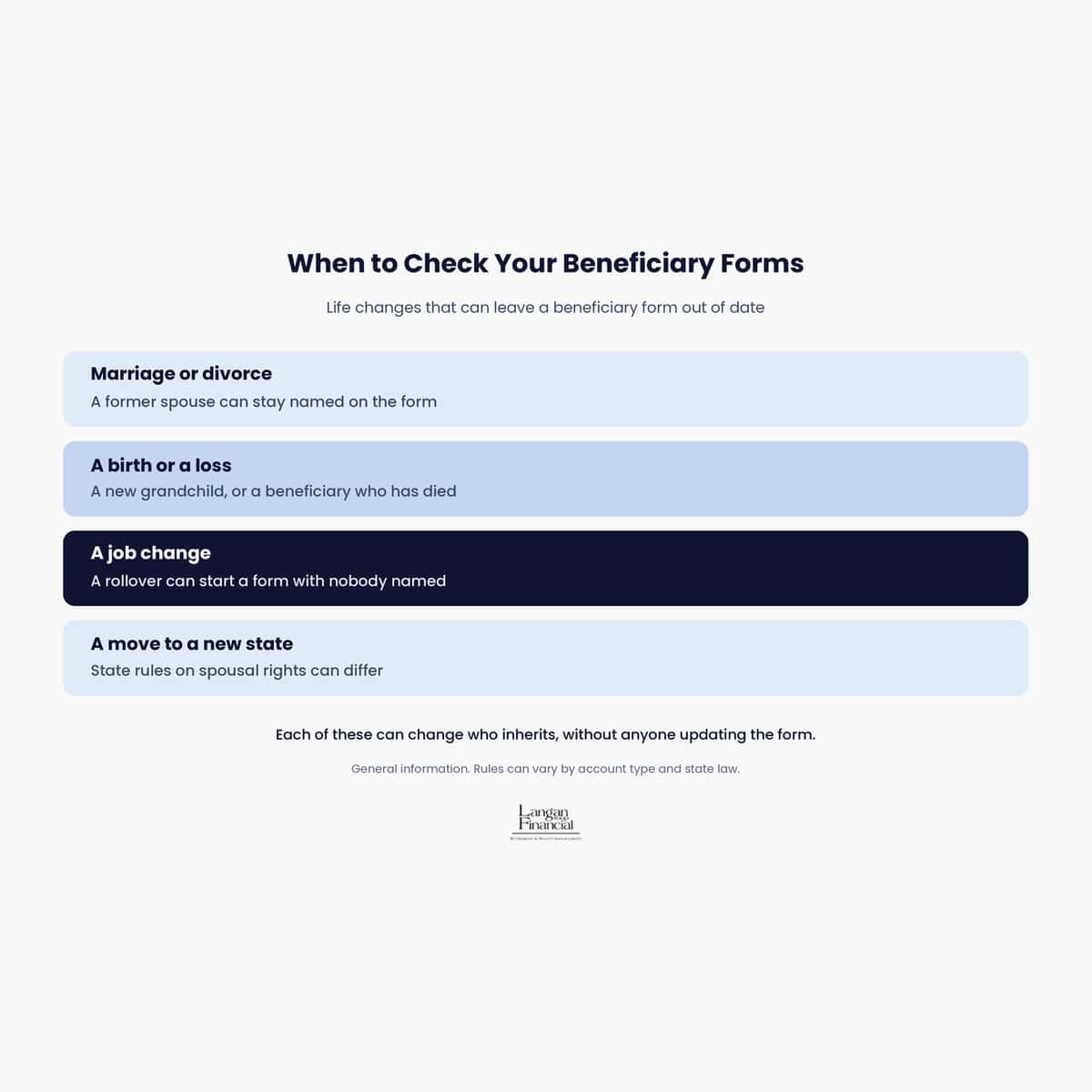
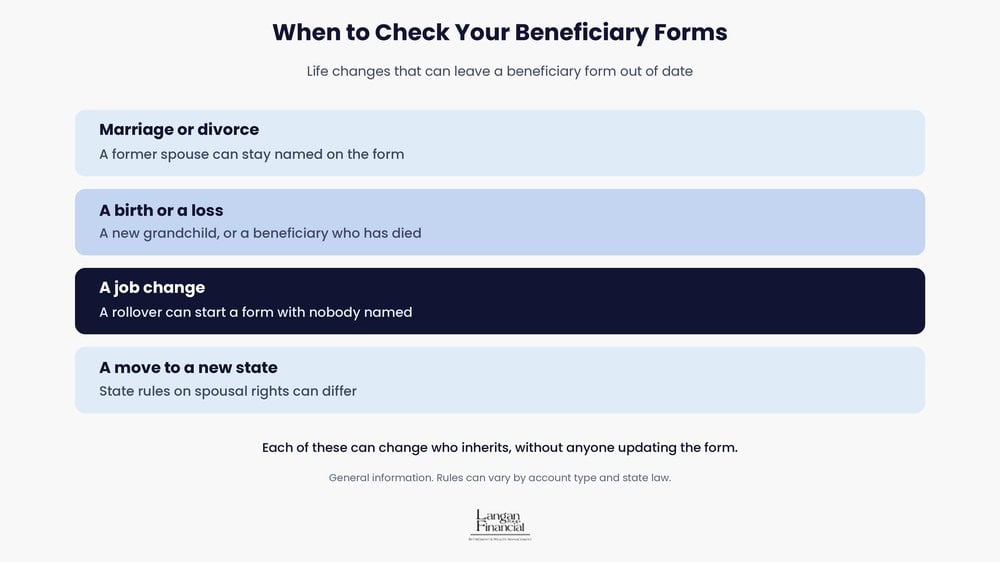
Four Life Changes That Can Leave a Form Out of Date
None of these update a beneficiary form on their own. Each one can leave a name in place that you would not choose today.
Marriage or divorce. A former spouse can remain named long after a divorce is final. Some states revoke a former spouse by statute, some do not, and certain employer plans are governed by federal law that can preempt state rules.
A birth or a loss in the family. A new child or grandchild will not appear on a form by itself. A beneficiary who has passed away can leave a share with nowhere clear to go.
A job change or a rollover. Moving an account often creates a new form, and the old designation generally does not follow the money.
A move to a new state. State rules on spousal rights and community property can differ from where you signed the original form.
Each of these is worth a look alongside the rest of your estate and legacy plans.
The rollover is easy to overlook. It feels like moving money rather than signing a new contract, so the beneficiary line rarely gets a second look.
What to Look For on Each Form
Each form has two lines. The primary beneficiary is paid first. The contingent beneficiary is paid only if no primary is living.
With the forms in front of you, five patterns are worth catching.
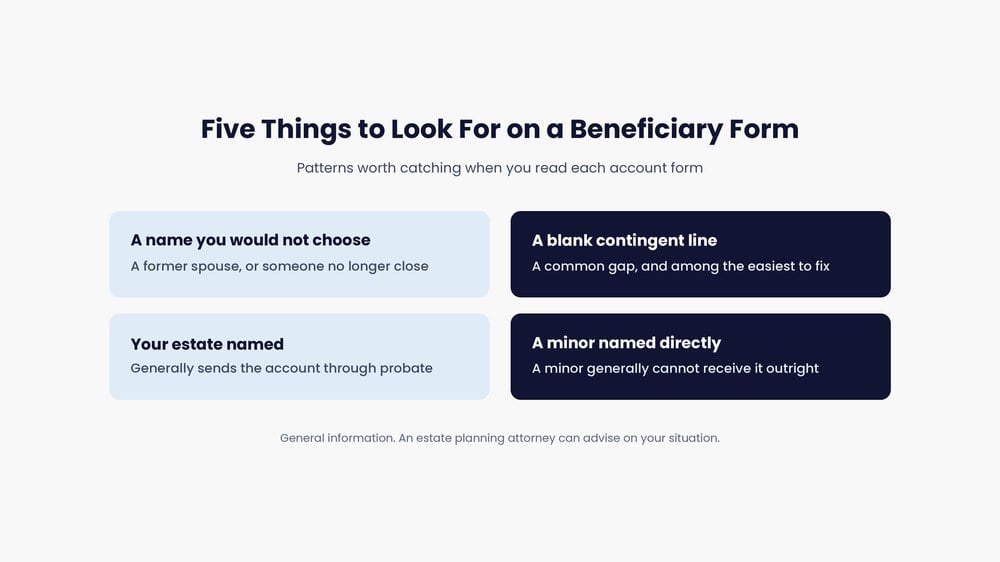
A name you would not choose today. A former spouse, or someone no longer in your life.
A blank contingent line. A common gap, and among the easiest to fix.
Your estate named as beneficiary. This generally sends the account through probate, the court process that settles what a will covers, and the withdrawal rules that apply differ from those for a person named directly on the form.
A minor named directly. A minor generally cannot receive an account outright, which can require a court process.
A name that does not match your will. Not necessarily a mistake, but worth confirming it is intentional. For a weekly planning question like this one, our retirement newsletter goes out each Wednesday.
Where legal advice matters. Naming a trust, providing for a minor, or handling a blended family are situations where an estate planning attorney should be involved rather than a form filled in alone.
Who Inherits Also Changes How Fast They Withdraw
For accounts inherited after 2019, most non-spouse heirs of a retirement account have ten years to empty it, rather than spreading withdrawals across a lifetime.
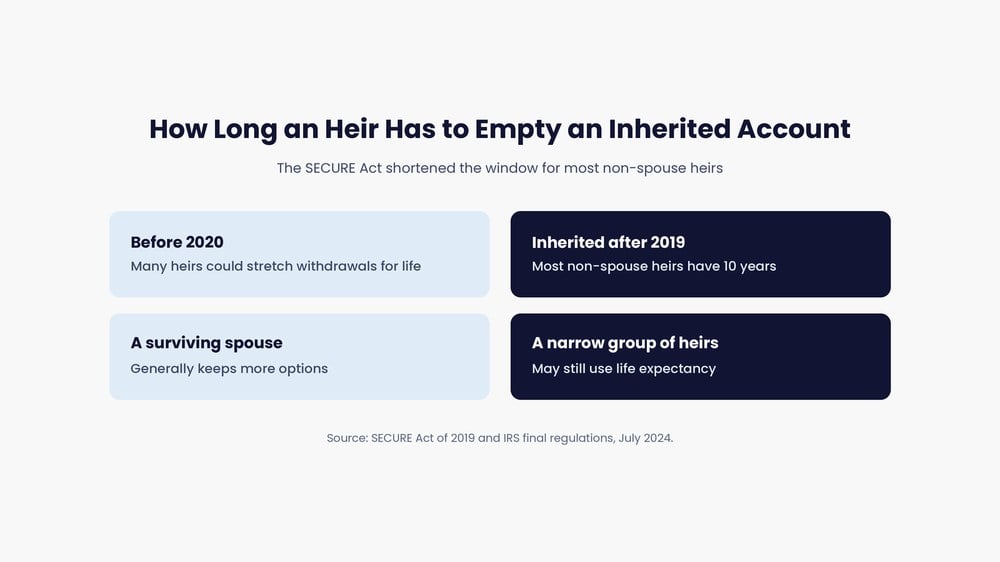
A surviving spouse generally keeps more options, and a narrow group of other heirs does as well.
Here is why that matters to the person inheriting. A traditional retirement account is taxed as ordinary income when it comes out. Ten years is a shorter window than a lifetime, so the same balance is spread across fewer tax years, and each withdrawal stacks on top of whatever that person already earns.
As an example, for an adult child still working, those ten years can land in their highest-earning stretch.
For couples, that is worth asking alongside whether the plan still works for one person.
Employer Plans Often Require Spousal Consent
For many employer retirement plans, federal law generally requires a spouse to sign off in writing before someone else can be named as the primary beneficiary. That signature is what is meant by spousal consent.
Individual retirement accounts usually do not carry the same requirement, though state law can affect it, particularly in community property states.
This matters most in blended families, where the intent may be to provide for children from a prior marriage. It is a solvable problem, and better raised with an attorney in advance than discovered afterward. It also sits close to how retirement income is taxed for whoever eventually receives the account.
Three Steps to Run the Review
The whole exercise is a list and a conversation.
First, list the accounts that pass by form. Retirement accounts, life insurance, annuities, which are insurance contracts, and any bank or brokerage accounts with a payable-on-death form, which names who receives the balance directly.
Second, find out who is named on each. Primary and contingent.
Third, note anything that surprised you. That list is what you bring to a conversation. It is usually shorter than people expect.
Still working: add a reminder to repeat this after any job change, since a rollover is the change most likely to reset a form.
Already retired: a yearly look is enough for most households, and it pairs naturally with the rest of your estate review.
Our free review guide, Who Inherits Each Account, gives you a line for each account and the short list of what to look for.
Speak With an Advisor Today
Once you know what your forms say, the next question is whether they still fit your plan. That is a conversation worth having, and we are glad to have it.
Or call 717-288-1880
Common Questions About Reviewing Beneficiary Designations
How often should you review beneficiary designations?
A yearly look is a reasonable habit, and any life change is worth an immediate check. Marriage, divorce, a birth, a loss in the family, a job change, or a move to a new state can each leave a form out of date without anyone deciding to.
Does a rollover change my beneficiary designation?
It often starts a new form. Moving a 401(k) to an IRA, or changing providers, generally means the old designation does not follow the money. If no one is named on the new account, it may follow the provider default rather than your intent.
What is a contingent beneficiary and do I need one?
A contingent beneficiary receives the account only if no primary beneficiary is living. Naming one is not required, but leaving the line blank means there is no instruction if the primary predeceases you, which can send the account to your estate and through probate.
Can I name my estate as the beneficiary?
You can, though it generally sends the account through probate and puts the account on a different withdrawal schedule than one going to a named person. There are situations where it is intentional. It is worth confirming with an estate planning attorney rather than leaving it by default.
What happens if I name a minor as beneficiary?
A minor generally cannot receive an account outright, which can require a court-appointed guardian or conservator. Attorneys often use a trust or a custodial arrangement instead. This is a case where legal advice matters more than a form.
Do I need my spouse’s consent to name someone else?
For many employer retirement plans, yes. Federal law generally requires spousal consent to name someone other than a spouse as the primary beneficiary. Individual retirement accounts usually do not carry that requirement, though state law can affect it.
Sources
Internal Revenue Service, Retirement Topics: Beneficiary
Internal Revenue Service, Publication 590-B, Distributions from Individual Retirement Arrangements
SECURE Act of 2019, and IRS final regulations on required minimum distributions, July 2024
Employee Retirement Income Security Act of 1974, spousal consent provisions
This article is provided for informational and educational purposes only and does not constitute investment advice, financial planning advice, tax advice, or legal advice. All investing involves risk, including potential loss of principal. Past performance is not a guarantee of future results. Individual results will vary based on specific financial circumstances. Beneficiary designation rules can vary by account type and state law. Estate planning decisions should be made in consultation with a qualified estate planning attorney. Please consult a qualified financial, tax, or legal professional before making any financial decisions. Securities offered through PKS Securities, Inc., a Broker-Dealer, Member FINRA/SIPC. Advisory services offered through Langan Financial Group, LLC, a Registered Investment Adviser. Registration does not imply a certain level of skill or training.