
For most of your working life, the money came from one place. In retirement it usually comes from several, each starting on its own schedule and taxed its own way.
Those sources are not always written down in one place. That list is worth making, because how much of your income is fixed and how much depends on markets shapes what a poor year does to you.
Still working: the list is a projection, and writing it down often surfaces a question that had not come up.
Already retired: the list is what arrives now, which is often different from what a statement projected years ago.
Either way it sits at the center of your retirement income plan.
The Three Kinds of Retirement Income
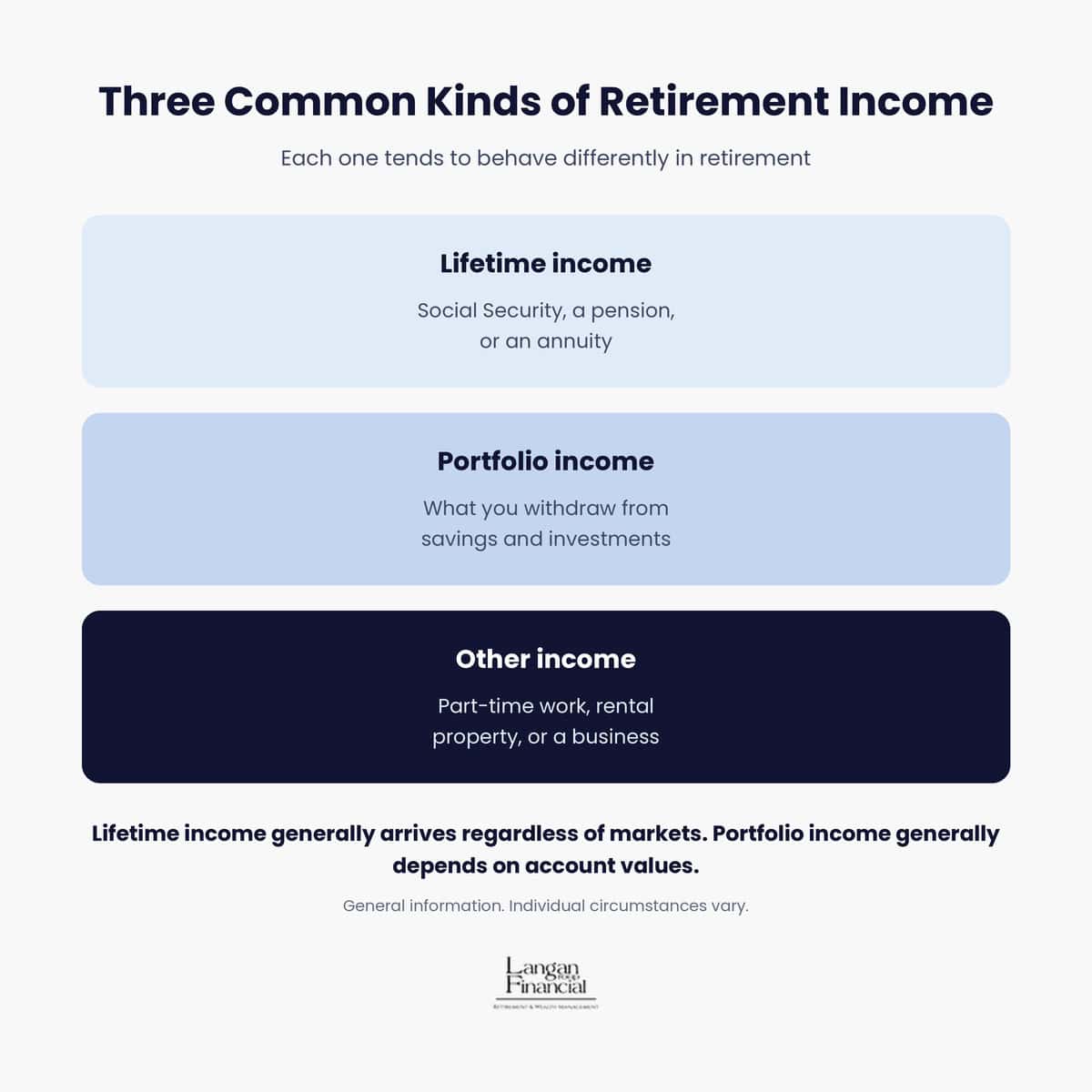
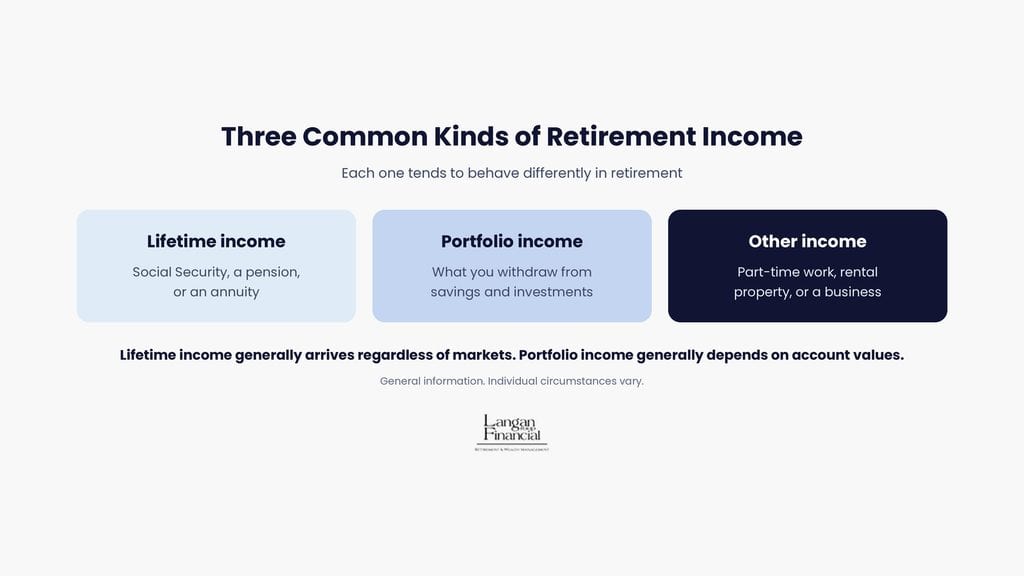
Retirement income generally falls into three groups, and each behaves differently once the paycheck stops.
- Lifetime income: Social Security, a pension, or an annuity, which is a contract with an insurance company that pays a set amount on a set schedule. It generally continues for as long as you live.
- Portfolio income: what you withdraw from savings. A 401(k) or traditional IRA, where the money was set aside before tax. A Roth account, where the tax was paid going in. Or an ordinary investment account with no retirement rules attached. You decide how much to take and when, within the withdrawal rules that apply to each account.
- Other income: part-time work, a rental property, or a business interest. For some households it covers a meaningful share of the monthly total. It also tends to be the least permanent, since a job ends, a tenant leaves, or a business is sold.
The difference that matters: lifetime income arrives whether markets cooperate or not. Portfolio income depends on what the accounts are worth when you withdraw. So how your income is split between those two kinds matters, not only what it adds up to. It belongs in the same conversation as your estate and legacy plans.
Four Questions Worth Asking About Each Source
Having the list is a start. Four answers make it useful.
The amount each source pays is individual to you, and each one can tell you what it is. Social Security publishes an estimate on your statement at ssa.gov. A pension administrator can provide a benefit estimate. An annuity contract states its terms. Account statements show balances. The figures exist. They are usually just in four different places.
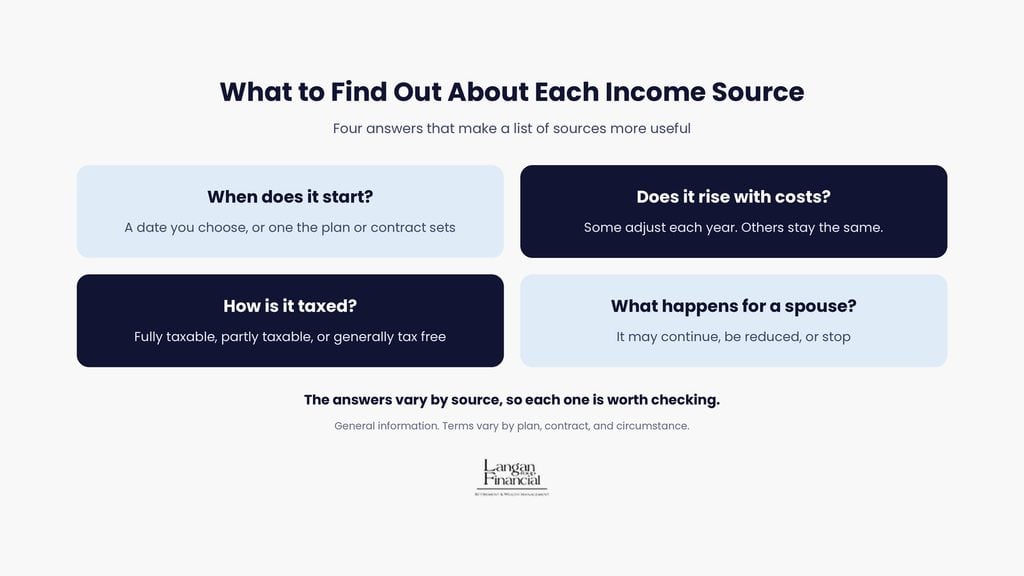
When does it start. Social Security and account withdrawals begin when you decide, within the limits the rules allow. A pension may start on a date the plan sets. An annuity begins on the date written in the contract. Those dates rarely line up, which is how gaps appear.
Does it adjust for inflation. Social Security generally receives an annual cost-of-living adjustment. Many pensions and annuities pay a fixed amount that does not rise with costs. Over a retirement that may run thirty years, that difference adds up.
How is it taxed. Withdrawals from a traditional retirement account are generally taxed as ordinary income. Roth withdrawals are generally tax free if the account rules are met. Up to 85 percent of Social Security can be taxable depending on total income.
Does it continue for a spouse. Social Security pays a survivor the larger of the two benefits, so a couple generally loses the smaller one. A pension may continue in full, drop to half, or stop, depending on the option chosen at retirement. An annuity follows its contract. For couples this one often matters more than the rest, and it is worth asking alongside whether the plan still works for one person.
When Each Source Can Begin
Several ages govern when income becomes available, and they do not line up with each other.
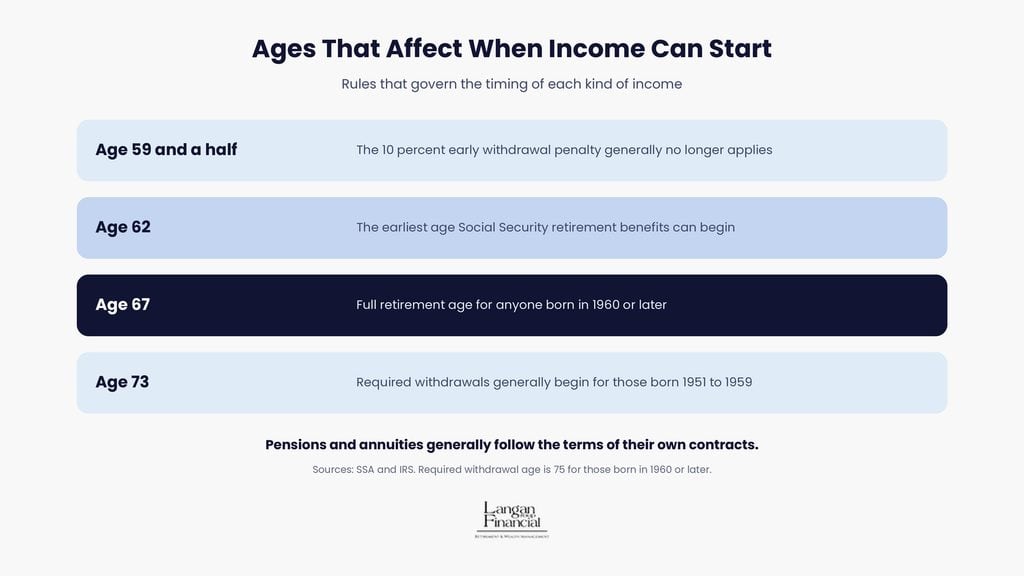
Age 59 and a half is when the early withdrawal penalty ends on most retirement accounts. Ordinary income tax still applies.
Age 62 is the earliest Social Security can begin. Claiming before full retirement age permanently reduces the monthly amount.
Full retirement age is 67 for anyone born in 1960 or later. Delaying past that age earns delayed credits up to age 70.
Age 73 is when required withdrawals begin for savers born from 1951 through 1959. For those born in 1960 or later, that age becomes 75. How those withdrawals are taxed is covered in tax-efficient investing.
Pensions and annuities follow their own terms. The contract or plan document governs when payments can begin and what options are available. Those documents are worth reading before the date arrives rather than after. Once the list exists, the next step is sizing the retirement income gap.
What the List Is For
Writing the sources down is not the point. Comparing them against something is.
Once the list exists, one comparison follows naturally. Add up the income that arrives for life, then set it against what you expect to spend on essentials. The difference is what savings would need to cover.
Our free retirement income source map gives you a line for each source and the four questions to answer about it.
Speak With an Advisor Today
We can map your income sources with you, look at how each one behaves, and talk through how the mix fits the rest of your plan.
Or call 717-288-1880
Common Questions About Retirement Income Sources
What are the main sources of retirement income?
Three kinds cover most situations. Lifetime income such as Social Security, a pension, or an annuity. Portfolio income withdrawn from retirement and taxable accounts. And other income such as part-time work, rental property, or a business interest.
What is the difference between lifetime income and portfolio income?
Lifetime income generally continues for as long as you live and arrives whether markets cooperate or not. Portfolio income is what you withdraw from savings, and the amount available depends on what those accounts are worth when you take it.
Which retirement income sources adjust for inflation?
Social Security generally receives an annual cost-of-living adjustment. Many pensions and annuities pay a fixed amount that does not rise with costs, though some contracts include an increase. The terms differ by plan and by contract.
How is retirement income taxed?
Withdrawals from a traditional retirement account are generally taxed as ordinary income. Roth withdrawals are generally tax free if the account rules are met. Up to 85 percent of Social Security can be taxable depending on total income. Pension and annuity treatment varies.
When can each retirement income source begin?
The early withdrawal penalty on most retirement accounts ends at 59 and a half. Social Security can begin as early as 62, with a permanent reduction before full retirement age, which is 67 for anyone born in 1960 or later. Required withdrawals begin at 73 for those born from 1951 through 1959. Pensions and annuities follow their own contract terms.
Sources
Social Security Administration, Retirement Benefits and Early or Delayed Retirement
Internal Revenue Service, Retirement Topics: Required Minimum Distributions
SECURE 2.0 Act of 2022, required minimum distribution age provisions
This article is provided for informational and educational purposes only and does not constitute investment advice, financial planning advice, tax advice, or legal advice. All investing involves risk, including potential loss of principal. Past performance is not a guarantee of future results. Individual results will vary based on specific financial circumstances. Social Security, pension, and annuity terms differ by individual, employer, and contract. Guarantees associated with an annuity are subject to the claims-paying ability of the issuing insurance company. Please consult a qualified financial, tax, or legal professional before making any financial decisions. Securities offered through PKS Securities, Inc., a Broker-Dealer, Member FINRA/SIPC. Advisory services offered through Langan Financial Group, LLC, a Registered Investment Adviser. Registration does not imply a certain level of skill or training.