
A lot of retirement worry comes down to one question. Is it enough?
It is a hard question to answer in one piece. It gets easier once you break it into two smaller ones: how much has to come from savings each month, and how much of that covers spending you could not adjust.
The first of those two is the retirement income gap, and sizing it takes one subtraction.
Still working: the numbers are projections, and doing the arithmetic early leaves room to act on what you find.
Already retired: the numbers are real, and the comparison shows how much of the plan is exposed to what markets do.
If you have not listed your sources yet, start with what you have and what each one pays.
Two Kinds of Retirement Spending
The comparison depends on a split that budgets rarely bother with.
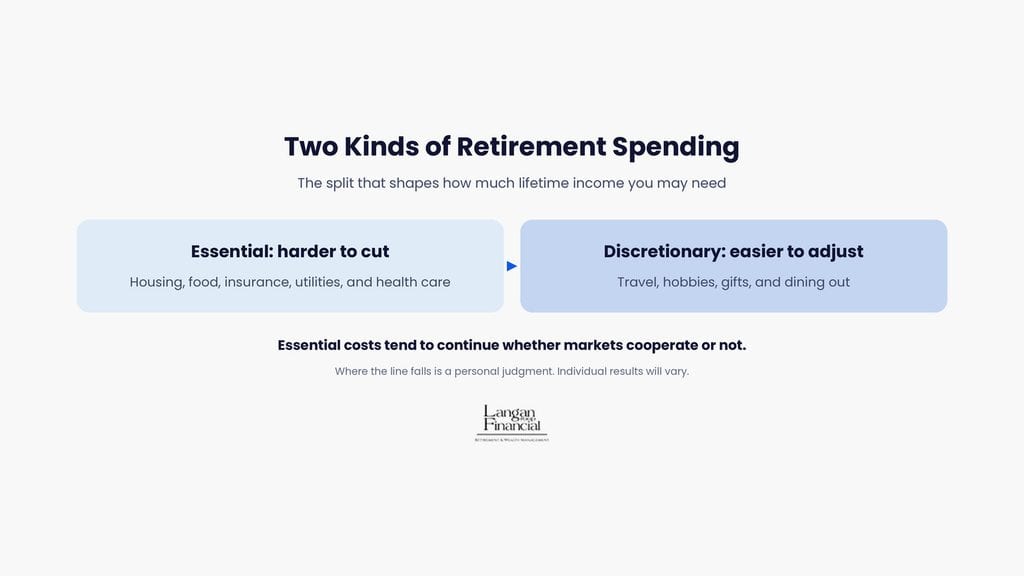
Essential expenses are the ones that continue whether markets cooperate or not. Housing, property taxes, insurance, food, utilities, transportation, and health care.
Discretionary expenses are the ones you could adjust in a difficult year. Travel, hobbies, gifts, dining out.
It is the same split that shapes the rest of your retirement income plan.
Where the line falls is a personal judgment. Some households treat an annual trip to see grandchildren as essential, and that is a legitimate answer. The value is in drawing the line deliberately rather than discovering it during a bad year.
Why the split matters more than the total: a household whose essentials are covered by lifetime income has a different set of choices in a downturn than one whose essentials depend on portfolio withdrawals.
The Subtraction
Once the two lists exist, the arithmetic is short.
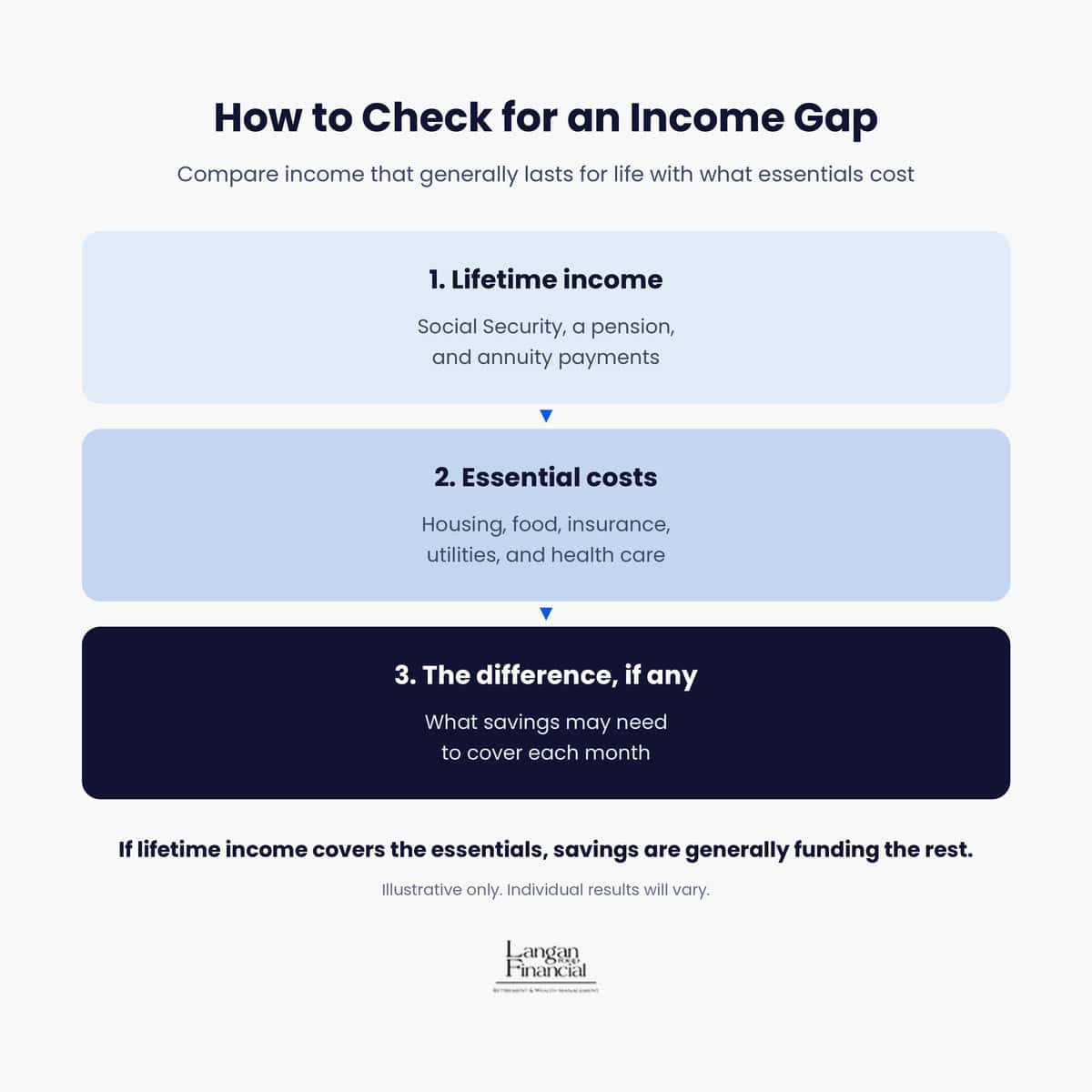
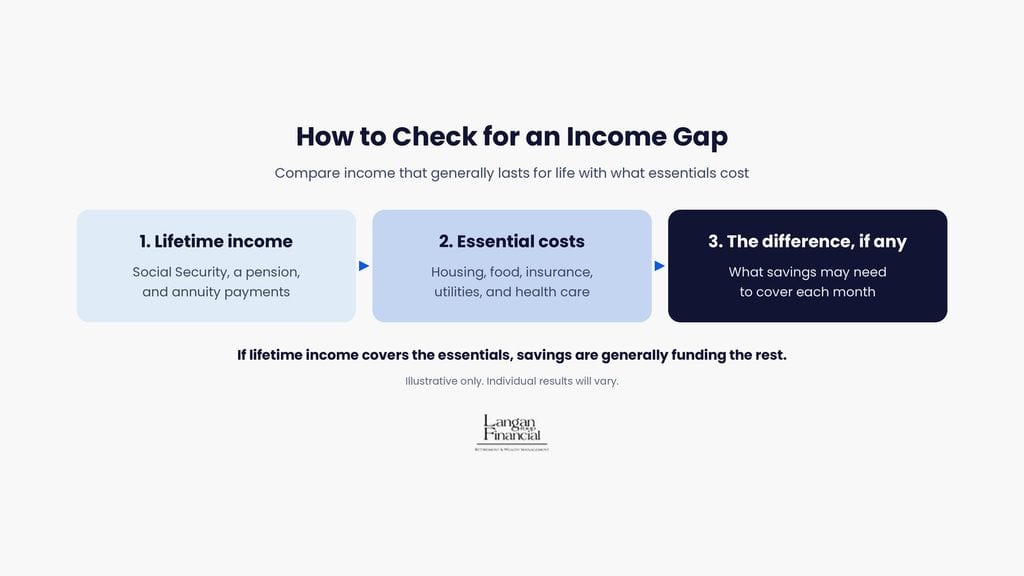
Add up the monthly income that arrives for life. This is what is often called lifetime income: Social Security, a pension, and any annuity payments. An annuity is a contract with an insurance company that pays a set amount on a set schedule. What these have in common is that they generally continue for as long as you live.
Add up your monthly essential expenses. The first list from the section above.
Subtract the second from the first. What remains is the gap your savings would need to cover each month. We walk through a question like this each week in our retirement newsletter.
Rough figures are enough. The value is in seeing the two numbers next to each other, which is a step that is easy to put off. Precision can come later, and the conversation is easier once the shape of the answer is visible.
What That Number Means for Your Plan
The result is not a pass or a fail. It tells you which kind of planning your situation calls for.
If lifetime income covers essentials, your savings are funding the discretionary half. That is the half you could adjust in a difficult year, which gives the plan room to absorb a downturn.
If it does not, savings are covering essentials too, and more of the plan depends on what markets do. That is not a failure. It is a reason to look harder at how withdrawals are taxed and how the accounts are arranged.
Neither answer is right or wrong. They point toward different decisions about cash, investment mix, and claiming.
Four Ways a Gap Can Narrow
If that subtraction left a larger number than you expected, four things can change it. Each one costs something.
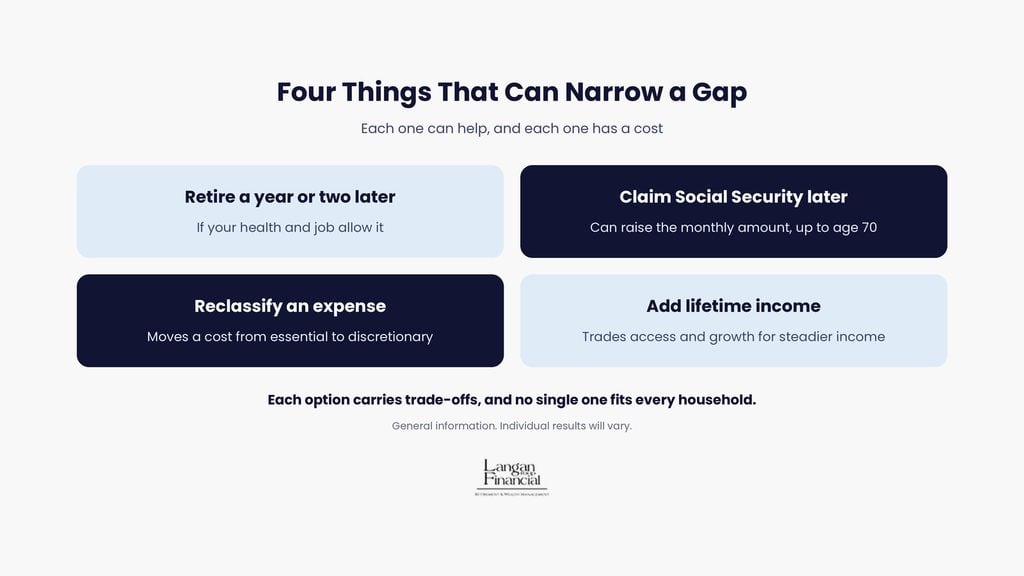
Change the date. Working longer shortens the number of years savings has to cover, and adds to what is saved. It can move the number more than the others, and it is often the last one on the list.
Change the claim. Delaying Social Security past full retirement age, which is 67 for anyone born in 1960 or later, can raise the monthly amount up to age 70. That decision interacts with everything else in the years before you retire.
Change the spending. Moving an expense from the essential column to the discretionary one narrows the gap on paper. Whether it narrows in practice is a judgment.
Change the mix. Converting part of your savings into lifetime income, usually through an annuity, raises the amount that arrives regardless of markets. In exchange you give up access to that money and the growth it might have produced, and the payments depend on the insurance company continuing to meet its obligations.
Each of these moves the others, so they are worth looking at together rather than one at a time.
Where to Start
The whole exercise is two lists and one subtraction.
Our free income retirement source map has a line for each income source, a place for essential and discretionary spending, and the subtraction at the end.
Speak With an Advisor Today
Bring your numbers and we will work through the comparison with you, then talk about which levers fit your situation.
Or call 717-288-1880
Common Questions About the Retirement Income Gap
What is a retirement income gap?
It is the difference between the income that arrives for as long as you live, such as Social Security or a pension, and what you expect to spend on essential expenses. The remainder is the part your savings and investments would need to cover.
How do you calculate a retirement income gap?
Add up the monthly income you expect to receive for life. Add up your monthly essential expenses. Subtract the second from the first. Rough figures are enough to make the comparison useful.
What counts as an essential expense in retirement?
Generally the costs that continue whether markets cooperate or not. Housing, property taxes, insurance, food, utilities, transportation, and health care. Where the line falls is a personal judgment rather than a rule.
Is it a problem if lifetime income does not cover essentials?
Not necessarily. It means savings are covering part of the essential spending, so the plan depends more on what markets do. That usually shapes three things: how much cash you hold so a down year does not force a sale at a poor time, how the accounts are invested since money covering groceries is doing a different job than money covering travel, and whether a Social Security claiming date is worth another look. Neither situation is right or wrong.
What can close a retirement income gap?
Working longer, delaying a Social Security claim, moving an expense from the essential column to the discretionary one, or adding lifetime income. Each carries trade-offs, and each one moves the others, so they are worth looking at together.
Sources
Social Security Administration, Retirement Benefits and Early or Delayed Retirement
Internal Revenue Service, Retirement Topics: Required Minimum Distributions
SECURE 2.0 Act of 2022, required minimum distribution age provisions
This article is provided for informational and educational purposes only and does not constitute investment advice, financial planning advice, tax advice, or legal advice. All investing involves risk, including potential loss of principal. Past performance is not a guarantee of future results. Individual results will vary based on specific financial circumstances. Social Security, pension, and annuity terms differ by individual, employer, and contract. Guarantees associated with an annuity are subject to the claims-paying ability of the issuing insurance company. Please consult a qualified financial, tax, or legal professional before making any financial decisions. Securities offered through PKS Securities, Inc., a Broker-Dealer, Member FINRA/SIPC. Advisory services offered through Langan Financial Group, LLC, a Registered Investment Adviser. Registration does not imply a certain level of skill or training.