
RETIREMENT
By Alex Langan, JD, Chief Investment Officer
Langan Financial Group · 7 min read
Some parts of a retirement plan arrive with a date attached. Medicare open enrollment runs from October 15 through December 7. Required withdrawals start at a set age. Tax returns are due in April.
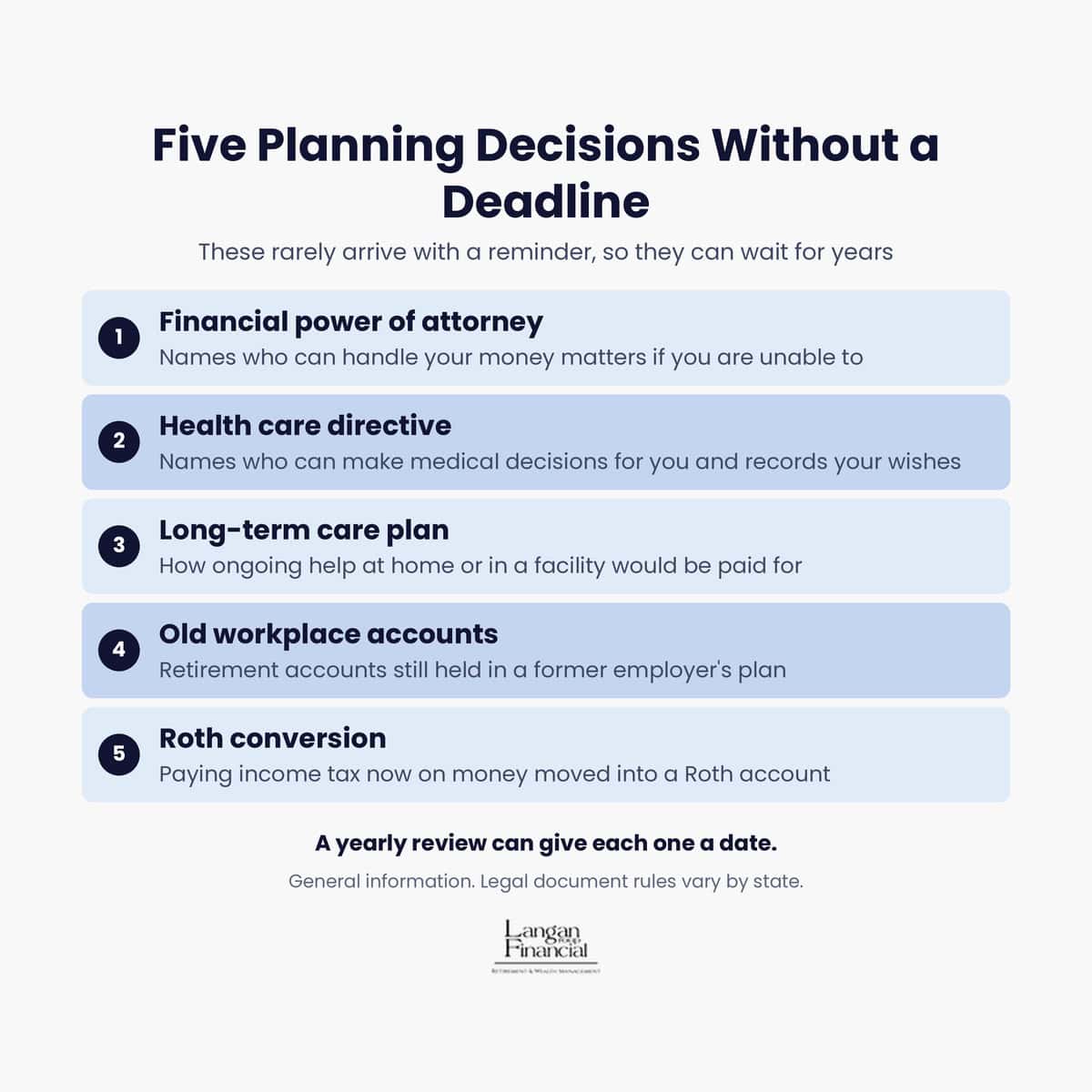
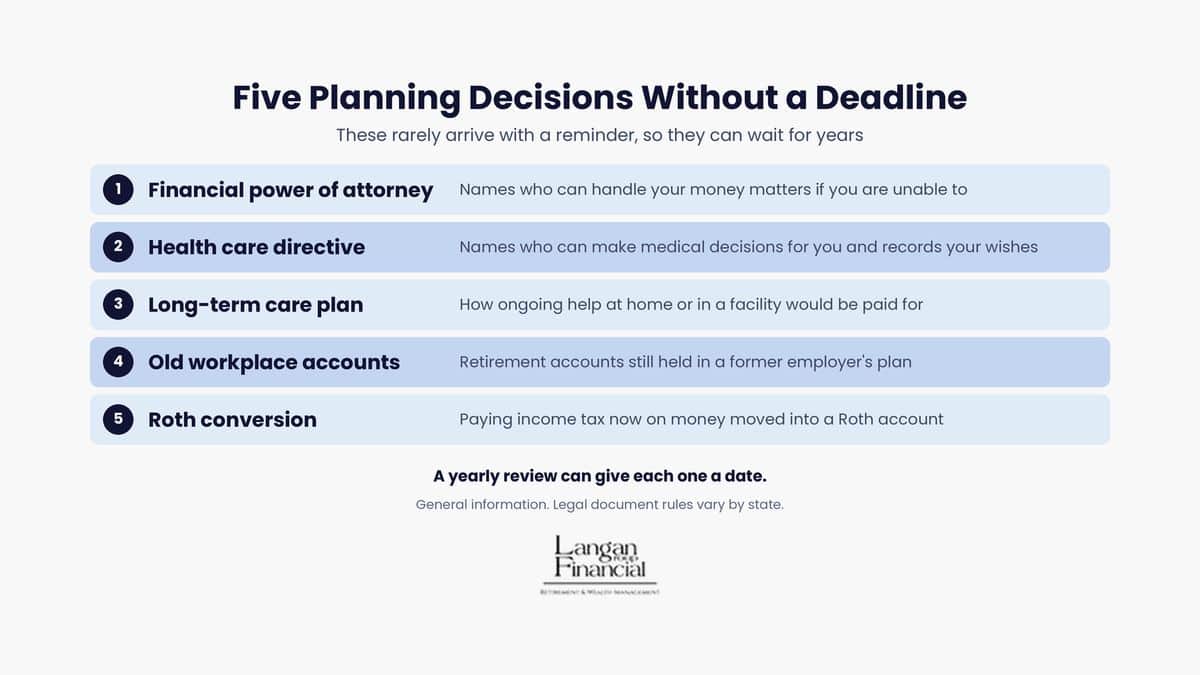
Other decisions come without a set date. They rarely arrive with a reminder, so they can wait for years. An annual financial review is one way to give them a regular time to come up.
This article covers five of those decisions, why they tend to wait, and how a yearly review can help. Beneficiary forms are another good example, and we covered them in who inherits your retirement accounts.
Still working: several of these are easier to handle now, while your health and your current employer plan give you more options to compare.
Already retired: the legal documents are often the place to start, especially if they were signed many years ago.
Why Decisions Without a Deadline Tend to Wait
These decisions have a few things in common. Each touches a subject that can feel uncomfortable, such as illness, the ability to make your own decisions, or taxes. Each usually involves more than one person, such as a spouse, an attorney, or an advisor. And little seems to change if another month goes by, so another month tends to go by.
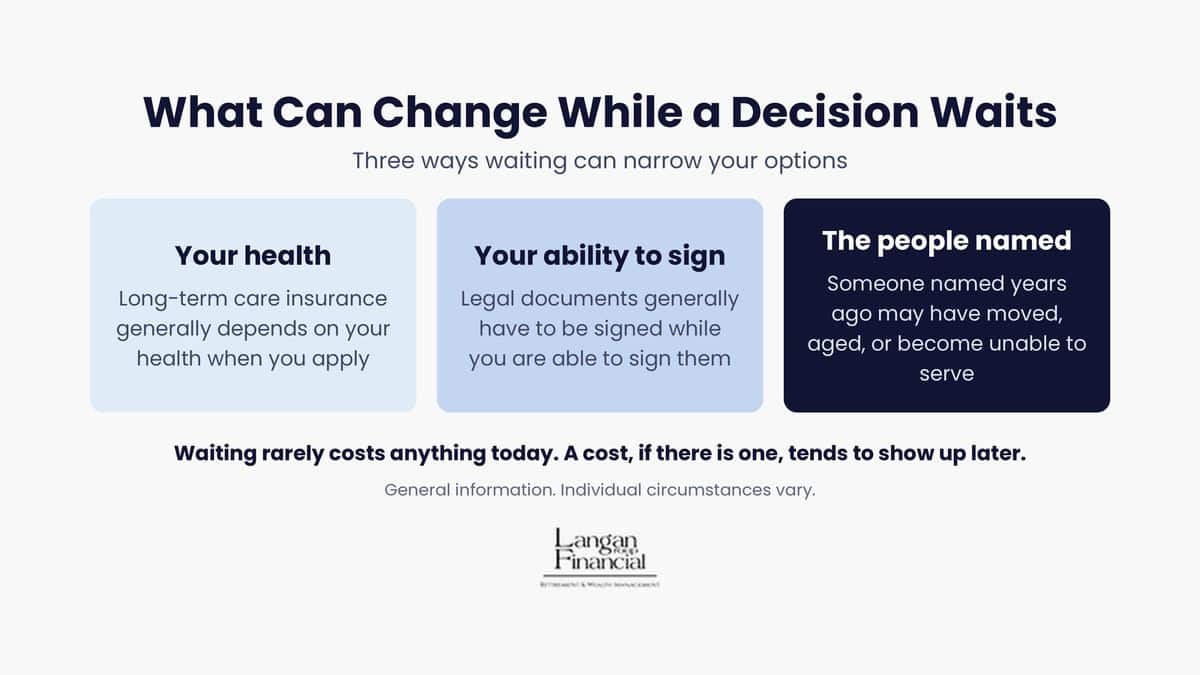
Waiting rarely costs anything today. The cost, when there is one, tends to show up later, when some options have narrowed. The sections below explain where that happens for each decision.
A Financial Power of Attorney and a Health Care Directive
A financial power of attorney is a legal document naming someone who can manage your financial matters if you are unable to. That can include paying bills, handling accounts, and filing taxes. Without one, a family member may need to ask a court for that authority, which can take time and cost money.
A health care directive is sometimes called a health care power of attorney or an advance directive. It names someone to make medical decisions if you cannot, and it records your wishes about care. Forms and terms vary by state.
These documents generally have to be signed while you are able to sign them. That is the main reason waiting can matter here. A document prepared during an ordinary week, with time to think about who to name, is a very different experience from one arranged in a hurry.
If you already have these documents, the question is whether they still fit. A move to another state, a marriage, a divorce, or a loss in the family can each affect who you would name today. These documents are part of estate and legacy planning, and an estate planning attorney is the right person to prepare or update them.
A Plan for Long-Term Care
Long-term care means ongoing help with daily activities such as bathing, dressing, or eating, whether at home, in assisted living, or in a nursing facility. Medicare generally does not pay for this kind of care. It may cover a limited stay in a skilled nursing facility after a qualifying hospital stay, but that is a different kind of care.
A plan does not have to mean buying a policy. It is a decision about how the care would be paid for if it were needed, whether from savings, insurance, family help, or some combination. Long-term care insurance is generally priced and approved based on your age and health when you apply, which is why this decision can narrow with time.
How those costs could fit alongside your other expenses is a question for your retirement income plan.
Old Workplace Retirement Accounts
A 401(k) or similar account left at a former employer keeps working. But each one is another statement, another login, and another beneficiary form to keep current, and it can be easy to lose track of over the years.
Whether to leave an old account where it is, move it, or combine it with another depends on fees, investment choices, and the rules of each plan. The right answer varies from one household to the next.
If you are not sure how many old accounts you have, our article on finding old retirement accounts from former employers walks through where to look.
A Roth Conversion
A Roth conversion means moving money from a traditional retirement account into a Roth account and paying income tax on the amount converted now. In exchange, qualified withdrawals later are generally tax free, and Roth accounts generally do not require withdrawals during your lifetime.
A conversion is optional, which is part of why it tends to sit. There is a yearly cutoff, though. A conversion generally has to be completed by December 31 to count for that tax year, and once made, the tax rules do not allow it to be reversed.
A common reason people hesitate is worry that the rules could change after they have paid the tax. We look at that question, and at what Congress has changed before, in Roth account rules and how they have changed.
How an Annual Financial Review Gives Each Decision a Date
You do not need to settle the five decisions at once. What tends to help is giving them a regular time to come up. To make it easy to remember, tie it to something you already do once a year, such as your birthday, filing your taxes, or your annual physical.
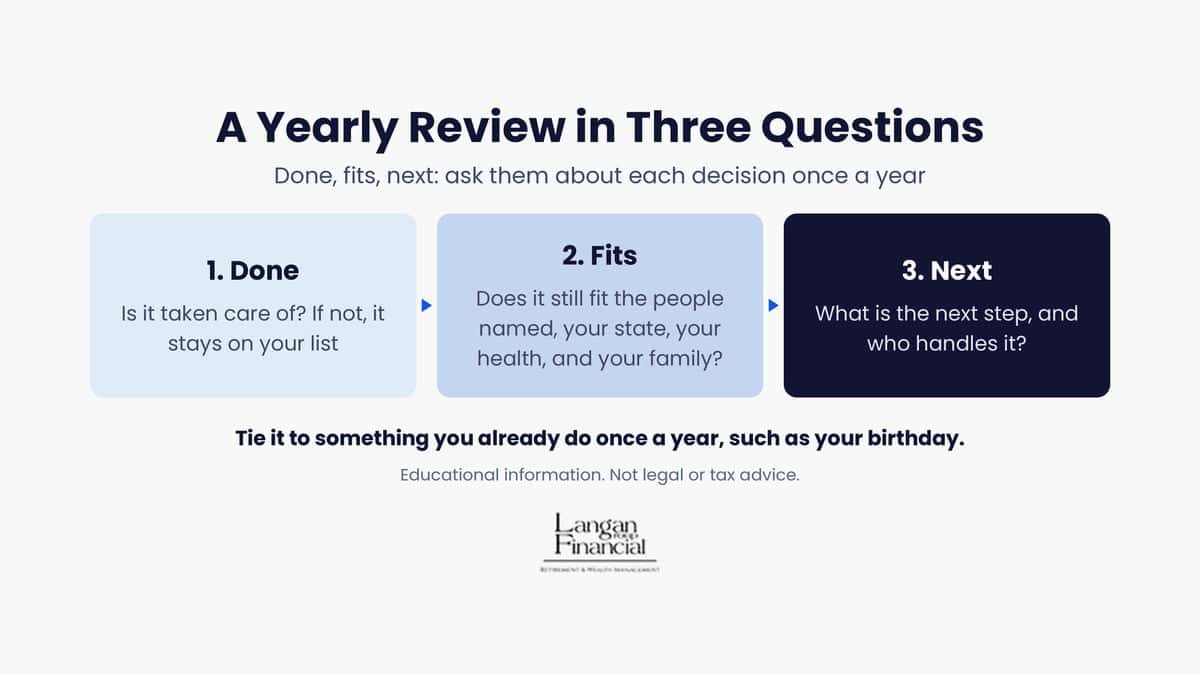
Then ask three short questions about each decision on your list. An easy way to remember them: done, fits, next.
- Done: is this decision taken care of? If it is not, it stays on the list, and the third question tells you what comes next.
- Fits: if it is done, does it still fit your life? Look at the people named, the state you live in, your health, and your family.
- Next: what is the next step, and who handles it? Write down one action and one name, whether that is you, a spouse, your attorney, your advisor, or your tax professional.
Our free guide, Planning Decisions to Review Each Year, has a page for each of these questions and a list to fill in for your own decisions.
If you would like a planning question like this in your inbox each week, you can sign up for our retirement newsletter.
Speak With an Advisor Today
We can help you put these decisions in order and look at how a Roth conversion might fit your income and taxes. We can also note where an attorney or tax professional belongs in the process.
Or call 717-288-1880
Common Questions About an Annual Financial Review
What is an annual financial review?
It is a set time each year to look at the parts of your plan that have no deadline of their own. That can include legal documents, long-term care, old accounts, and a possible Roth conversion. For each one, you ask whether it is done, whether it still fits, and what the next step is.
Why do these decisions get put off?
Each can be handled at most points in the year, so there is no outside reason to act this month. Many also involve an uncomfortable subject or more than one person, which makes them easy to set aside.
Does Medicare pay for long-term care?
Medicare generally does not pay for long-term care when it consists of help with daily activities such as bathing or dressing. It may cover a limited stay in a skilled nursing facility after a qualifying hospital stay.
How often should legal documents be reviewed?
There is no set rule. A yearly check is a simple habit, along with a review after a move to another state, a marriage, a divorce, or a loss in the family. An estate planning attorney can tell you whether a document still works as intended.
Is there a deadline for a Roth conversion?
A conversion is optional, but it generally has to be completed by December 31 to count for that tax year. Once made, the tax rules do not allow a conversion to be reversed.
Sources
Internal Revenue Service, Retirement Topics: Required Minimum Distributions (RMDs)
Internal Revenue Service, Instructions for Form 8606, Recharacterizations
Centers for Medicare and Medicaid Services, Long-Term Care Coverage
This article is provided for informational and educational purposes only and does not constitute investment advice, financial planning advice, tax advice, or legal advice. All investing involves risk, including potential loss of principal. Past performance is not a guarantee of future results. Individual results will vary based on specific financial circumstances. Tax rules referenced are current as of the date of publication and are subject to change. A Roth conversion is a taxable event, and current tax rules do not allow it to be reversed. Legal documents and their requirements vary by state and should be prepared by a qualified attorney. Please consult a qualified financial, tax, or legal professional before making any financial decisions. Securities offered through PKS Securities, Inc., a Broker-Dealer, Member FINRA/SIPC. Advisory services offered through Langan Financial Group, LLC, a Registered Investment Adviser. Registration does not imply a certain level of skill or training.
STILL HAVE QUESTIONS?
See How These Decisions Fit Together in Your Own Plan
A twenty-minute conversation can help you understand your options.
Or call 717-288-1880