
TAX STRATEGIES
By Alex Langan, JD, Chief Investment Officer
Langan Financial Group · 7 min read
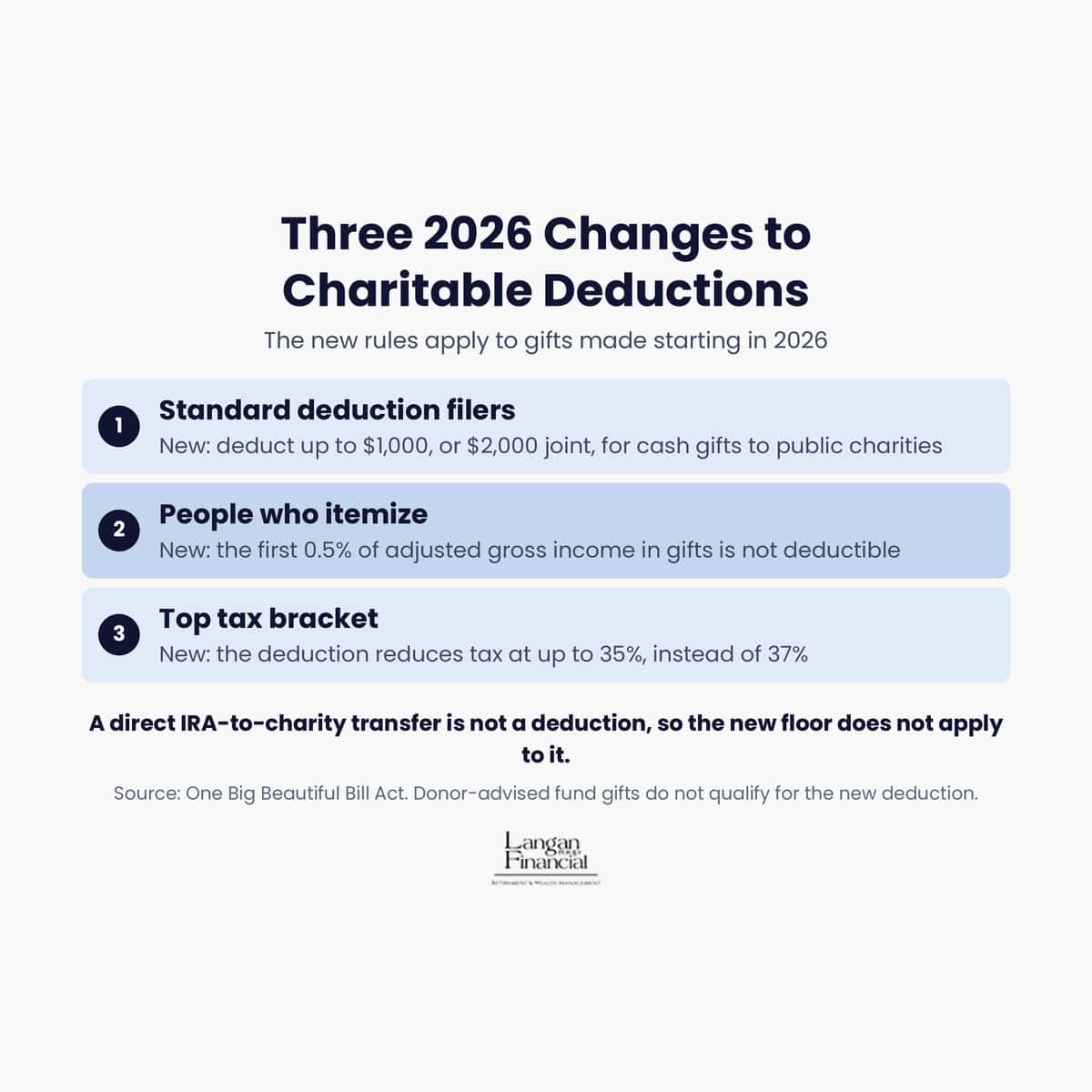
Charitable giving strategies changed in 2026, because the rules for deducting gifts changed. People who take the standard deduction can now deduct some cash gifts, itemizers face a new floor, and top-bracket taxpayers face a new cap. The way you give can change the tax effect of the same donation.
This article compares the main ways to give under the 2026 rules: cash, investments, donor-advised funds, and grouping gifts into one year. For IRA owners 70 and a half or older, we cover direct transfers from an IRA in how qualified charitable distributions work.
Still working: giving investments and grouping gifts may matter more in high-income years.
Already retired: the new deduction for standard deduction filers may fit your giving, especially if you no longer itemize. A direct IRA transfer at 70 and a half or older is another option to compare.
What Changed for Charitable Deductions in 2026?
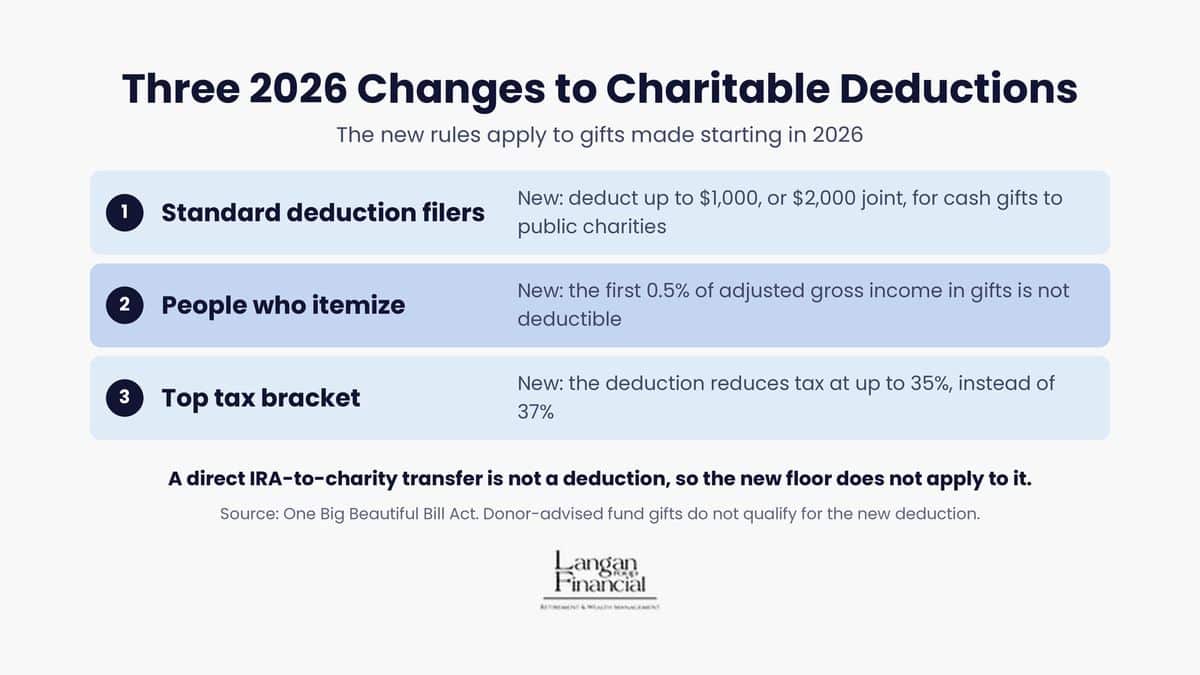
- A deduction for people who take the standard deduction. Starting in 2026, you can deduct up to $1,000, or $2,000 for joint filers, for cash gifts to public charities without itemizing. Gifts to donor-advised funds and private foundations generally do not qualify, and the law does not adjust the amount for inflation.
- A 0.5% floor for itemizers. Charitable gifts are deductible to the extent they exceed 0.5% of your adjusted gross income, which is the income figure on your tax return before deductions. With $100,000 of adjusted gross income, for example, the first $500 of gifts produces no deduction.
- A 35% cap for the top bracket. For people in the 37% bracket, the deduction reduces tax at up to 35%.
The limit on cash gifts to public charities stays at 60% of adjusted gross income.
Do You Itemize or Take the Standard Deduction?
Whether you itemize decides which charitable rules apply. Add up the deductions you would list if you itemized, such as mortgage interest, state and local taxes, and charitable gifts. Compare the total with the 2026 standard deduction of $32,200 for joint filers or $16,100 for single filers.
People 65 or older also receive an additional standard deduction, which can make the standard deduction the larger amount for retirees. If you take the standard deduction, the new $1,000 or $2,000 deduction for cash gifts applies.
How Do the Main Charitable Giving Strategies Compare?
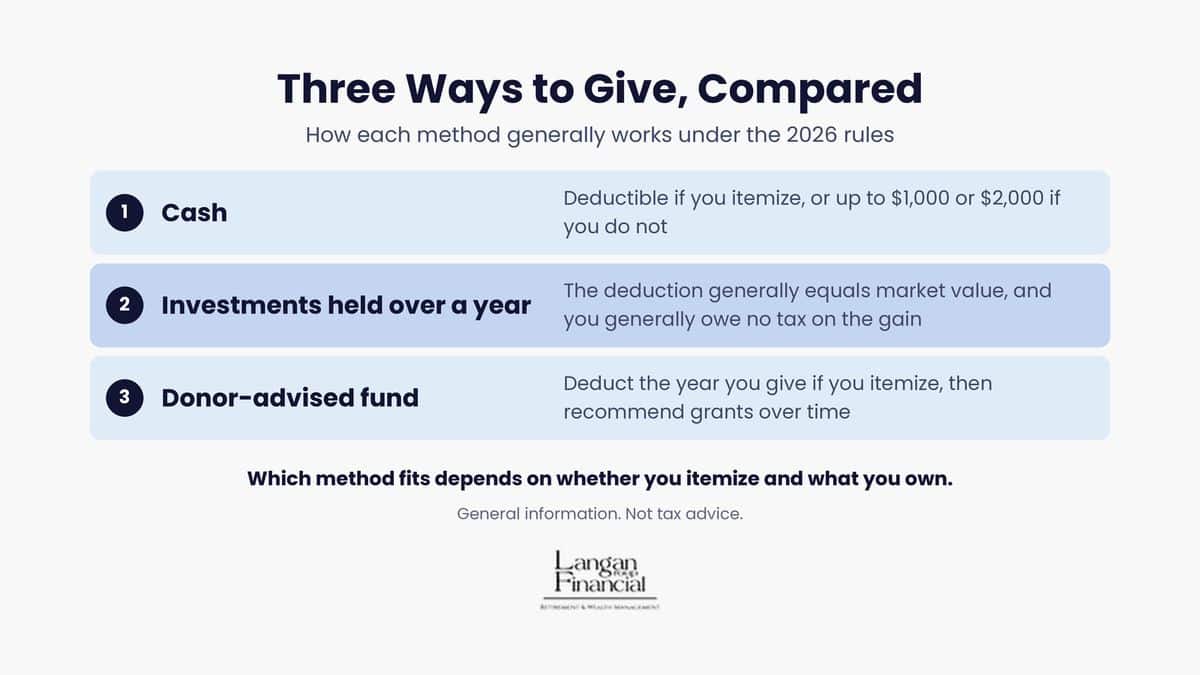
- Cash. Cash is the simplest gift. A cash gift is deductible if you itemize, after the 0.5% floor, or up to $1,000 or $2,000 if you take the standard deduction.
- Investments that have grown in value. For itemizers, the deduction for investments held more than a year generally equals market value, and you generally owe no tax on the gain.
- A donor-advised fund. A donor-advised fund is an account at a sponsoring charity that lets you give in one year and recommend grants over time.
- A direct IRA-to-charity transfer. For IRA owners 70 and a half or older, the IRS generally leaves the transfer out of income.
Why Can Giving Investments Work Differently From Cash?
If you sell an investment that has grown in value, you generally owe tax on the gain. If you give the investment to a charity instead, you generally owe no tax on the gain. Itemizers can also generally deduct the market value for investments held more than a year.
The tax rules generally limit the deduction for gifts of investments to public charities to 30% of adjusted gross income. You can generally carry unused amounts forward for up to five years. Gifts of investments come from taxable accounts, not IRAs. For how the IRS taxes gains, see tax-loss harvesting and capital gains. Which accounts hold which investments is part of tax-efficient investing.
How Does Grouping Gifts Into One Year Work?
Grouping, sometimes called bunching, means making two or more years of planned gifts in one year. The larger total can push your itemized deductions above the standard deduction that year, and you take the standard deduction in the other years.
The new 0.5% floor applies each year you itemize, so grouping gifts can mean the floor applies once instead of several times. A donor-advised fund is one way to group gifts while still sending money to charities over time.
Should You Give This Year or Next?
Income can change from one year to the next, especially around retirement. A higher-income year might be a final working year or a year with a large sale of investments. In a year like that, an itemized deduction can lower tax at a higher rate.
In a lower-income year, the standard deduction may be larger than your itemized deductions. In that case, the new $1,000 or $2,000 deduction for cash gifts may apply instead. Looking at both years together can show which year a larger gift fits.
How Do Couples Coordinate Their Giving?
- The new deduction. The $2,000 amount applies to married couples who file a joint return.
- IRA transfers. Each spouse who is 70 and a half or older can make a QCD from his or her own IRA, up to $111,000 each for 2026.
- Which assets to give. Giving investments with larger gains can avoid more tax on those gains, so the choice of account and investment can matter.
How Does the New 35% Cap Work?
The cap affects people in the 37% tax bracket. For those taxpayers, each dollar of itemized deductions, including charitable gifts, reduces tax by up to 35 cents instead of 37 cents. The cap does not change the deduction for people in lower brackets.
What About Naming a Charity as a Beneficiary?
Some people leave money to charity through a beneficiary form instead of a gift during life. A traditional IRA left to a charity generally passes without income tax, because the charity does not pay income tax. The same IRA left to a family member is generally taxable income to that person when withdrawn.
The tax difference is one reason some families name a charity as beneficiary of an IRA and leave other assets to heirs. Beneficiary forms generally control who inherits retirement accounts, which we explain in who inherits your retirement accounts. Charitable bequests can also be part of your estate and legacy planning.
Which Giving Mistakes Are Worth Avoiding?
- Selling a winning investment, then giving cash. Selling first generally means paying tax on the gain. Giving the investment directly can avoid that tax.
- Giving an investment that lost value. The tax rules generally limit the deduction to the current market value. Selling first, using the loss, and giving cash can work better.
- Expecting the new deduction for a donor-advised fund gift. Gifts to donor-advised funds do not count toward the new $1,000 or $2,000 deduction.
- Waiting until the last week of December. Transfers take time, and custodians and charities set their own processing times.
What Should Happen by December 31?
- Checks. A check generally counts in the year you mail it.
- Gifts of investments. A gift generally counts when the shares reach the charity, and transfers can take several days.
- Donor-advised fund gifts. The gift counts when the fund receives it.
- Records. Keep a written receipt for each gift. If your noncash gifts total more than $500 for the year, IRS Form 8283 goes with your return. Noncash gifts over $5,000, other than publicly traded investments, generally require a qualified appraisal. For the full year-end calendar, see year-end tax planning for retirees.
Common Questions
What changed for charitable deductions in 2026?
People who take the standard deduction can deduct up to $1,000, or $2,000 for joint filers, for cash gifts to public charities. Itemizers face a 0.5% floor, and top-bracket taxpayers face a 35% cap.
Do gifts to a donor-advised fund qualify for the new deduction for people who do not itemize?
Gifts to donor-advised funds do not qualify for the new $1,000 or $2,000 deduction. You can deduct gifts to donor-advised funds if you itemize.
What is the 0.5% floor?
Starting in 2026, itemizers can deduct charitable gifts to the extent the gifts exceed 0.5% of adjusted gross income.
Why give investments instead of cash?
For itemizers, the deduction for investments held more than a year generally equals market value, and you generally owe no tax on the gain.
Does the 35% cap affect me?
The cap affects people in the 37% tax bracket. For those taxpayers, itemized deductions, including charitable gifts, reduce tax by up to 35 cents per dollar.
What is bunching?
Bunching means grouping two or more years of planned gifts into one year, so itemized deductions exceed the standard deduction that year.
When does a charitable gift count for the year?
A mailed check generally counts in the year you mail it. A gift of investments generally counts when the shares reach the charity. Get The Confident Retirement Brief each Wednesday. Subscribe to the newsletter. If you would like to talk through how this fits your own plan, our team is here to help. Schedule a consultation.
Sources
- Internal Revenue Service, Publication 526, Charitable Contributions
- Internal Revenue Service, Publication 590-B, Distributions from Individual Retirement Arrangements
- Internal Revenue Service, IR-2025-103, Tax inflation adjustments for tax year 2026
- Internal Revenue Service, Notice 2025-67
- Council on Foundations, One, Big, Beautiful Bill: Impact on Philanthropy
This article is provided for informational and educational purposes only and does not constitute investment advice, financial planning advice, tax advice, legal advice, or insurance advice. All investing involves risk, including potential loss of principal. Past performance is not a guarantee of future results. Individual results will vary based on specific financial circumstances. Securities offered through PKS Securities, Inc., a Broker-Dealer, Member FINRA/SIPC. Advisory services offered through Langan Financial Group, LLC, a Registered Investment Adviser. Registration does not imply a certain level of skill or training. Langan Financial Group does not prepare or file tax returns. Tax consequences should be reviewed with your tax professional. Tax rules and figures are current as of the date of publication and can change.
Alex Langan is a licensed attorney. Langan Financial Group is not a law firm. Neither he nor the firm provides legal advice or practices law for the firm or its clients, and no attorney-client relationship is created.
STILL HAVE QUESTIONS?
See How These Decisions Fit Together in Your Own Plan
A twenty-minute conversation can help you understand your options.
Or call 717-288-1880