RETIREMENT
By Alex Langan, JD, Chief Investment Officer
Langan Financial Group · 7 min read
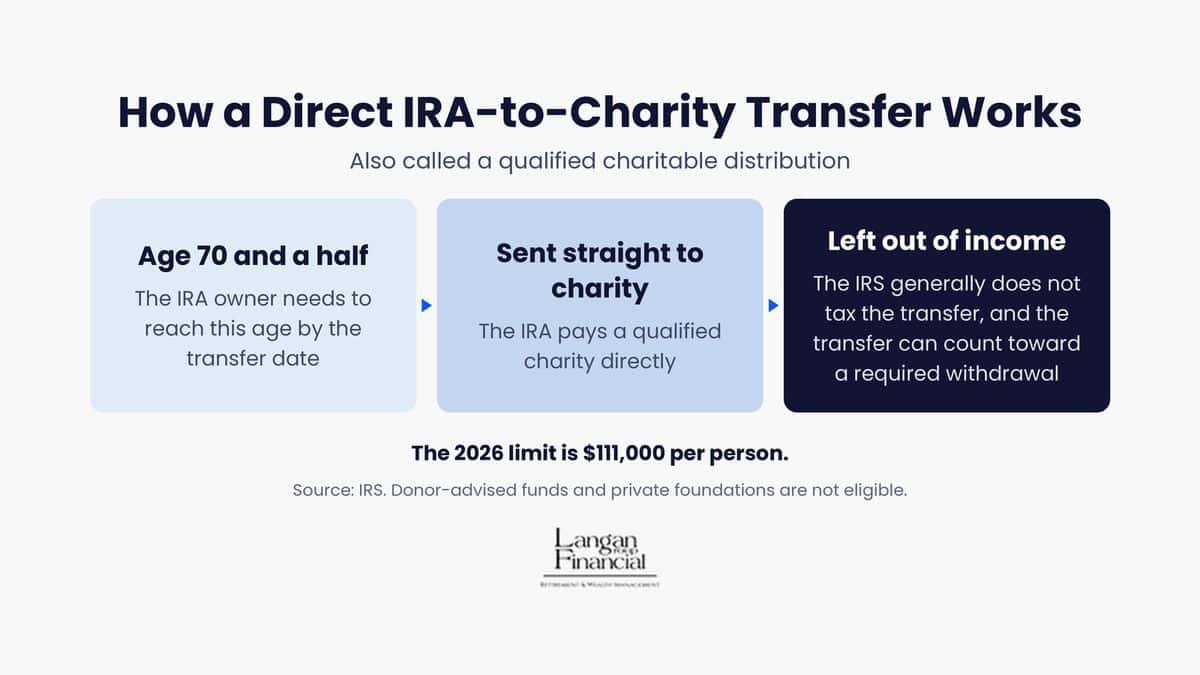
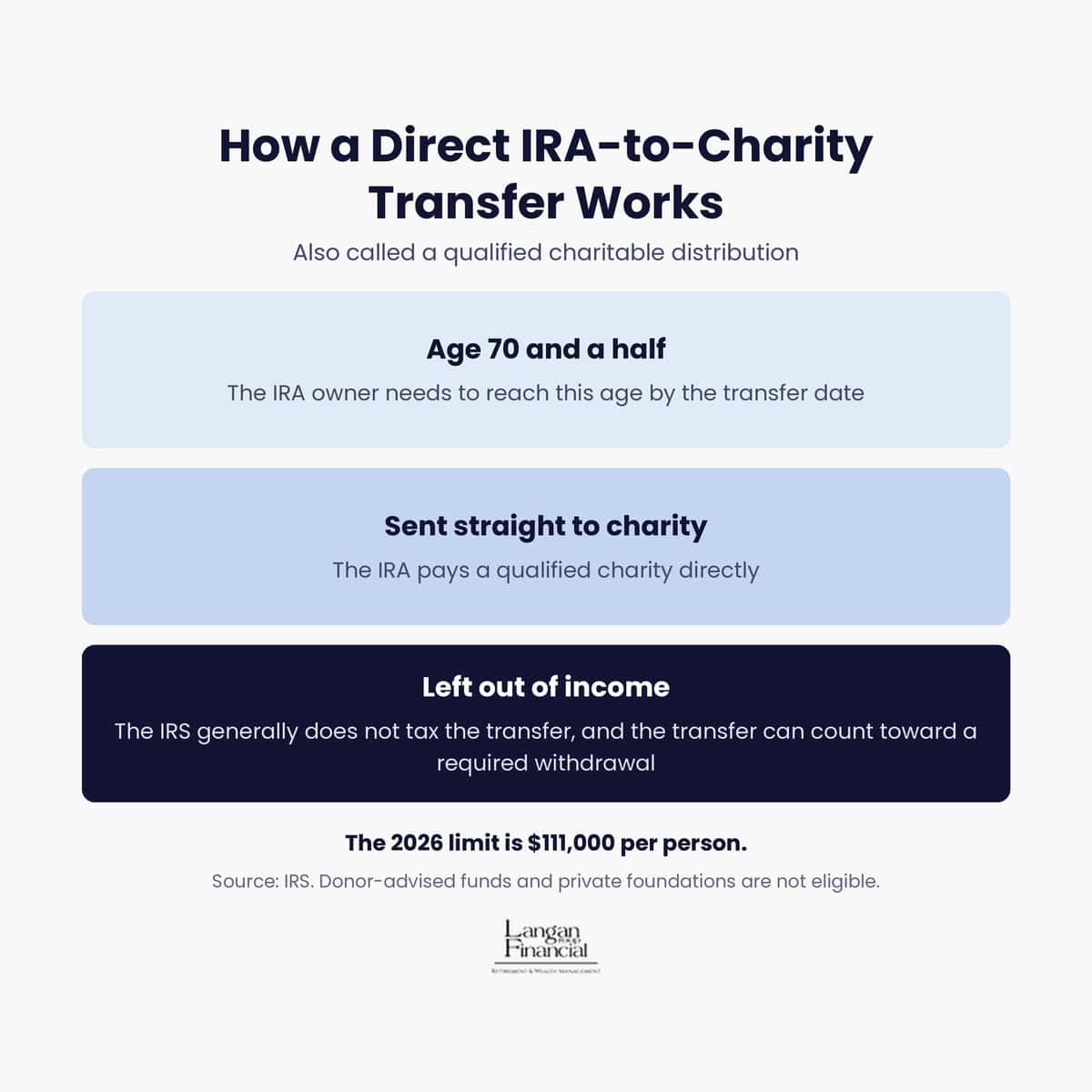
A qualified charitable distribution is money your IRA sends directly to a qualified charity, and the IRS generally leaves the transfer out of your taxable income. If you are 70 and a half or older, you can give up to $111,000 this way in 2026. The transfer can also count toward your required minimum distribution.
A qualified charitable distribution, often called a QCD, is one of several ways to give before December 31. This article covers who can use one, which charities qualify, how the transfer interacts with required withdrawals, and how to report it. For the full year-end calendar, see year-end tax planning for retirees.
Age 70 and a half or older: a QCD is a giving method worth comparing first, because it works whether or not you itemize.
Not yet 70 and a half: the other ways to give, covered in our companion article, apply now, and a QCD becomes an option later.
What Is a Qualified Charitable Distribution?
A QCD is a distribution from an IRA that goes straight from the IRA custodian, the firm that holds your IRA, to a qualified charity. Because the money goes to the charity instead of to you, the IRS generally excludes the amount from your taxable income.
A QCD differs from taking a withdrawal and then writing a check. A withdrawal counts as income first. The check is then deductible if you itemize. If you take the standard deduction, the new rule allows up to $1,000 or $2,000.
Who Can Make a Qualified Charitable Distribution?
- Age. You need to be 70 and a half or older on the date of the transfer.
- Account type. QCDs come from IRAs. An ongoing SEP or SIMPLE IRA, meaning one still receiving employer contributions, is generally not eligible. Workplace plans such as 401(k)s are not eligible, though money rolled into an IRA can be.
- Limit. The 2026 limit is $111,000 per person. Each spouse can give up to the limit from his or her own IRA. The IRS adjusts the limit for inflation each year.
Which Charities Can Receive a QCD?
Public charities, such as religious organizations, schools, and community nonprofits, generally qualify. Three kinds of organizations are not eligible:
- Donor-advised funds. Donor-advised funds, which are accounts at sponsoring charities, are not eligible to receive a QCD.
- Private foundations. Private foundations are generally not eligible.
- Supporting organizations. Supporting organizations, which exist to support other charities, are not eligible.
The law also allows a one-time QCD of up to $55,000 in 2026 to certain split-interest arrangements, such as a charitable gift annuity. A charitable gift annuity is a contract in which a charity pays you income in exchange for a gift. This option has its own rules, so it is worth reviewing with a tax professional.
How Does a QCD Count Toward a Required Minimum Distribution?
Required minimum distributions generally start at age 73 for people born from 1951 through 1959, and at age 75 for people born in 1960 or later. Once those withdrawals begin, a QCD made during the year can count toward the required amount. The years before required withdrawals begin can be a planning window, covered in the quiet planning window between retirement and age 73.
Because QCDs can start at 70 and a half, they are also available in the years before required withdrawals begin.
Why Can a QCD Matter More Than a Cash Gift?
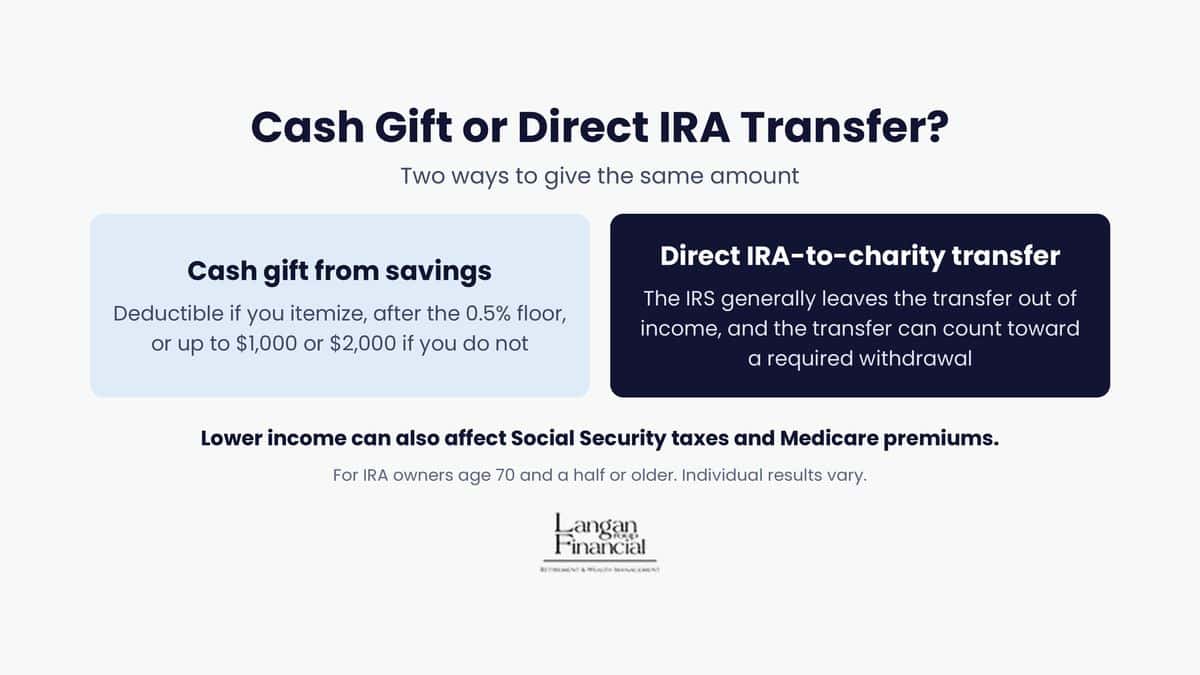
A QCD keeps the transferred money out of your adjusted gross income, which is the income figure on your tax return before deductions. A lower adjusted gross income can matter in several places:
- Taxes on Social Security. Less income can reduce the share of your Social Security that the IRS taxes.
- Medicare premiums. Medicare generally uses your income from two years earlier to set the Medicare income surcharge. Lower income can reduce or avoid that surcharge.
- The senior deduction. The new deduction for people 65 or older phases out at higher incomes, so lower income can keep more of the deduction available.
- The new 0.5% floor. Starting in 2026, itemizers get no deduction for charitable gifts up to 0.5% of their adjusted gross income. A QCD is not a deduction, so the floor does not apply.
We explain how these pieces connect in how Social Security and Medicare connect to your taxes and what to review during Medicare open enrollment.
How Do You Make a QCD Before December 31?
- Confirm the charity qualifies. Ask the charity, or check the IRS Tax Exempt Organization Search tool.
- Contact your IRA custodian. Ask for a qualified charitable distribution. The custodian sends the money to the charity or issues a check payable to the charity.
- Leave time. Custodians need time to process requests, so starting in October or November leaves room before December 31.
- Get a written receipt. Ask the charity for a written acknowledgment of the gift.
When During the Year Should You Make a QCD?
Timing within the year matters once required withdrawals begin. Withdrawals you take earlier in the year generally count toward your required amount first. Say you take your full required withdrawal in March and make a QCD in November. The QCD still goes to charity, but the QCD does not reduce the March withdrawal you already reported as income.
Making the QCD before other withdrawals generally lets more of the gift count toward the required amount. If you take regular monthly withdrawals, ask your IRA custodian how a QCD fits with that schedule.
What Fine Print Should You Know?
- No double benefit. Because the IRS leaves a QCD out of income, you do not also get a charitable deduction for the same gift.
- Inherited IRAs. A person who inherited an IRA can generally make a QCD from that account once he or she is 70 and a half or older.
- Deductible IRA contributions after 70 and a half. Deductible IRA contributions made after you reach 70 and a half may reduce the amount of your QCDs that you can leave out of income. A tax professional can help you track this.
- More than one charity. You can split QCDs among several charities, as long as the total for the year stays within the $111,000 limit.
- Roth IRAs. Qualified withdrawals from a Roth IRA are already tax free, so a QCD from a Roth IRA generally adds no tax benefit.
- IRA withdrawals, not 401(k) withdrawals. A QCD from an IRA counts toward the required withdrawal for your IRAs. A QCD does not count toward a required withdrawal from a 401(k) or similar workplace plan.
- No benefit in return. The QCD needs to be the full gift. If you receive a benefit in return, such as event tickets or a meal, the transfer may not qualify.
When Might a QCD Not Fit?
A QCD is one option, and other methods can fit better in some situations. If you are not yet 70 and a half, a QCD is not available. If you want to give to a donor-advised fund, the fund is not eligible to receive a QCD. If you own investments that have grown in value in a taxable account, giving those investments directly can be worth comparing.
How Is a QCD Reported on Your Tax Return?
Your IRA custodian reports the distribution on Form 1099-R, the tax form that reports retirement account withdrawals. The form generally does not show that the money went to charity. On your tax return, you or your tax preparer generally list the full distribution on the IRA line. You then leave the QCD amount out of the taxable amount and enter “QCD” next to that line. Tell your tax preparer about each QCD you made, and keep the charity’s receipt with your records.
Gifts can also be part of your estate and legacy planning. For other ways to give, see charitable giving strategies under the 2026 rules.
Common Questions
What is a qualified charitable distribution?
A qualified charitable distribution, or QCD, is money sent directly from an IRA to a qualified charity. The IRS generally leaves the amount out of the IRA owner’s taxable income.
How old do you need to be to make a QCD?
You need to be 70 and a half or older on the date of the transfer.
How much can you give through a QCD in 2026?
You can give up to $111,000 per person in 2026. Each spouse can give up to the limit from his or her own IRA.
Can a QCD count toward my required minimum distribution?
A QCD made during the year can count toward that year’s required minimum distribution.
Can I split a QCD among several charities?
You can make QCDs to more than one charity in the same year, as long as the total stays within the $111,000 limit for 2026.
Can a QCD go to a donor-advised fund?
Donor-advised funds, private foundations, and supporting organizations are generally not eligible to receive a QCD.
Do I need to itemize to benefit from a QCD?
The IRS generally leaves a QCD out of taxable income whether you itemize or take the standard deduction. Get The Confident Retirement Brief each Wednesday. Subscribe to the newsletter. If you would like to talk through how this fits your own plan, our team is here to help. Schedule a consultation.
Sources
- Internal Revenue Service, Publication 590-B, Distributions from Individual Retirement Arrangements
- Internal Revenue Service, Notice 2025-67
- Internal Revenue Service, Retirement topics: Required minimum distributions
- Internal Revenue Service, Publication 915, Social Security and Equivalent Railroad Retirement Benefits
This article is provided for informational and educational purposes only and does not constitute investment advice, financial planning advice, tax advice, legal advice, or insurance advice. All investing involves risk, including potential loss of principal. Past performance is not a guarantee of future results. Individual results will vary based on specific financial circumstances. Securities offered through PKS Securities, Inc., a Broker-Dealer, Member FINRA/SIPC. Advisory services offered through Langan Financial Group, LLC, a Registered Investment Adviser. Registration does not imply a certain level of skill or training. Langan Financial Group does not prepare or file tax returns. Tax consequences should be reviewed with your tax professional. Tax rules and figures are current as of the date of publication and can change.
Alex Langan is a licensed attorney. Langan Financial Group is not a law firm. Neither he nor the firm provides legal advice or practices law for the firm or its clients, and no attorney-client relationship is created.
STILL HAVE QUESTIONS?
See How These Decisions Fit Together in Your Own Plan
A twenty-minute conversation can help you understand your options.
Or call 717-288-1880