Almost every household has had some version of the conversation about downsizing before retirement. It starts at the kitchen table, goes in circles, and ends without a decision. Then it comes back six months later and does the same thing.
It is easy to assume that means someone is being stubborn. Usually it means something else.
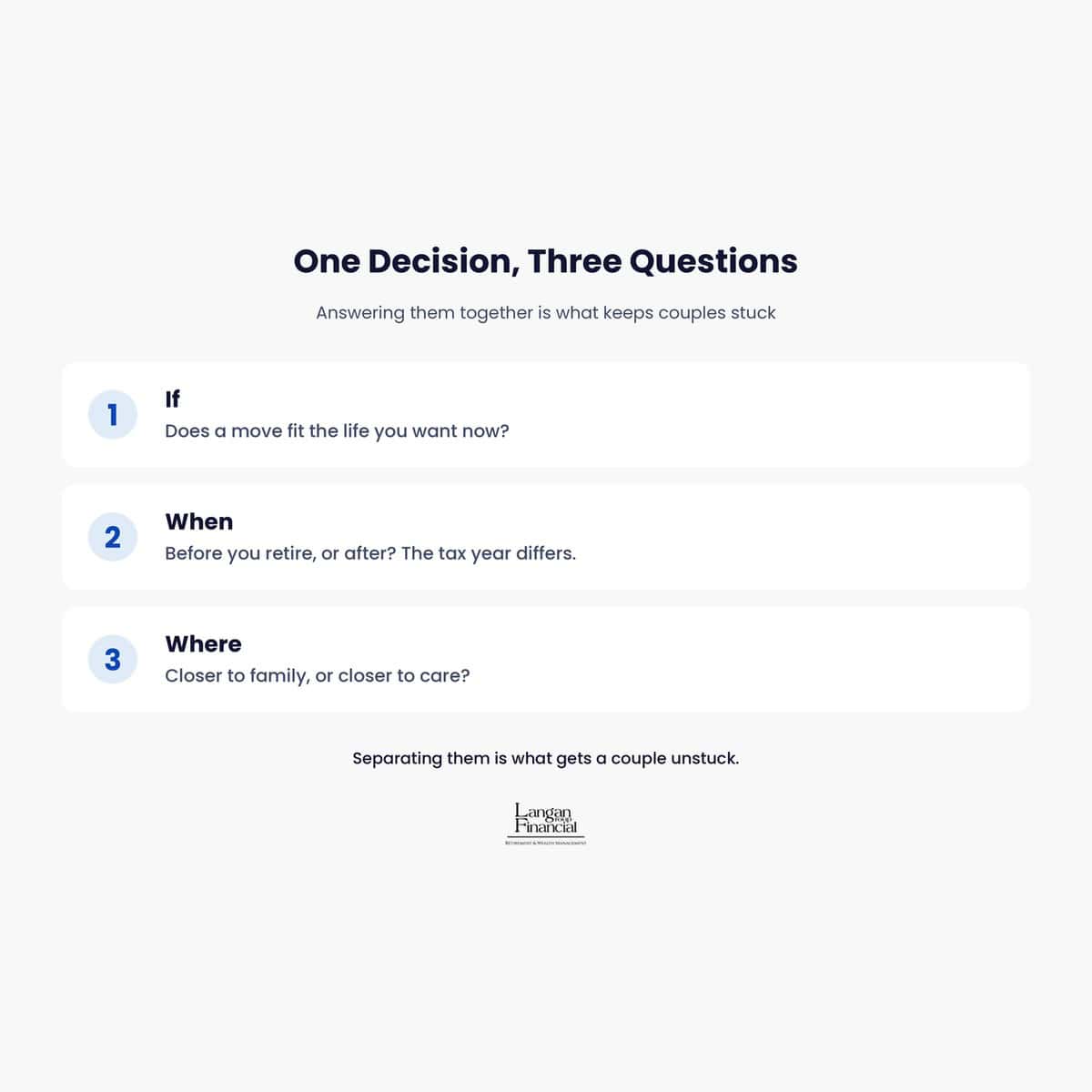
Downsizing feels like one question when it is really three.
Whether a move makes sense at all. When to do it. And where to go. Trying to answer all three at once is what keeps a couple circling.
Still working: if you are 50 or older, this is the window where downsizing before retirement offers the most options. Income to support a mortgage if you want one, time to prepare the house, and flexibility on the timing.
Already retired: the question is often more immediate. Upkeep, stairs, or a house that has quietly become larger than the life inside it.
Either way, the housing decision does not sit on its own. It runs through your retirement income plan, your taxes, and what you intend to leave behind.
Why the Downsizing Conversation Stalls
Picture the exchange. One person says the house is more than they want to keep up.
The other hears a proposal to leave the neighborhood, the church, and the people they have known for thirty years.
Neither has said what they actually mean, because the question was never separated. One was answering if. The other was answering where.
They are three different conversations, and they pull in different directions.
- If is about the house and how it fits your life now.
- When is about your income, your health, and the market.
- Where is about proximity to family, to care, and to what you would miss.
Most couples find they agree on one or two of them and disagree on exactly one. Naming which one is most of the work.
What People Plan, and What They Actually Do
Before going further, one finding is worth sitting with, because it complicates the whole picture.
Most people who intend to downsize do not end up in a smaller home.
A National Association of Realtors report looked at sellers aged 61 to 70 who sold a 2,000 square foot home between June 2024 and June 2025. The typical one bought another about the same size. Sellers aged 71 to 79 trimmed roughly 100 square feet, less than a compact parking space.
NAR’s research team notes that retirement age buyers often mention the intention of downsizing, but there is not much change in housing sizes as people age.
Why this matters for your plan: if part of your downsizing before retirement math assumes you will free up cash by moving to something smaller, that assumption is worth checking. Sometimes the smaller house in the better location costs more, not less.
The other half of the picture is that most people do not want to move at all.
A 2024 AARP report found that 75 percent of Americans aged 50 and over have a strong preference for staying in their current home as they age. Another 73 percent hope to remain in their communities.
None of that means a move is wrong. It means the case for downsizing before retirement should be built on your own numbers, not on an assumption about what downsizing generally does.
Question One: Does Downsizing Make Sense at All?
This one has nothing to do with numbers yet. Downsizing before retirement starts with a simpler question: does the house still fit?
What Usually Pulls People Toward Downsizing
- Rooms that go unused, or a yard that has become a chore
- Stairs, maintenance, or repairs you no longer want to manage
- Wanting to be closer to family, to medical care, or to a community you already know
- A large share of net worth sitting in a single asset
What Usually Holds People Here
- This is home, and that is a real thing to weigh
- Neighbors, routines, and a place that already works
- Moving is expensive and exhausting
The question worth writing down: if we never moved, what would we regret? And if we moved next year, what would we miss? Answer both before you look at a single number.
Question Two: When to Downsize Before Retirement
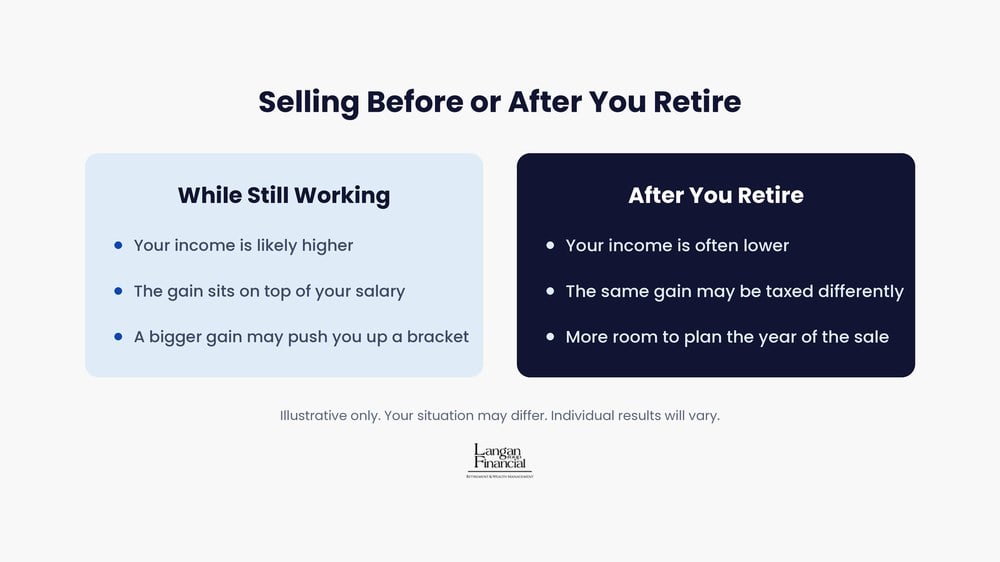
Timing is where the financial side of downsizing before retirement enters, and it is genuinely different depending on whether you are still working.
Still working: income is still coming in, which can make a mortgage or a bridge loan easier to carry. A gain above the exclusion also lands on top of your salary, which is worth knowing before you pick a year.
Already retired: your income picture is different, and you have more room to choose the year of a sale. That flexibility can matter if a sale would interact with other decisions you are already making.
Borrowing costs are part of this too, though probably less than you would expect. In mid-August, Freddie Mac put the 30 year fixed rate mortgage at 6.67 percent, against 6.58 percent a year earlier.
A full year of waiting moved the rate by less than a tenth of a point. If a move would mean carrying a mortgage, the rate matters. It is rarely the thing that settles the question.
This is where a move stops being a housing question and becomes a question about how your income holds up over time.
The tax side has its own rules, and they are more forgiving than most people expect. A single filer may exclude up to $250,000 of gain from a main home sale and a married couple up to $500,000 under the home sale exclusion, if they meet the tests.
Question Three: Where Would You Go?
This is the question people answer first and should probably answer last, because it is the one most loaded with feeling.
Same area or somewhere new. Closer to family or closer to care, which are not always the same place. A smaller house, a condo, or a community where help is available later if you need it.
There is more to look at than there was. Freddie Mac noted for sale inventory improving from the limited supply of recent years, with listing prices modestly below year ago levels.
Where couples usually differ: it is rarely the if. It is usually the when, or how far away. Naming which of the three you disagree on is most of the work, and it is often a ten minute conversation once the questions are separated.
The Other Side: What Staying Costs
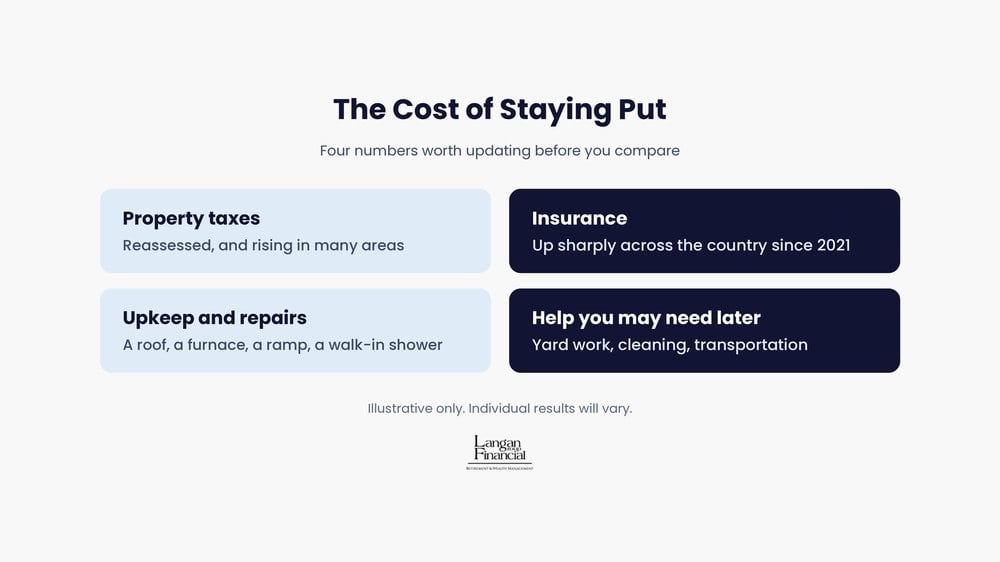
Downsizing has costs. So does staying, and that side rarely gets added up.
According to Insurify, the national average cost of home insurance has risen about 46 percent since 2021. Estimates from other industry sources vary, but they point the same direction.
The cost of staying is not fixed. A house you have owned for decades may cost meaningfully more to hold now than it did five years ago, and many households have not recalculated.
Still working: project the number forward to your retirement date. Insurance and taxes rarely move down.
Already retired: compare it to what you expected when you retired. For many households it has grown faster than the rest of the budget.
What a Move Actually Costs
Most people price the obvious part of downsizing before retirement: the commission, the repairs to get the house ready, and the movers. The list is longer than that, and the items people miss are rarely small.
One-Time Costs
- Real estate commission and closing costs on both ends
- Repairs and staging to get the current house ready to sell
- The move itself, which for a household of several decades is rarely a weekend job
- Remodeling the new place, particularly for single floor living, wider doorways, or a step-in shower
- Furniture that fits, since pieces sized for the old house often do not work in the new one
- Updating estate documents if you move to another state
Costs That Change With the Address
- Property tax rates, which can differ sharply between neighboring townships
- Homeowners insurance, which varies by state and by exposure to weather risk
- Association or community fees, which often replace some upkeep costs rather than adding to them
- Cost of living generally, including everything from groceries to utilities
- Travel, if the move puts distance between you and family you currently see often
Healthcare deserves its own line. Moving can mean new providers, and whether they are in network depends on your coverage. Confirm that with your plan before a move, not after.
If a move would take you to another state, the arithmetic gets more involved. Moving states in retirement brings its own set of costs, and a large share of people who move for tax reasons end up coming back.
The Part Nobody Puts on a Spreadsheet
There is a finding here that looks like a contradiction, and we would rather explain it than pick the half that suits an argument.
One 2024 survey of movers found that 70 percent reported some level of regret. Twenty-nine percent said they expected to be happier after relocating and were not.
A separate survey found that 75 percent of people who moved in the past year were pleased with the decision, and 73 percent said it was worth the inconvenience.
Both can be true, because they are measuring different things. Most people are glad they moved. Most also wish they had handled some part of it differently.
The regret is usually about the process, not the destination. Not budgeting realistically. Not starting to pack sooner. Underestimating what it would take out of them.
The Finding Worth Acting On
One pattern runs through this research consistently. People who moved by choice reported less stress and fewer regrets than people who moved out of necessity.
Choice usually meant a lifestyle reason or getting closer to family. Necessity usually meant money.
That has a direct planning implication for downsizing before retirement. The same move made three years early, while it is still a choice, tends to go better than the one made three years late. By then the stairs or the budget have already decided for you.
It is also the strongest argument we know for having this conversation before it becomes urgent.
A Calm Way to Approach Downsizing Before Retirement
The method that tends to work for downsizing before retirement is simple, and it is the reason we built a guide around it.
Each person answers the three questions separately, in writing, before any discussion. Then you compare.
Couples who do it this way often discover they agree on whether a move makes sense and disagree only on the year, or agree on the year and disagree on the distance. That is a much smaller problem than the one they thought they had.
It also works for someone thinking it through alone, and for a couple who agree on everything but have never picked a date.
Our free planning guide, Your Home in Retirement, is built around this method. Part one is the three questions, with no math. Part two is your numbers. Each person fills it out alone, then you compare.
Speak With an Advisor Today
We will run the real numbers with you: the sale side and the staying side together, how either would fit your income plan. We will also help you see which of the three questions is the one to settle first.
Or call 717-288-1880
A sale also touches what you intend to leave behind, so it is worth looking at alongside your estate and legacy plans.
If you would rather start by reading, our weekly retirement newsletter covers one planning question like this every Wednesday.
Common Questions About Downsizing Before Retirement
Is it better to downsize before or after you retire?
There is no single answer. Selling while you are still working means the gain lands on top of your salary, which can matter above the exclusion. Selling after you retire often means a different income picture and more room to choose the year. The right answer depends on your income, your health, and what you want the move to accomplish.
How much does it actually cost to move?
More than most people plan for. Real estate commission, repairs to get the house ready, the move itself, and furnishing a new place all add up. The honest comparison is that total against what the current house costs you every year to hold.
What if my spouse and I disagree?
That is the normal case, not the exception. Most couples find they agree on one or two of the three questions and disagree on exactly one. Writing your answers separately and then comparing tends to surface which one in about ten minutes.
Does downsizing always free up money?
Not always. A smaller house in a more expensive area can cost more to buy and more to hold. Property taxes, insurance, and any association fees can offset a lower purchase price. The comparison worth making is total annual cost, not square footage.
Do most people who downsize end up happy with the decision?
Most are glad they moved. Surveys also find that most have at least one regret, and those regrets are usually about the process rather than the destination: not budgeting realistically, not starting sooner, underestimating the effort. One consistent pattern is that people who moved by choice reported less stress than people who moved out of necessity.
We are in our early fifties. Is it too early to think about this?
No. The years before you stop working are when downsizing before retirement offers the most options: income to support a mortgage if you want one, time to prepare the house, and flexibility on timing. Thinking it through early is what creates choices later.
Sources
Freddie Mac, Primary Mortgage Market Survey, August 13, 2026
National Association of Realtors, Home Buyers and Sellers Generational Trends, 2026
AARP, Home and Community Preferences Survey, 2024
Insurify, home insurance premium trends, 2026
Anytime Estimate, 2025 Moving Trends survey, and HireAHelper moving and retirement studies, 2025 and 2026
Internal Revenue Service, Publication 523, Selling Your Home
About the Financial Author

Alexander Langan, J.D., is the Chief Investment Officer at Langan Financial Group. In this role, he manages investment portfolios, acts as a fiduciary for group retirement plans and consults with clients regarding their financial goals, risk tolerance and asset allocation.
With a focus on ERISA Law, Alex graduated cum laude from Widener Commonwealth Law School. He then clerked for the Supreme Court of Pennsylvania and worked in the Legal Office of the Pennsylvania Office of the Budget, where he assisted in directing and advising policy determinations on state and federal tax, administrative law, and contractual issues.
Alex is also passionate about giving back to the community and has helped establish The Foundation of Enhancing Communities’ Emerging Philanthropist Program, volunteers at his church, and serves as a board member of Samara: The Center of Individual & Family Growth. Outside of work and volunteering, Alex enjoys his time with his wife Sarah and their three children, Rory, Patrick, and Ava.
About Langan Financial Group
For everything you’ve built.
Your savings. Your business. Your family’s future. Each deserves thoughtful planning that starts with what matters to you.
Langan Financial Group provides financial planning and investment management for individuals, families, and business owners. With offices in Camp Hill and York, Pennsylvania, we serve clients throughout Central Pennsylvania.
We help you work through questions about retirement income, investment decisions, Social Security, and how taxes may affect your financial plan. Our approach starts with understanding your goals, your financial picture, and your comfort with investment risk. From there, we help you evaluate your options and develop a plan that can evolve as your life changes.
We also help businesses and organizations evaluate workplace retirement plans and understand their responsibilities as plan sponsors.
Disclosures
The information in this material is not intended as tax or legal advice. Please consult legal or tax professionals for specific information regarding your individual situation. The opinions expressed and material provided are for general information.