
A lot of people remember something about a tax break for older home sellers, and wonder how it relates to the home sale exclusion today. They are not imagining it.
There was a special rule. It let sellers age 55 or older exclude up to $125,000 of gain from the sale of a home, once in a lifetime. It has not existed since 1997.
What replaced it is broader, and for most households it is better. But it comes with conditions that the old rule did not have, and the limits have not moved in nearly three decades.
Still working: if a sale is somewhere on your horizon, this is worth understanding before you pick a year.
Already retired: if a move is closer than that, the same rules apply and the timing question is a little different.
The tax rules only matter once a sale is on the table. If you are still working out whether a move makes sense at all, downsizing before retirement is really three questions, and the tax one is not the first.
What Changed in 1997, and What Replaced It
The Taxpayer Relief Act of 1997 rewrote this part of the tax code and created the home sale exclusion we use today. It did not simply end the over-55 break. It replaced two separate provisions with one.
- The one-time exclusion of $125,000 for sellers age 55 and older
- A separate rollover that let you defer the gain if you bought another home
In their place came a single rule with no age requirement, a higher limit, and the ability to use it more than once. The change applies to sales after May 6, 1997.
Worth knowing: the new rule was more generous than the old age-based cap, but less generous than the uncapped rollover it also replaced. If you remember being able to defer an unlimited gain by buying another house, that is the provision that went away.
How the Home Sale Exclusion Works Now
Under current rules, a single filer may exclude up to $250,000 of gain from the sale of a main home. A married couple filing jointly may exclude up to $500,000, if they meet the ownership and use tests.
Those limits have not changed since 1997, and they are not adjusted for inflation. A house bought in the 1990s has had a long time to appreciate against a fixed cap.
The Tax Applies to Your Gain, Not the Sale Price
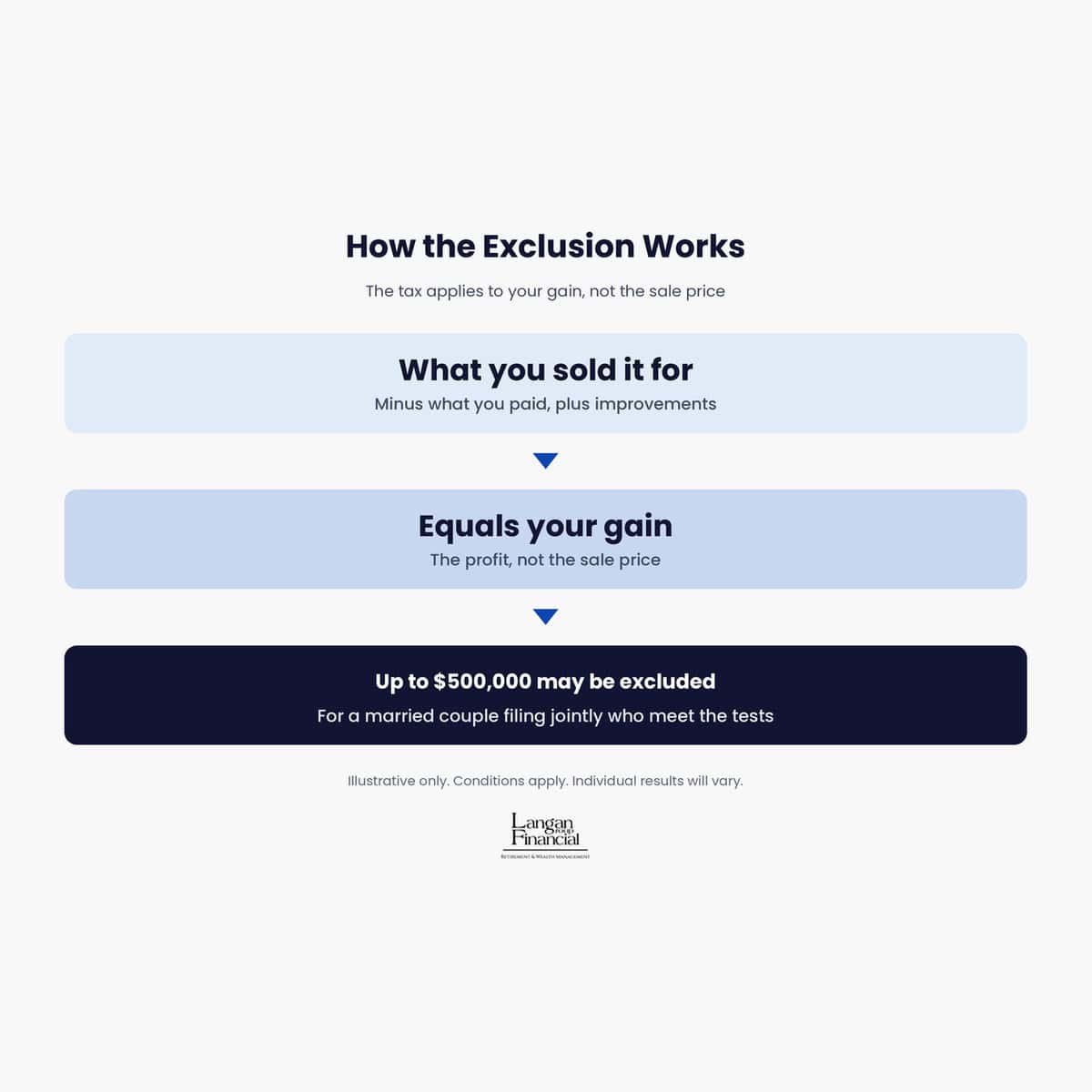
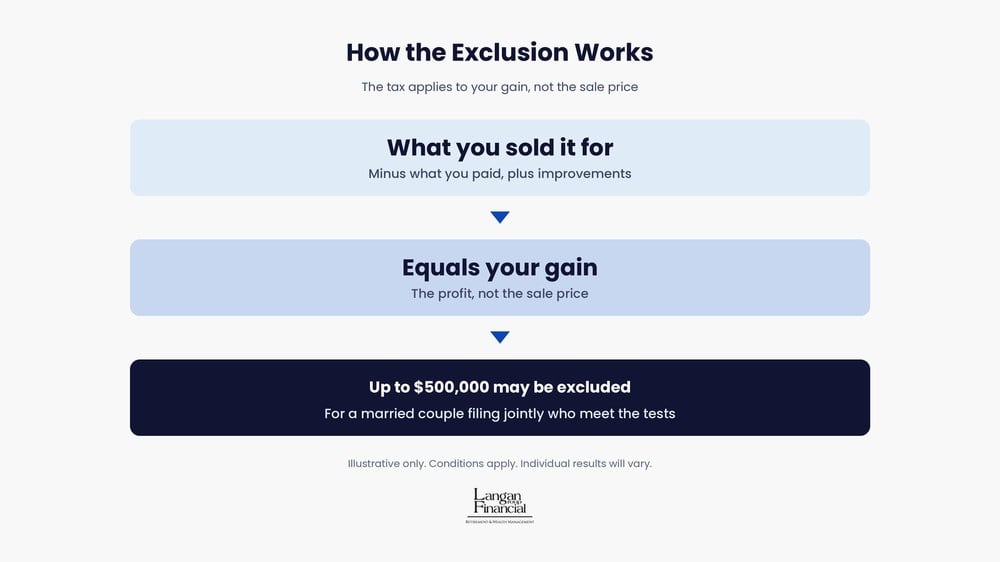
This is the point about the home sale exclusion that surprises people most. Selling a house for $700,000 does not mean $700,000 of taxable anything.
Your gain is roughly the sale price, minus selling costs, minus what you originally paid, minus the improvements you have made over the years.
Keep your improvement records. A new roof, an addition, a finished basement, a replaced HVAC system. Each of those may raise your basis, which lowers the gain. People who cannot document improvements often calculate a larger gain than they actually have.
The Tests Behind the Home Sale Exclusion
The home sale exclusion is not automatic. There are conditions, and they are worth knowing before you plan around the number.
- Ownership and use. In general you need to have owned the home and used it as your main home for at least two of the five years before the sale.
- Couples are treated differently on each test. Either spouse can meet the ownership test, but both must meet the use test.
- Frequency. The exclusion can generally be used once every two years.
There are exceptions and partial exclusions for people who fall short of the tests because of a work change, a health issue, or certain other unforeseen circumstances.
Selling Before or After You Stop Working
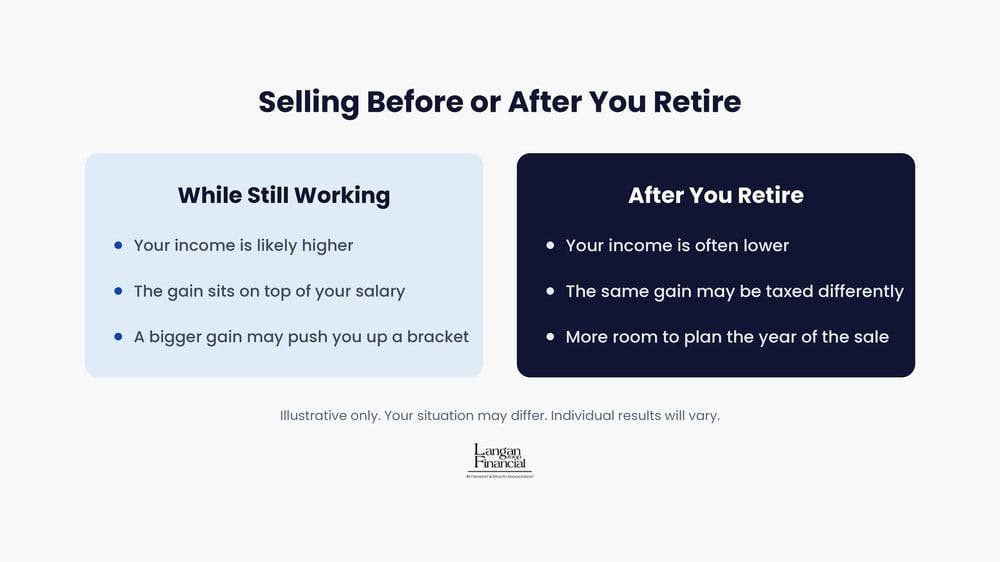
The home sale exclusion does not change based on whether you are employed. Your income picture does, and that is what makes timing worth thinking about.
Still working: a sale in a working year means any gain above the exclusion lands on top of your salary. If your gain is comfortably under the limit, this matters less.
Already retired: your income is often lower and more predictable, and you may have more room to choose which year a sale happens.
That flexibility can be worth something if the gain is large, or if a sale would interact with other decisions in the same year.
If the sale would also take you across a state line, the tax picture widens further. Moving states in retirement brings income tax, property tax, and insurance differences that can outweigh the one-time gain.
This is one of the reasons the when question in the downsizing decision is worth separating from the if and the where.
If you would rather start by reading, our weekly retirement newsletter covers one planning question like this every Wednesday.
If You Have Lost a Spouse
There are two provisions here that are easy to miss, and both can matter a great deal.
The Two-Year Window
A surviving spouse may be able to use the full $500,000 exclusion rather than the $250,000 single amount, if the sale happens within two years of the death and they have not remarried.
The Revaluation at Death
Separately, the share of a home that passed at a spouse’s death is generally revalued as of that date. In many cases that reduces the taxable gain substantially, and sometimes it eliminates it.
A home sale is rarely the only thing that changes after a death. It is worth looking at alongside your estate and legacy plans, and at whether the plan still works for one person.
For some widowed sellers, the exclusion question turns out to be moot. There may be little or no gain left to exclude. This is worth confirming with a tax professional before assuming a sale will produce a tax bill.
Working Out Your Own Home Sale Exclusion
The arithmetic behind the home sale exclusion is not complicated. Getting the inputs right is the part that takes effort. It also sits alongside the rest of your tax-efficient planning for the year.
- What you originally paid for the house
- Improvements you have made over the years, with records where possible
- What it might sell for today, minus selling costs
- The difference, which is your rough gain
- Your exclusion limit, based on filing status
If your rough gain sits comfortably below the limit, the tax question may be simpler than you expected. If it sits above, that is worth a conversation before you choose a year.
Our free planning guide, Your Home in Retirement, has a place to work through these numbers. Part two walks through what you paid, what the house may be worth, your rough gain, and the exclusion limit that applies to you.
Still working: run the numbers on what you expect at your retirement date. Even a rough estimate tells you which side of the limit you are likely on.
Already retired: run them on today’s values, and note which year a sale would land in relative to your other income.
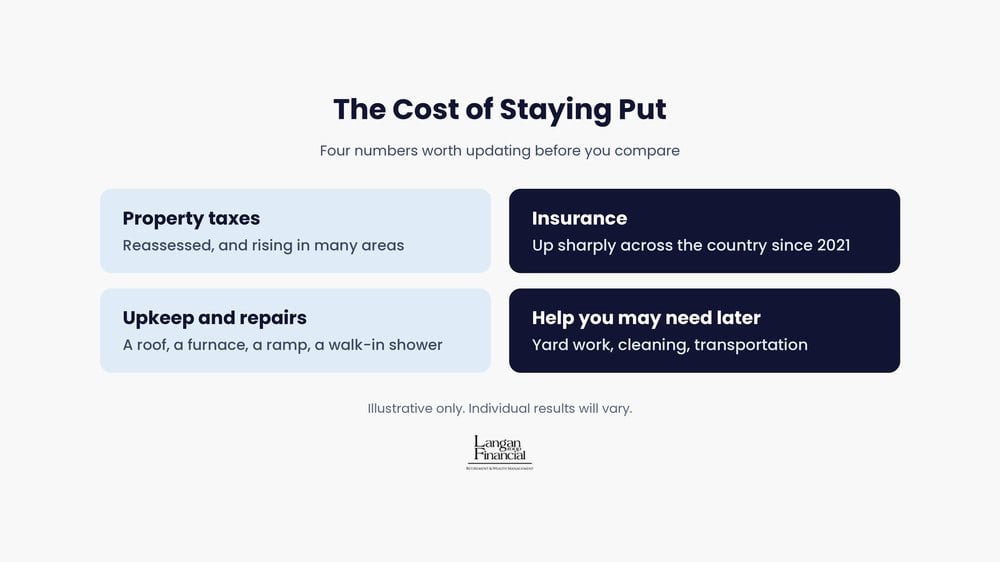
The other half of the picture is what the house costs you to keep. According to Insurify, the national average cost of home insurance has risen about 46 percent since 2021. Estimates from other industry sources vary, but they point the same direction.
Not Sure Which Side of the Limit You Are On?
Find out with a short conversation. We will work through them with you: the sale side and the cost of staying together, and how either would fit your income plan.
Or call 717-288-1880
Common Questions About the Home Sale Exclusion
Do people over 55 still get a special tax break when they sell a home?
Not a separate one. The old rule was a one-time exclusion of $125,000 available only to sellers age 55 or older. In 1997 it was replaced with a broader rule that has no age requirement at all, and the current limits are higher.
How much of a home sale is tax-free?
For most sellers who meet the conditions, up to $250,000 of gain is excluded when filing single and up to $500,000 when married filing jointly. Anything above that may be taxable. Because the limits are not indexed for inflation, a home owned for several decades can produce a gain that runs past them.
Is the tax based on the sale price?
No, and this is the most common misunderstanding. The tax applies to your gain. That is roughly the sale price, minus selling costs, minus what you paid, minus improvements over the years. A large sale price does not automatically mean a large tax bill.
What are the ownership and use tests?
Two tests, applied to the five years before a sale. You generally need two years of ownership and two years of living there as your main home. The periods do not have to line up. For couples the tests work differently from each other, and the exclusion is generally available no more than once every two years.
Does it matter whether I sell before or after I retire?
It can. A sale while you are still working means any gain above the exclusion lands on top of your salary. After you retire, your income picture is often different and you may have more room to choose the year. The right timing depends on your situation.
What if my spouse has died?
There is a provision worth knowing. A surviving spouse may be able to claim the full $500,000 home sale exclusion if the sale happens within two years of the death and they have not remarried. Separately, the share of the home that passed at death is generally revalued at that point, which can reduce or eliminate the taxable gain entirely.
Sources
Internal Revenue Service, Publication 523, Selling Your Home
Internal Revenue Service, Topic No. 701, Sale of Your Home
Taxpayer Relief Act of 1997, Public Law 105-34, amendments to Internal Revenue Code Section 121
Insurify, home insurance premium trends, 2026
About the Financial Author

Alexander Langan, J.D., is the Chief Investment Officer at Langan Financial Group. In this role, he manages investment portfolios, acts as a fiduciary for group retirement plans and consults with clients regarding their financial goals, risk tolerance and asset allocation.
With a focus on ERISA Law, Alex graduated cum laude from Widener Commonwealth Law School. He then clerked for the Supreme Court of Pennsylvania and worked in the Legal Office of the Pennsylvania Office of the Budget, where he assisted in directing and advising policy determinations on state and federal tax, administrative law, and contractual issues.
Alex is also passionate about giving back to the community and has helped establish The Foundation of Enhancing Communities’ Emerging Philanthropist Program, volunteers at his church, and serves as a board member of Samara: The Center of Individual & Family Growth. Outside of work and volunteering, Alex enjoys his time with his wife Sarah and their three children, Rory, Patrick, and Ava.
About Langan Financial Group
For everything you’ve built.
Your savings. Your business. Your family’s future. Each deserves thoughtful planning that starts with what matters to you.
Langan Financial Group provides financial planning and investment management for individuals, families, and business owners. With offices in Camp Hill and York, Pennsylvania, we serve clients throughout Central Pennsylvania.
We help you work through questions about retirement income, investment decisions, Social Security, and how taxes may affect your financial plan. Our approach starts with understanding your goals, your financial picture, and your comfort with investment risk. From there, we help you evaluate your options and develop a plan that can evolve as your life changes.
We also help businesses and organizations evaluate workplace retirement plans and understand their responsibilities as plan sponsors.
Disclosures
The information in this material is not intended as tax or legal advice. Please consult legal or tax professionals for specific information regarding your individual situation. The opinions expressed and material provided are for general information.