
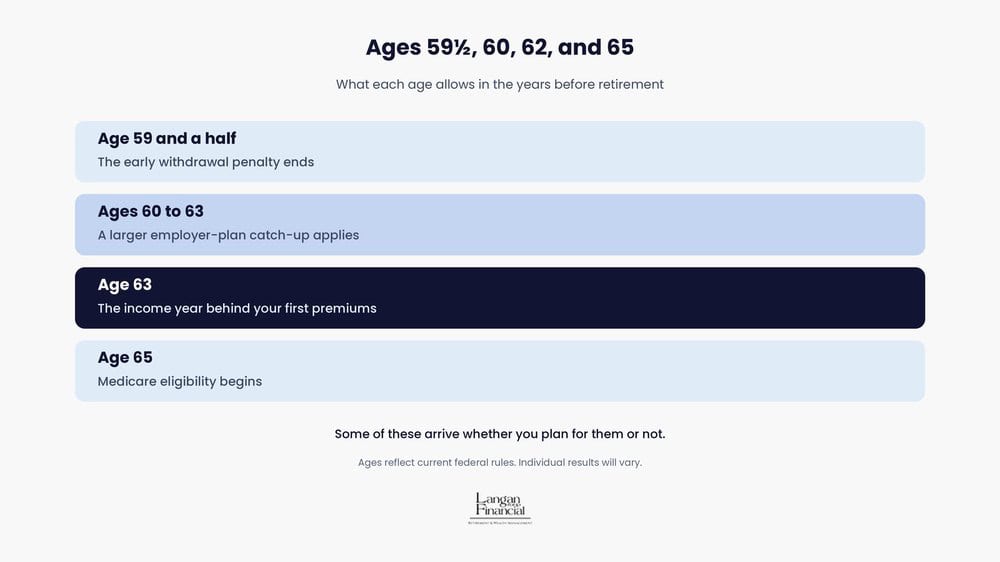
The five years before retirement feel like plenty of time, and for most of that stretch, they are.
But the five years before retirement contains several rules that take effect on their own schedule. A plan built around a single date can miss them entirely.
Still working: this is the stretch where the widest range of decisions is still open to you, and where the highest-earning years can fall.
Already retired: some of what follows has passed, but the appeal process and the withdrawal decisions are still live.
It also runs straight through your retirement income plan.
Age 59 and a Half: When the Early Withdrawal Penalty Ends
Withdrawals from most retirement accounts stop carrying the 10 percent early distribution penalty at 59 and a half. Ordinary income tax still applies.
This does not mean withdrawals become a good idea. It means one constraint lifts, which changes what is possible in the years before you claim Social Security.
For some households that opens a genuinely useful stretch. The years between stopping work and starting Social Security can be the lowest-income years of a lifetime, which is a different planning environment from either side of it.
For couples it is also worth asking whether the plan still works for one person, since the answer shapes how much flexibility those years really give you.
The five years before retirement is where that stretch gets designed, or where it gets missed.
Worth confirming: exceptions run in both directions, and the rules differ between employer plans and individual accounts. It is worth checking how they apply to your particular accounts rather than assuming.
Ages 60 Through 63: A Four-Year Window to Save More
A catch-up contribution is an extra amount you are allowed to put in above the standard limit. Anyone 50 or over can already use one.
Under the SECURE 2.0 Act, a 2022 retirement law, a larger catch-up amount applies to employer retirement plans for people aged 60 through 63.
It is one of the few genuinely new provisions in the five years before retirement, and it is recent enough that many people have not heard of it.
The specific amounts are set annually by the IRS and change most years, so the figure worth checking is the current one rather than any number you read a while ago.
What makes this window matter is timing. It falls in the years when earnings can be highest and mortgages are often paid off.
It is also short. Four years, and then it closes. Anyone who reaches 64 without using it has simply moved past it.
It is one of several shifts covered in what changes in the last five working years.
The Income Year Behind Your First Medicare Premiums
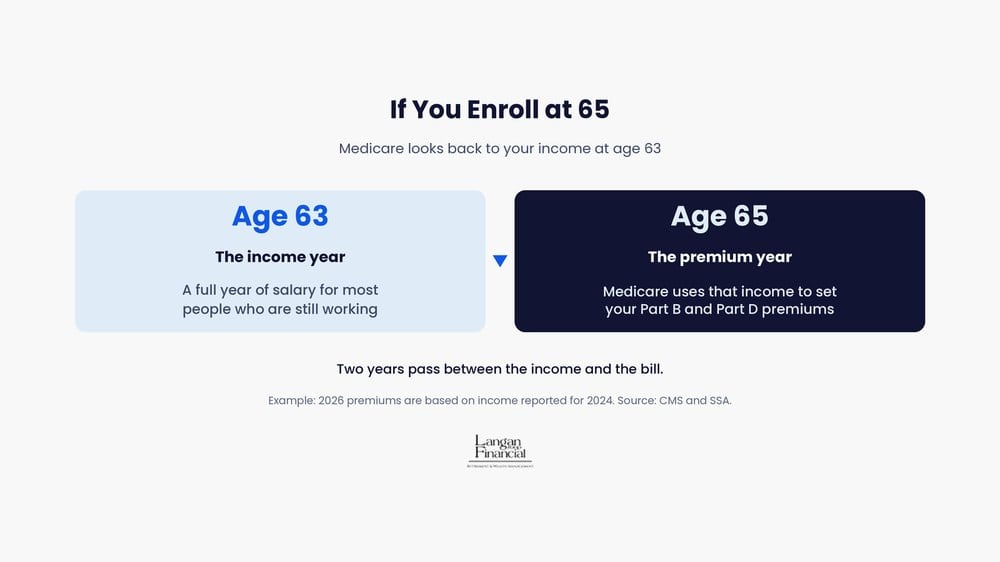
This is the part of the five years before retirement that catches people, because 63 is not a milestone in itself.
Medicare looks back two years from the year you enroll. Most people enroll at 65, when eligibility begins, which makes 63 the reference year. If you delay enrollment because you are still covered by an employer plan, the reference year moves with you: enroll at 67 and Medicare looks back to 65.
The two-year gap is the fixed part. The specific age depends on when you enroll.
Medicare Part B covers doctor visits and outpatient care. Part D covers prescription drugs. Both carry a monthly premium.
Medicare sets Part B and Part D premiums using income from two years earlier. Premiums in 2026 are based on income reported for 2024. Someone enrolling at 65 is priced on the year they turned 63.
For most people still working, that is a full year of salary.
Above certain income levels, Medicare adds a surcharge on top of the standard premium. It carries an acronym, IRMAA, for the income-related monthly adjustment amount. In plain terms, it is a higher Medicare premium for higher earners.
It applies per person, so a married couple above a threshold pays it twice.
Still working: knowing which calendar year that is changes what you might choose to do in it.
Already retired: if your income has dropped since then, the appeal route below exists for exactly that situation.
Why it belongs in a five-year plan: by the time the premium arrives, the income year is closed. The window to influence it is before it, not after.
One-time income counts. A large withdrawal, a property sale, or a Roth conversion in that year can raise a premium two years later, which is one reason the order you draw from accounts matters more near retirement than it did before.
Age 65: Medicare Eligibility Begins, and the Gap Before It
Medicare eligibility begins at 65. Enrollment is generally required unless you are already receiving Social Security, and the enrollment windows carry a lasting cost if missed.
The harder question is what happens if you stop working before then. Coverage between your last day and 65 is yours to arrange, through an employer plan, a spouse’s plan, COBRA, or the marketplace.
For a couple retiring at 62, that stretch can run three years.
Those same early retirement years carry their own market risk, which we covered in the years when a downturn hurts most.
It is one of the most common gaps we see in an otherwise sound plan. The savings number works, and the coverage number was never priced.
The fix is arithmetic rather than strategy. Price it, then decide whether the date still works. Most people find it does, once they know the figure.
Form SSA-44: Asking Medicare to Use a Newer Income Year
If your income has dropped since that year, there is a route worth knowing about.
Stopping work is a qualifying life-changing event. Form SSA-44 asks Social Security to use a more recent year’s income instead of the one on file.
A Roth conversion or a one-time capital gain does not qualify. Retirement, a marriage or divorce, the death of a spouse, and the loss of a pension generally do.
Savings, Timing, Account Mix, and Your Income Year
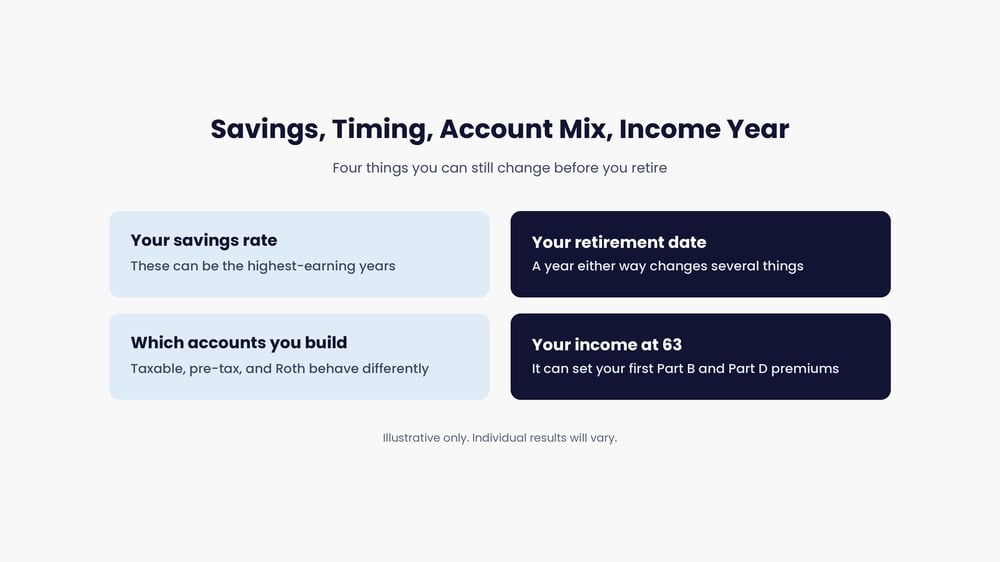
The reason to map the five years before retirement is not to feel behind. It is to see which levers are still in reach.
Still working: savings rate, retirement date, account mix, and the income in the year Medicare will look back to are all still open. So is the order your market returns arrive in, at least in how you prepare for it.
Already retired: withdrawal order is a live decision every year, and the appeal route above may apply if your income has dropped.
Our free readiness guide, What to Handle Before You Retire, walks through the dates and the numbers together, including the coverage gap if you plan to stop before 65.
Speak With an Advisor Today
We can put your dates side by side and work out which income year Medicare will price you on, so the decisions ahead are yours rather than the calendar’s.
Or call 717-288-1880
Common Questions About the Five Years Before Retirement
How many years before retirement should I start planning seriously?
There is no single answer, but five years is a useful marker. Several rules take effect inside that window. Age 59 and a half ends the early withdrawal penalty. Ages 60 through 63 allow a larger catch-up contribution. And the income year Medicare looks back to usually falls while you are still working.
What is the Medicare two-year lookback?
Medicare sets your Part B and Part D premiums using your income from two years earlier. Premiums in 2026 are based on income reported for 2024. For someone enrolling at 65, that means the year they turned 63 determines their first premium.
What happens at age 59 and a half?
Withdrawals from most retirement accounts stop carrying the 10 percent early distribution penalty. Ordinary income tax still applies, and there are exceptions in both directions, so it is worth confirming how the rules apply to your accounts.
Can I appeal a Medicare surcharge if I have retired?
Stopping work is a qualifying life-changing event. Form SSA-44 asks Social Security to use a more recent year of income instead. A Roth conversion or a one-time capital gain does not qualify.
Is five years enough time to make a difference?
For most of the decisions that matter, yes. Savings rate, retirement date, account mix, and the income in the year Medicare looks back to are all still open. What five years does not give you is room to fix all of them in the final months.
Sources
Centers for Medicare and Medicaid Services, 2026 Medicare Parts A and B Premiums and Deductibles
Social Security Administration, Medicare Premiums: Rules for Higher-Income Beneficiaries, and Form SSA-44
Internal Revenue Service, Retirement Topics: Catch-Up Contributions
SECURE 2.0 Act of 2022, Section 109
This article is provided for informational and educational purposes only and does not constitute investment advice, financial planning advice, tax advice, or legal advice. All investing involves risk, including potential loss of principal. Past performance is not a guarantee of future results. Individual results will vary based on specific financial circumstances. Tax rules referenced are current as of the date of publication and are subject to change. Please consult a qualified financial, tax, or legal professional before making any financial decisions. Securities offered through PKS Securities, Inc., a Broker-Dealer, Member FINRA/SIPC. Advisory services offered through Langan Financial Group, LLC, a Registered Investment Adviser. Registration does not imply a certain level of skill or training.