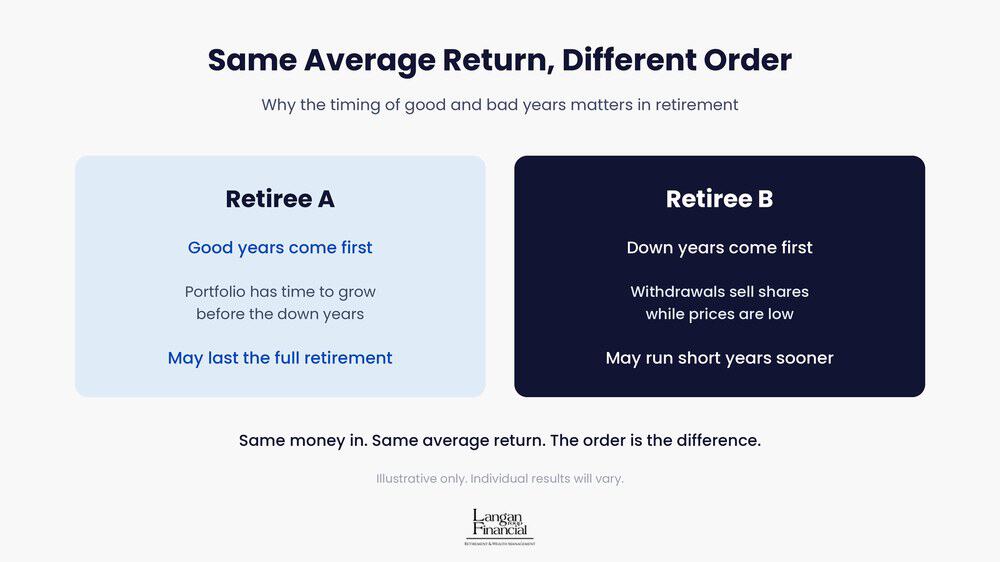
Two retirees with the same average return but different order of returns end up in different places.

How to Help Make Your Retirement Savings Last

Two retirees with the same average return but different order of returns end up in different places.

Sequence of returns risk is one of the least discussed forces in retirement, and one of the most powerful. You spent years saving. The balance grew. You may have even hit the number you were aiming for. So it can be surprising to learn what actually decides the outcome: two people with the same savings, the same withdrawals, and the same average return can still end up in very different places.

The difference is timing. Not the timing of when you buy or sell. It is the order in which good and bad market years arrive once you start living off your money. This idea has a name: sequence of returns risk. It rarely gets discussed, and there is a reason for that. Almost every number the industry publishes is an average, and an average is exactly what hides it.


What Sequence of Returns Risk Really Means

Here is the heart of it. While you are working and saving, a market drop can actually help you. Your regular contributions buy more shares at lower prices, and you have time to wait for a recovery. A down year is a paper loss.

How a market drop affects you differently while working versus in retirement.

Retirement flips that. Once you begin taking money out, a down year is no longer just on paper. To pay your bills, you may have to sell investments while prices are low. Those shares are then gone. They cannot take part in the recovery when the market climbs back.

The short version comes down to two very different situations:

Still working: a drop can be an opportunity, because you keep investing and buy at lower prices.

Already retired: a drop can be a setback, because you may be selling shares to cover living costs.

Coordinating your retirement income so you are not forced to sell at the wrong time is one of the quiet keys to making savings last. According to Charles Schwab, the order and timing of poor returns can have a large impact on how long your savings last. A drop in the early years of retirement can create problems that go well beyond the immediate hit to your balance.

Still working: if you are 50 or older, this is worth understanding now. The exposure grows as your balance grows and your working years shrink, and it peaks in the last five years before you stop.

Already retired: this is the window where sequence of returns risk matters most, because you are selling shares to fund living costs.

Why Average Returns Can Mislead You

Most people focus on one figure: the average annual return. It feels like the whole story. But for someone taking withdrawals, the average can hide a lot.

Hypothetical illustration: two retirees earn an identical average return over a long retirement. One gets the strong years early. The other gets the weak years first, and spends those years selling shares at low prices, leaving less behind to recover. Their averages match. Their outcomes may not. That is sequence of returns risk, and it is why the fragile decade around your retirement date deserves extra care.

Returns are only half of it. Rising prices push your withdrawals up at the very moment your savings are falling. That combination is what does the damage, and Bengen’s own paper follows one retiree straight through it.

What a Weak Start Did to One Retirement Plan

Illustrative example from published research: Bengen’s paper follows a hypothetical retiree through actual market returns and inflation from that era. She finished 1967 with just over $1 million. The decade behind her had been kind: the market returned 12.9 percent a year while inflation ran under 2 percent. She raised her yearly withdrawal to $40,000, a little under 4 percent of the balance. It looked comfortable.

Then came a weak 1969, followed by the bear market of 1973 and 1974. By the end of 1974 her fund had fallen to $777,000. Inflation did further damage. What remained could buy less than $500,000 of what she had held in 1967, less than half its value.

She had not chosen to spend a dollar more. But her withdrawal had been rising with inflation while her savings fell, so she was now drawing at a rate of about 8 percent a year. She had been taking just under 4 percent, and ended at roughly 8 percent without making a single new decision. That is sequence risk in one sentence.

Bengen’s figures assume a portfolio split evenly between large-company stocks and intermediate-term Treasury bonds, rebalanced each year, with withdrawals adjusted annually for inflation. Different assumptions produce different results, and individual results will vary.

Why Panic Selling Makes It Worse

Bengen also noted what tends to happen next. Panic, he wrote, may well grip such an investor, causing her to search for drastic remedies. Selling everything after a decline can turn a difficult stretch into a permanent one, because those shares are then absent for whatever recovery follows.

His data pointed the other way. Retirements that began in some of the worst years on record still recovered. He described that as a testament to the recovery power of the stock market, and to the need to avoid emotion when investing. The harder discipline is usually staying put when staying put feels worst.

Prudential’s research points the same direction. The returns a portfolio earns in the first decade of retirement are a key indicator of whether it can sustain someone through the whole of it.


The 4 Percent Rule and What the Research Says Now

For decades, the 4 percent rule was a common starting point. The idea was that you could withdraw 4 percent of your savings in the first year, then adjust that amount for inflation each year after. Done that way, the money had a good chance of lasting 30 years.

That rule is still a useful reference, but the research has moved:

  • Morningstar’s research for 2026 puts the figure at 3.9 percent for a portfolio holding 30 to 50 percent in stocks. This figure is built for a retiree who wants a steady inflation-adjusted amount each year. Note that the stock range is an assumption inside the research, not a suggested mix for you. That is a little below the old rule of thumb and a little above the 3.7 percent it estimated a year earlier.
  • That figure assumes a 90 percent chance of money remaining after a 30-year retirement, so it is built for someone just beginning retirement. Morningstar is clear that a retiree with a shorter horizon ahead can reasonably support a higher rate. Published research on time horizons shows how much that matters. Over roughly 20 years, the sustainable rate has been estimated as high as 5 to 5.5 percent. Stretching to 40 years pulls it down toward 3.5 percent.
  • William Bengen published the original research in 1994. He has since revised his own figure upward as he widened the range of assets in his analysis.

What the Disagreement Actually Tells You

Notice where those two respected sources landed against the original 4 percent. Morningstar came in below it. Bengen himself has moved above it. That disagreement is the lesson, not the arithmetic. The lesson is not to memorize a number. It is that a safe withdrawal rate depends on your situation, your mix of investments, and the markets you retire into. It is worth revisiting rather than setting once and forgetting, alongside tax-efficient investing, which changes how much of that number you actually keep.


Four Ways Families Work to Manage Sequence of Returns Risk

The good news is that sequence of returns risk is not a matter of luck alone. You cannot control the order of returns, but you can shape how ready your plan is for a weak stretch. Here are four common approaches.

Four ways to manage sequence of returns risk: a cash and bond cushion, flexible spending, a right-sized risk level, and coordinated income timing.

A Cushion of Steadier Assets

Holding one to a few years of spending in cash and bonds can mean you are not forced to sell stocks during a downturn. You spend from the steadier assets and give your stocks time to recover. Schwab describes a larger version of the same idea: about a year of expenses in cash, plus another three to five years in high-quality short-term bonds and cash equivalents. The right size depends on your own spending, your other income, and how much market movement you are comfortable with.

It also helps not to have everything riding on one thing. A mix spread across different types of investments means no single sector or corner of the market decides how your retirement goes.

One caution is worth stating plainly. Which account the money comes from matters less than what you sell inside it. Two accounts holding the same investments will sell the same shares. Moving a withdrawal from one to the other changes the tax treatment without changing the market risk.

Flexible Spending

A plan with some give in it can ease the pressure on your portfolio at the exact moment it matters most, which is the moment sequence of returns risk does its damage. That means trimming a little in weak years and enjoying more in strong ones.

A Right-Sized Risk Level

The investment mix that felt right in your forties may carry more sequence of returns risk than you want as you near retirement. Matching your risk level to your stage of life is a central part of thoughtful investment planning.

The opposite error is real too. A mix that turns too conservative can leave a retirement lasting 25 or 30 years short on the growth it needs to keep up with rising costs.

Still working: in your early fifties, your retirement date is far enough off to ride out a rough patch. The question is when to begin shifting, not whether.

Already retired: the same question applies in reverse. If your first years have gone well, it is worth asking whether your mix still matches where you are now.

Coordinated Income Timing

When your Social Security, withdrawals, and other income sources are timed to work together, you can lean on the right source at the right moment. That includes during a market dip. A larger Social Security check covers more of the bills, which is one less reason to sell anything in a weak year. That makes the timing of your Social Security claim a large part of the picture.

Wondering how your plan would handle a weak start?

A short, no-pressure conversation can help you see how ready your savings are for a rough first few years. We are happy to be a second set of eyes before any decisions become permanent.

Or call 717-288-1880


Common Questions About Sequence of Returns Risk

What is sequence of returns risk in simple terms?

Sequence of returns risk is the danger that weak market returns early in retirement can do lasting harm. You are taking money out at the same time, so your savings shrink in a way that is hard to recover from. The same weak returns later in retirement usually do far less damage.

Does this mean I should avoid stocks in retirement?

Not necessarily. Stocks have historically helped retirement savings keep pace with inflation over long periods. The goal is usually balance: enough growth to last, with enough stability to avoid selling everything at a bad time. The right mix depends on your situation, including how long the money needs to last and what you intend to leave behind through estate and legacy planning.

How do I know if my withdrawal rate is reasonable?

Divide the amount you plan to withdraw in a year by your total savings, then hold it next to the 3.9 percent starting figure above. If yours sits well above that, especially after a weak market, it may be worth a closer look with a professional. Remember that the 3.9 percent is built for someone just beginning a 30-year retirement, so a shorter horizon ahead can support a higher rate. The order you draw from your accounts can affect that number too.

Questions About Withdrawal Rates

Is the 4 percent rule still valid?

It remains a useful starting point, but it was only ever a rule of thumb, not a plan. Current research suggests a lower starting figure depending on conditions. Your own number depends on your mix of investments, your other income, and your goals.

What if my first retirement years have already been weak?

It is not too late to make adjustments. The levers are the same ones described above, and they still apply. That can mean rebuilding a cushion so you are not selling into further declines, or looking at whether any spending can flex for a while. It also means checking that your risk level still fits where you are now. What tends to cause lasting damage is selling everything and waiting for certainty. A conversation with a professional can help you sort out which adjustments actually fit your situation.


A Calm Way Forward

Running out of money is one of the most common worries in retirement. Sequence of returns risk explains why that worry is real, but it also points to a calm response. You cannot control the markets. You can help control how ready your plan is.

Would you like a second set of eyes on how your plan might handle a weak first few years? That is exactly the kind of review worth having before decisions become permanent. If you would rather start by reading, our weekly retirement newsletter covers one planning question like this every Wednesday. Start a conversation with our team whenever you are ready.


Sources

Charles Schwab, “Timing Matters: Understanding Sequence of Returns Risk,” Schwab Retirement Plan Services — workplace.schwab.com
Morningstar, The State of Retirement Income, 2026 base-case safe withdrawal rate research — morningstar.com
William P. Bengen, “Determining Withdrawal Rates Using Historical Data,” Journal of Financial Planning, October 1994.
William P. Bengen, revisions to his safe withdrawal estimate, including the 1997 Journal of Financial Planning follow-up and A Richer Retirement, 2025.
Prudential, The Retirement Red Zone — prudential.com
Michael Kitces, “Adjusting Safe Withdrawal Rates to the Retiree’s Time Horizon,” summarizing time-horizon research including Blanchett (2007) and Pfau (2012) — kitces.com


This article is provided for informational and educational purposes only and does not constitute investment, tax, or legal advice. It is not a recommendation to buy or sell any security or to adopt any investment strategy. Any examples are hypothetical and for illustration only. Individual results will vary. Past performance is not a guarantee of future results. Figures referenced are current as of the date of publication and are subject to change. Please consult a qualified professional about your specific situation.

Securities offered through Cambridge Investment Research, Inc., a Broker-Dealer, Member FINRA/SIPC. Advisory services through Cambridge Investment Research Advisors, Inc., a Registered Investment Adviser. Langan Financial Group and Cambridge are not affiliated.

Talk it through with an advisor

If you would like a second opinion on how this applies to your own plan, we are glad to walk through it with you.