
Most of a financial plan can be changed any week of the year. Health coverage is one of the few parts with a deadline attached.
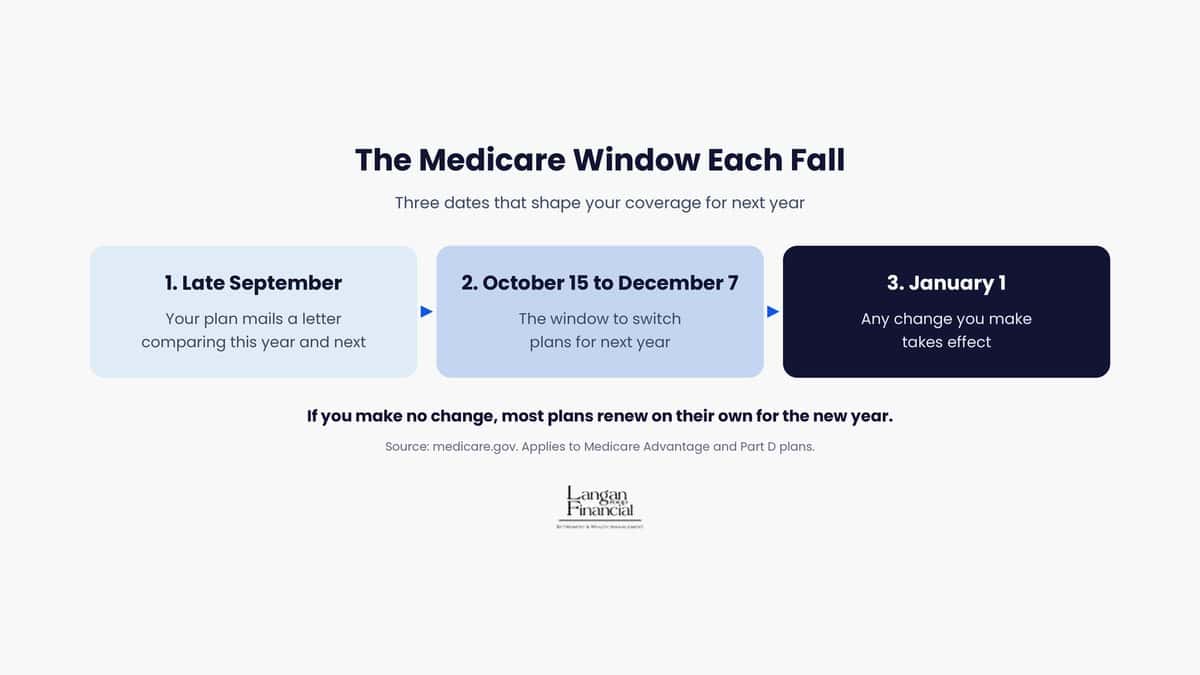
Medicare open enrollment runs from October 15 through December 7. Changes made in that window start on January 1. Outside it, the choices are mostly set until the next fall.
Still working: if you are not on Medicare yet, your employer likely has its own window with its own dates. The habit is the same, and it is covered in open enrollment before you retire.
Already on Medicare: the notice your plan mailed in late September is the place to start.
The Three Dates That Matter
There are only three, and the middle one is the window itself.
- Late September. Your plan mails an Annual Notice of Change. It compares your plan this year with the same plan next year. If you cannot find yours, your plan can send another copy, and you can also compare plans at medicare.gov or by calling 1-800-MEDICARE.
- October 15 through December 7. The window to switch Medicare Advantage or Part D plans, move between Original Medicare and Medicare Advantage, or add or drop drug coverage.
- January 1. Any change you make takes effect. Switching in October and switching in December have the same start date.
If you do nothing, most plans renew on their own for the new year, with whatever changes the notice described. Doing nothing can be the right answer for your situation. It is worth reaching on purpose rather than by letting the mail pile up.
Five Things Worth Checking in the Notice
The notice is not short, but five items carry most of the weight.
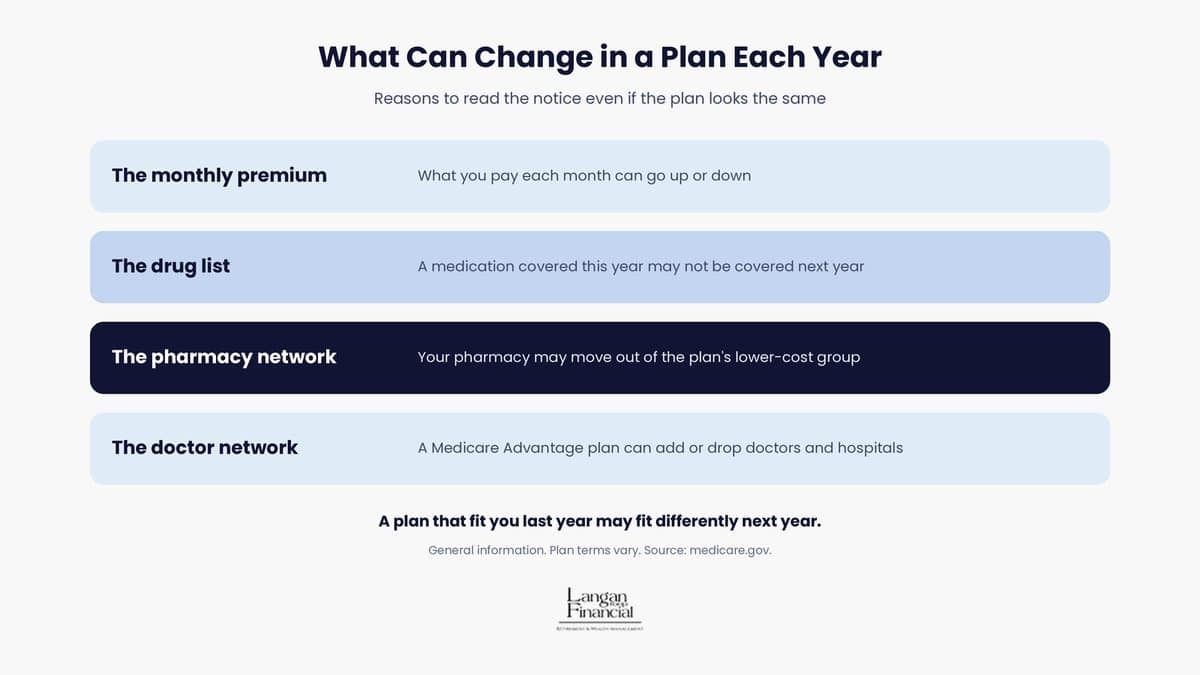
- The monthly premium. What you pay each month can go up or down. The notice shows both years.
- The drug list. Plans update their list of covered drugs, called a formulary, each year. A medication covered this year may not be covered next year, or may move to a tier that costs more.
- The pharmacy network. Your pharmacy may still be covered but no longer be a preferred one, which can change what you pay.
- The doctor network. A Medicare Advantage plan can add or drop doctors and hospitals. Original Medicare works differently, since it is not built on a network.
- The yearly deductible. The deductible is what you pay before the plan begins covering costs, and it can change as well. It is one of the costs worth weighing alongside the rest of your essential monthly spending.
A plan that fit you last year can fit differently next year without you changing a thing. The notice is the one place those changes appear before they take effect.
Two Costs Medicare Limits
Most of what you pay is set by your plan. Two Part D limits are set by Medicare, and they apply no matter which plan you choose.
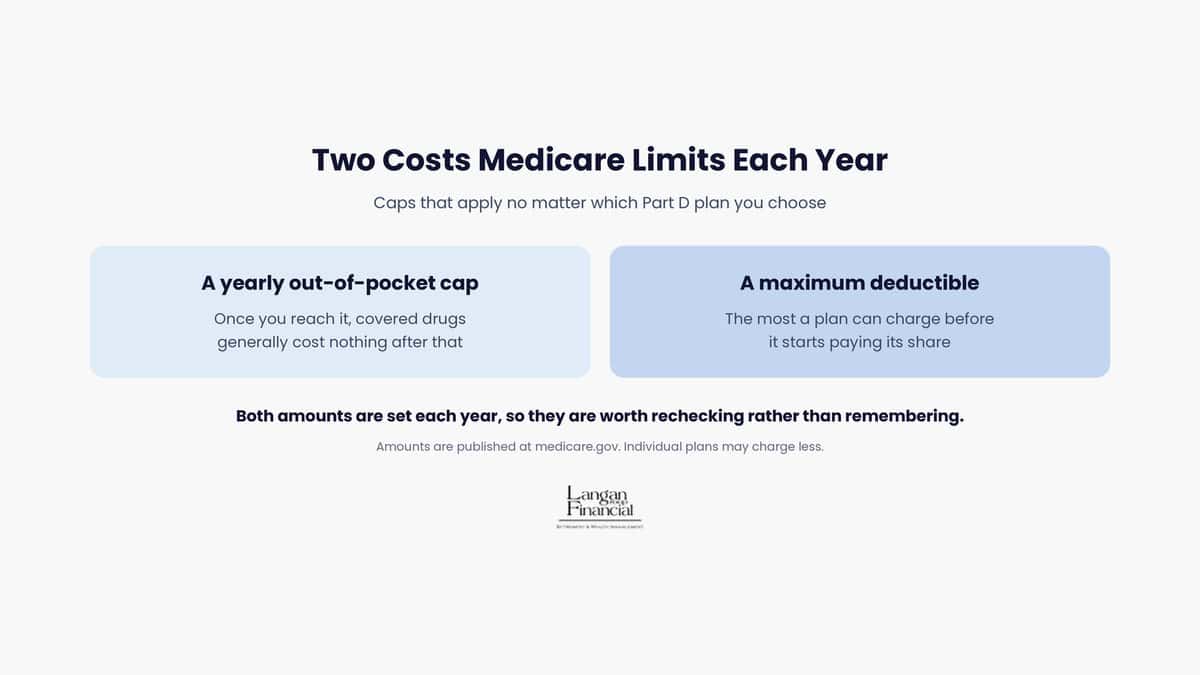
There is a yearly cap on what you pay out of pocket for covered Part D drugs. Once you reach it, covered drugs generally cost you nothing for the rest of that year. The amount is set each year, and it is one of the costs worth estimating during pre-retirement planning.
There is also a limit on the yearly deductible a Part D plan can charge, meaning the amount you pay before the plan starts paying its share. Plans may charge less than the limit, and some charge nothing at all.
Both limits change most years. Rather than remembering last year’s numbers, look up the current ones at medicare.gov or on the first pages of your notice, where your plan lists what it charges.
The cap counts what you pay out of pocket for covered drugs, meaning the deductible, copays, and coinsurance. It does not count your monthly premium, drugs your plan does not cover, or medications billed under Part B.
There is also a payment option worth knowing about. Every Part D plan is required to offer a program that spreads your out-of-pocket drug costs across the calendar year in monthly amounts, rather than charging them as they happen. It is called the Medicare Prescription Payment Plan. It does not reduce what you owe in total, and you have to opt in, but it can even out a large bill that would otherwise land in January.
Where Coverage Meets Your Income Plan
There is one place the coverage side and the money side touch.
Medicare bases your premium on the tax return from two years earlier. Above certain income levels, which Medicare sets each year, you pay a surcharge on Part B and Part D called the income-related monthly adjustment amount. A large withdrawal, a Roth conversion, or the sale of a property can raise a premium two years after you do it.
That does not make any of those decisions wrong. It means the timing belongs in the same conversation as how your withdrawals are taxed, not in a separate one.
Speak With an Advisor Today
We do not sell Medicare plans. We can talk through how a coverage decision fits your income, your taxes, and what you expect to spend.
Or call 717-288-1880
A Short Plan for the Next Few Weeks
- Find the notice your plan mailed and read it, including the pages that look unchanged.
- Write down your premium and deductible for this year and next.
- Check each medication you take against next year’s drug list.
- Confirm your doctors and your pharmacy are still in the plan.
- Compare other plans at medicare.gov or by calling 1-800-MEDICARE if anything has moved.
We send a planning question like this one each Wednesday in our retirement newsletter.
Our free checklist, Your Annual Enrollment Review, has a page for writing this year and next year side by side.
Common Questions About Medicare Open Enrollment
When is Medicare open enrollment?
Medicare open enrollment runs from October 15 through December 7 each year. Changes made during that window take effect on January 1 of the following year.
What can I change during Medicare open enrollment?
You can switch Medicare Advantage plans, switch Part D drug plans, move from Original Medicare to a Medicare Advantage plan or back, and add or drop drug coverage.
What happens if I do nothing during open enrollment?
Most plans renew on their own for the new year, along with whatever changes were described in the notice your plan mailed in the fall. Doing nothing is a choice, and it can be a reasonable one.
What is an Annual Notice of Change?
It is the letter your Medicare plan mails in late September. It compares your plan this year with the same plan next year, including the premium, the deductible, the covered drug list, and the network.
Is there a limit on what Part D drugs can cost me in a year?
Yes. Medicare sets a yearly cap on what you pay out of pocket for covered Part D drugs, and once you reach it, covered drugs generally cost nothing for the rest of that year. Medicare also limits the yearly deductible a plan can charge. Both amounts are set each year and published at medicare.gov, and individual plans may charge less.
Is there another chance to change Medicare coverage after December 7?
There is a second window from January 1 through March 31 for people already in a Medicare Advantage plan. During that window you can switch to another Medicare Advantage plan or return to Original Medicare.
Sources
Centers for Medicare and Medicaid Services, Joining a Plan and Open Enrollment
Centers for Medicare and Medicaid Services, Medicare Costs, updated each year
Internal Revenue Service, Publication 969, Health Savings Accounts and Other Tax-Favored Health Plans
This article is provided for informational and educational purposes only and does not constitute investment advice, financial planning advice, tax advice, legal advice, or insurance advice. Langan Financial Group does not sell Medicare plans and is not connected with or endorsed by the federal government or the Medicare program. All investing involves risk, including potential loss of principal. Past performance is not a guarantee of future results. Individual results will vary based on specific financial circumstances. Medicare rules, premiums, deductibles, plan terms, and enrollment dates are set by law and by each plan, and can change. Figures shown are those published for the years named. Please consult a qualified financial, tax, or legal professional, and medicare.gov or 1-800-MEDICARE for coverage questions, before making decisions. Securities offered through PKS Securities, Inc., a Broker-Dealer, Member FINRA/SIPC. Advisory services offered through Langan Financial Group, LLC, a Registered Investment Adviser. Registration does not imply a certain level of skill or training.