

Why the Answers May Be Simpler Than You Think
People spend years choosing funds. They compare fee structures. They study Roth conversion math. They worry about trust language and beneficiary forms.
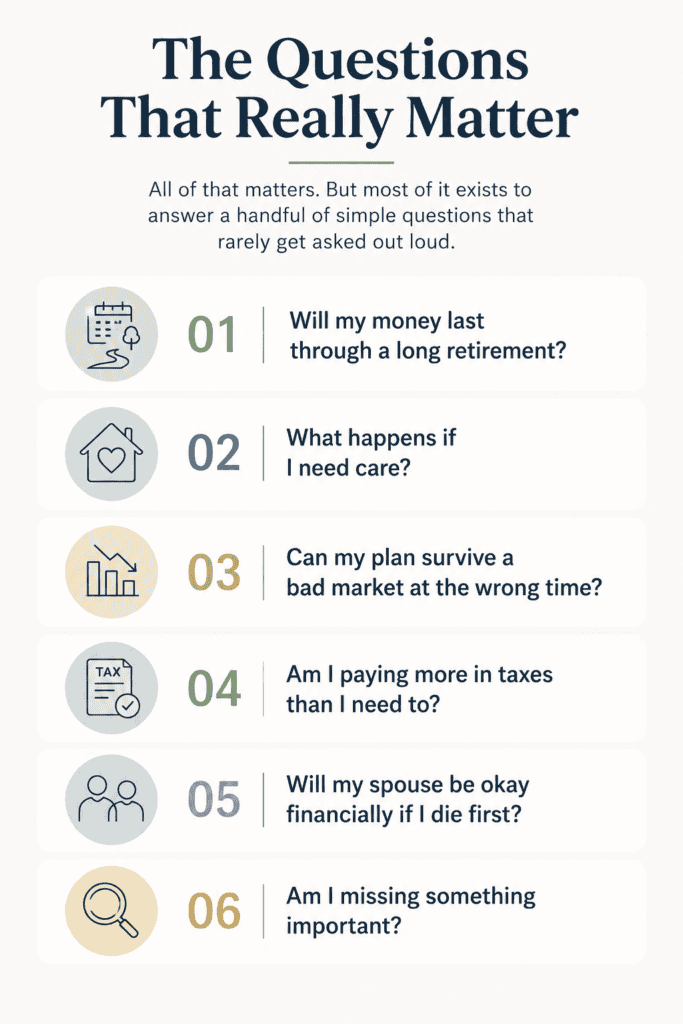
All of that matters. But most of it exists to answer a handful of simple questions that rarely get asked out loud:
- Will my money last through a long retirement?
- What happens if I need care?
- Can my plan survive a bad market at the wrong time?
- Am I paying more in taxes than I need to?
- Will my spouse be okay financially if I die first?
- Am I missing something important?
These are the questions that keep people up at night. Not the fund lineup. Not the expense ratio. The real fears sit underneath the complexity. And most planning conversations never quite reach them.
Why These Fears Persist Even When the Numbers Look Fine
Here is something worth knowing. These fears are not signs that something is wrong with you. They are predictable patterns that show up in nearly every retiree and pre-retiree, regardless of wealth.
Behavioral economists Daniel Kahneman and Amos Tversky showed that losing money feels about twice as painful as gaining the same amount feels good. This is called loss aversion. It is not a flaw. It is how our brains are wired.
That wiring served humans well for thousands of years. When the threat was a predator, reacting fast kept you alive. But in retirement planning, the same instinct creates problems. It makes people sell investments at the worst time. It makes market drops feel permanent. It makes the fear of a bad outcome feel larger than its actual likelihood.
The researchers who study this, including Richard Thaler, Tali Sharot, and three decades of DALBAR data, all point to the same conclusion. Naming these patterns reduces their power. When you understand why a fear feels so urgent, you can separate the feeling from the decision.
That is what the next six sections are designed to do.
Fear 1: Will My Money Last?
The real question: Does my income plan work for 25 to 30 years, including inflation, healthcare costs, and the unexpected?
Why it sticks: Loss aversion. The fear of running out feels far heavier than the comfort of having enough. Kahneman’s research explains why. Losses loom larger than gains in our mental math. Even households with strong savings often carry this fear because the consequences of being wrong feel permanent.
The common misconception: Most people expect to spend less as they age. Research from the Employee Benefit Research Institute tells a different story. Healthcare spending often rises sharply after 75, offsetting the drop in travel and lifestyle costs.
But here is a genuinely surprising finding. David Blanchett at Morningstar has documented that many retirees actually underspend. The fear of running out is so persistent that people deprive themselves of spending their plan could support. They die with far more than they intended to leave behind, having skipped trips, experiences, and generosity they could have afforded.
The goal of good planning is not just security. It is permission to live the life the plan was built for.
If you are in your 50s: This is the decade where small adjustments make the biggest difference. Increasing savings by even 2 to 3 percent of income, or delaying retirement by one year, can shift a 25-year projection meaningfully.
If you are 60 to 65: The question shifts from “am I saving enough” to “how do I turn savings into income?” The transition from accumulation to distribution is the most consequential planning decision most people face.
If you are 65 or older: The focus is withdrawal rate and sequence. William Bengen’s research and the Trinity Study suggest that a sustainable rate depends on your specific mix of income sources, not a single rule of thumb.
Signal to look for: Your income projection has been tested at ages 85, 90, and 95, and it holds for both spouses individually, not just as a couple.
Fear 2: What Happens if I Need Care?
The real question: If one of us needs care for three or more years, does the plan survive without dismantling everything else?
Why it sticks: Optimism bias. Tali Sharot’s research shows something striking. Most people correctly estimate that roughly 70 percent of those over 65 will need some form of long-term care. But they dramatically underestimate that it will happen to them. “I know the statistics. I probably will not need it.” That gap between knowing and believing is a documented cognitive pattern.
The common misconception: Most people believe Medicare covers long-term care. It does not cover custodial care, which is the type most people actually need. Custodial care includes help with daily activities like bathing, dressing, and eating. That cost falls entirely outside Medicare.
The Genworth Cost of Care Survey tracks these numbers annually. In Pennsylvania, a private room in a nursing facility can range from approximately $10,000 to over $15,000 per month depending on location and level of care. Home health aide costs add another layer. A three-year care event without a plan behind it can reshape an entire household’s financial future.
Ask yourself this. If your spouse needed full-time care starting tomorrow, do you know exactly which assets would pay for it, for how long, and what would be left for the other spouse? If the answer is not specific, it is not a plan yet.
Signal to look for: You have a specific, written answer for how three or more years of care would be funded, and you know how it affects the non-caregiving spouse’s income and lifestyle.
Fear 3: What if the Market Drops at the Wrong Time?
The real question: Is my plan built for uncertainty, or does it depend on calm markets?
Why it sticks: Myopic loss aversion. The more often you check your portfolio, the more emotionally costly the experience. Not because losses happen more often than gains. Markets actually have slightly more up days than down. But because the pain of a loss day feels roughly twice as intense as the pleasure of an equivalent gain day. DALBAR has tracked the cost of this pattern for over 30 years. The average equity investor consistently earns significantly less than their own investments, because they react at the wrong moment.
The common misconception: “Staying invested always wins.” Over long periods, yes. But Michael Kitces and Wade Pfau have documented that the sequence of returns, meaning when losses happen relative to when you start withdrawing, can matter as much as the overall rate of return. A 20 percent decline in year two of retirement is far more damaging than the same decline in year twelve.
This is why an income floor matters. If your essential expenses are covered by sources that do not require selling investments, such as Social Security, a pension, or a bond ladder, then a market decline becomes uncomfortable but not catastrophic. The pressure to react disappears.
Signal to look for: You can identify a specific income floor that covers essential expenses for at least two years without requiring any investment withdrawals.
Fear 4: Am I Paying More in Taxes Than I Should?
The real question: Is my plan tax-coordinated across all income sources, or just tax-deferred?
Why it sticks: Anchoring bias. Most people anchor on their working-years tax rate. They expect retirement to be cheaper. For many households, it is not. Required minimum distributions starting at 73, Social Security taxation above modest thresholds, and Medicare IRMAA surcharges can combine to create effective rates that rival or exceed working years. The anchor creates genuine shock when the first full year of retirement taxes arrives.
The common misconception: “I will be in a lower bracket when I retire.” That may be true for some. But for households with pensions, Social Security, and growing RMDs, the bracket compression can be minimal. And IRMAA adds a layer most people never see coming. One dollar over the threshold triggers the full surcharge.
The difference between tax-deferred and tax-coordinated is significant. Tax-deferred means you postponed the bill. Tax-coordinated means someone has looked at the timing, sequencing, and interaction of every income source through age 80 or beyond, including how each one affects the others.
Signal to look for: You have a tax projection that runs through age 80 and covers Social Security, RMDs, and Medicare premiums together, not in separate conversations.
Fear 5: Will My Spouse Be Okay if I Am Gone?
The real question: Does my plan protect the surviving spouse’s income, tax situation, and healthcare costs, or does it only work while both of us are alive?
Why it sticks: Status quo bias. Couples build a plan that works for two. They rarely revisit what happens when one person is no longer there. The assumption that “things will be fine” goes unchallenged because examining it is emotionally difficult.
The common misconception: Most couples believe the survivor will be financially secure. In reality, three things often happen at once. Social Security income drops by one benefit at the first death. Many pension options reduce or stop for the survivor. And the remaining spouse often moves into a higher tax bracket as a single filer. These changes can happen within the same year.
Hypothetical Scenario: For Illustration Only
Consider a couple with combined Social Security of $4,800 per month. The higher earner receives $2,900 and the lower earner receives $1,900. If the higher earner dies first, the survivor keeps the larger benefit and loses the smaller one. Monthly income drops by approximately $1,900. At the same time, the survivor files taxes as a single filer, which may push the same income into a higher bracket. Medicare premiums may also increase based on the new filing status. None of these changes require a mistake. They happen automatically. The question is whether someone has planned for them in advance.
This is a hypothetical illustration. Actual amounts depend on individual circumstances, benefit elections, and tax law at the time of the event.
If you are in your 50s or early 60s: Pension elections and Social Security claiming decisions made now can permanently shape the survivor’s income decades from now. These are often one-time, irreversible choices.
If you are 65 or older: Review what actually changes at the first death. Not in general terms. In specific dollar amounts. What income stays, what goes, and what new costs appear.
Signal to look for: You have discussed what happens to income, taxes, and Medicare premiums at the first death, and the survivor scenario has been projected with specific numbers.
Fear 6: Am I Missing Something I Have Not Thought Of?
The real question: Has anyone looked at the whole picture, not just the portfolio?
Why it sticks: This is the inverse of the Dunning-Kruger effect. The more someone understands about retirement complexity, the more they realize how many areas they have not yet addressed. Competent, experienced people tend to overestimate what they do not know. The meta-fear of “I must be missing something” is itself a product of intellectual honesty, not ignorance.
The common misconception: “My plan from a few years ago still fits.” Beneficiary designations, pension elections, tax law, Medicare thresholds, and income structures all shift over time. A plan set three years ago may not reflect today’s reality. It is not that the original plan was wrong. It is that the landscape moved.
Survey data bears this out. The Janus Henderson 2025 Investor Survey found that a significant share of investors express uncertainty about whether their plan addresses all of their major retirement concerns. The worry is rarely about what they have planned for. It is about what they may not have thought to plan for yet.
Vanguard’s Advisor’s Alpha research estimates that working with an advisor may add approximately 3 percent in net returns annually. The largest component of that value does not come from investment selection. It comes from behavioral coaching and coordination, making sure the pieces of a plan work together and that decisions are made in context rather than isolation.
Signal to look for: You have had a planning conversation in the last 12 months that covered all six of these areas together, not in separate meetings or with separate advisors.
One More Thing Worth Knowing
These six fears do not operate independently. A long-term care event amplifies the running-out-of-money fear. A bad market year activates the missing-something fear. The survivor scenario intersects with every other fear at the worst possible moment. When none of these areas have a specific plan behind them, a single life event can trigger several at once. That is why the order of operations matters. You address them before they interact, not after.
The Goal Is Not to Worry More Carefully
The purpose of naming these fears is not to add to the anxiety. It is the opposite.
When you understand why a fear persists, you can separate the feeling from the fact. When you know the real question underneath the complexity, you can check whether it has been answered. And when each of these six areas has a specific plan behind it, something changes.
You earn the right to stop worrying about them.
That is what good planning actually delivers. Not a guarantee that nothing will go wrong. A structure that holds when something does.
The next article in this series provides a 30-minute checkpoint you can do this weekend to score yourself on all six areas. Green, yellow, or red. No advisor needed for the assessment itself. Just honest answers.
But if you finish that checkpoint and find two or more areas marked yellow or red, that is worth a conversation before summer.
Not Sure Where You Stand on These Six Areas?
A complimentary conversation can help identify which areas may need attention, and which ones are already covered.Schedule a Complimentary Conversation
Sources cited in this article: Kahneman, D. and Tversky, A. (1979), Prospect Theory; Thaler, R. (1999), Mental Accounting Matters; Sharot, T. (2011), The Optimism Bias; DALBAR Quantitative Analysis of Investor Behavior, 2025; Bengen, W. (1994), Determining Withdrawal Rates Using Historical Data; Trinity Study (Cooley, Hubbard, Walz, 1998); Kitces, M. and Pfau, W., research on sequence of returns risk; Genworth/CareScout Cost of Care Survey (annual; figures cited reflect 2024 Pennsylvania data); Janus Henderson 2025 Investor Survey; Morningstar Mind the Gap Report, 2025; Vanguard Advisor’s Alpha, 2019 update; Employee Benefit Research Institute, retirement spending research; Blanchett, D. (Morningstar), research on retiree underspending patterns.
This article is for educational purposes only and should not be considered investment, tax, or legal advice. All investing involves risk, including the potential loss of principal. Past performance does not guarantee future results. Individual circumstances vary. Consult with a qualified professional before making any financial decisions.
The hypothetical scenario presented is for illustration only. It does not represent any actual client situation. Actual outcomes depend on individual circumstances, benefit elections, and applicable tax law.
No Fields Found.