
RETIREMENT
By Alex Langan, JD, Chief Investment Officer
Langan Financial Group · 9 min read
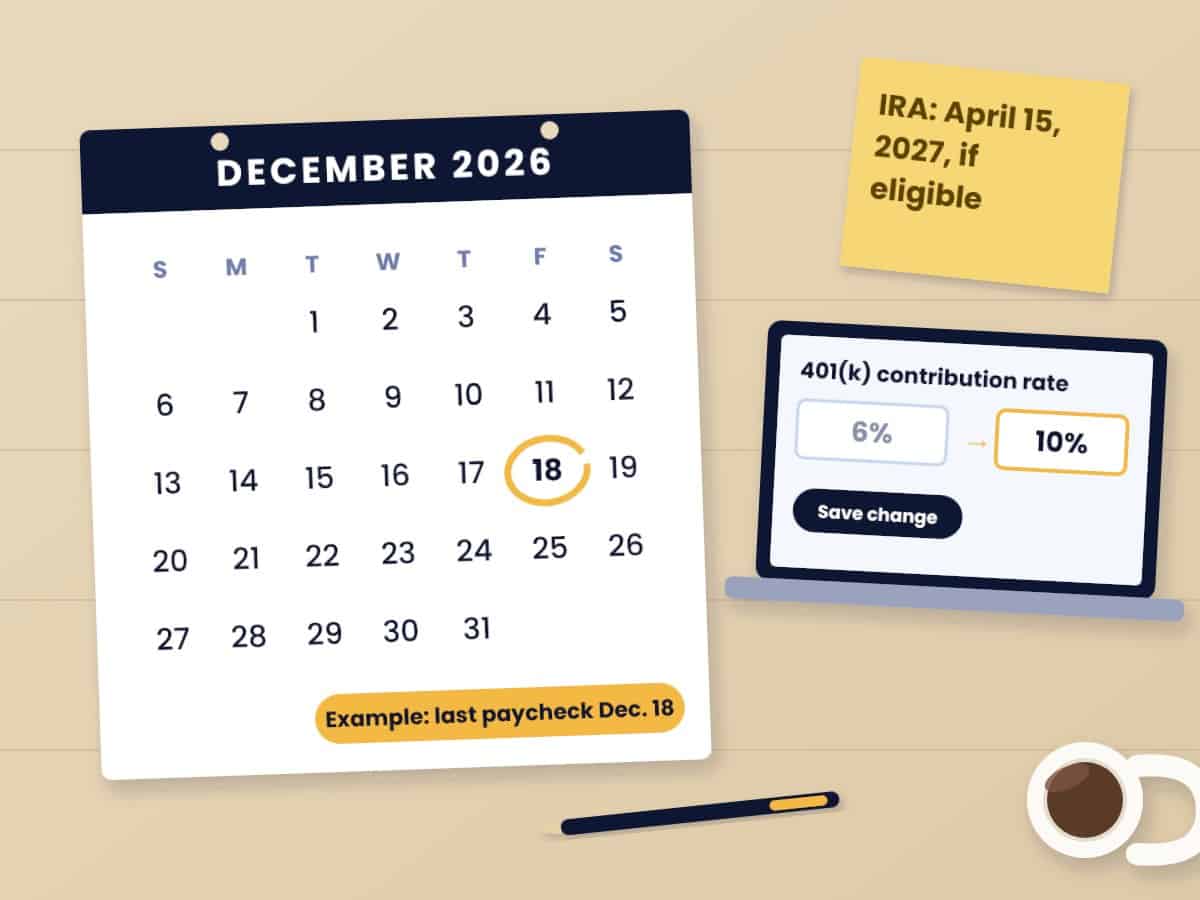
Year-end retirement contributions run on two calendars. 401(k), 403(b), and 457(b) contributions come out of your pay, so your last 2026 paycheck is generally the deadline. For eligible savers, 2026 IRA and HSA contributions can generally wait until the April 15, 2027 tax filing deadline.
So if you’re still working, here’s the one thing to do now: check your contribution rate before your last paychecks. Other items, such as RMDs, inherited IRA withdrawals, and Roth conversions, have December 31 deadlines, as the timeline below shows.
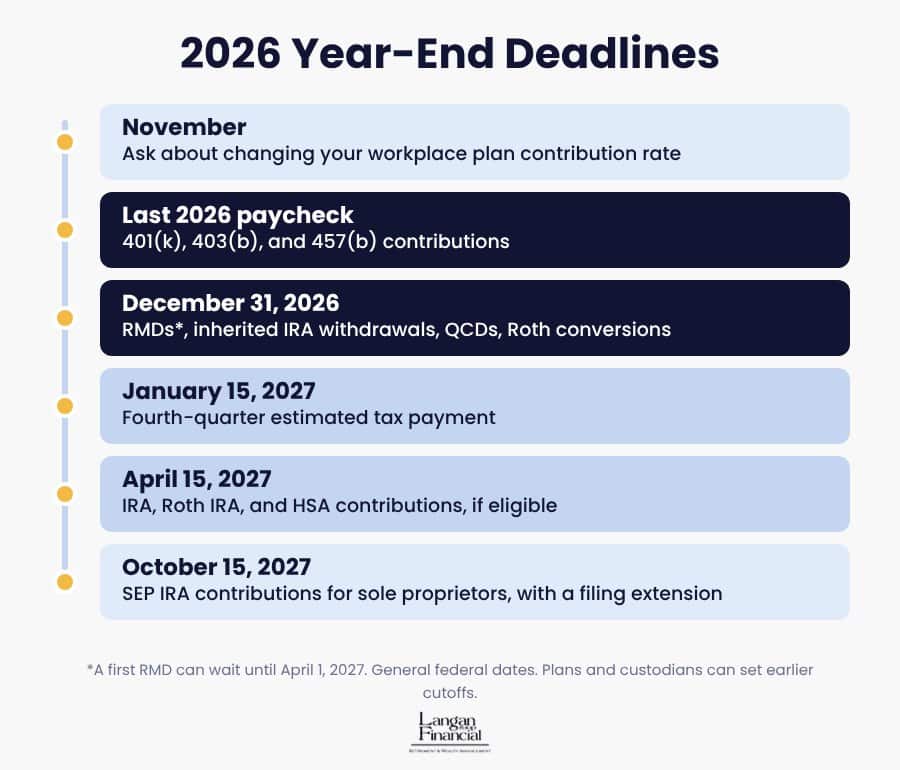
Let’s walk through it with Tom and Amy, the made-up couple from our year-end retirement checklist. Tom is 74 and retired. Amy is 62, works part-time, and has a 401(k). Amy’s deadline comes first. Tom’s options run through April, and they depend on Amy’s paycheck.
When Is the 401(k) Contribution Deadline for 2026?
Your employer sends 401(k) contributions out of each paycheck, and to count for 2026, a contribution generally has to come out of pay you receive in 2026. So if Amy wants to put more in this year, she needs to change her contribution rate before her final paychecks. Plans set their own processing dates for changes, so asking in November leaves room.
What Are the 2026 Contribution Limits?
At 62, Amy is in the 60-through-63 window, which allows a higher catch-up if her plan offers it. Here are the 2026 numbers:
| Account | 2026 limit | Catch-up | Deadline |
|---|---|---|---|
| 401(k), 403(b), 457(b) | $24,500 | Up to $8,000 more at 50 or older. Up to $11,250 instead at 60 through 63, if your plan allows it. | Your last 2026 paycheck |
| IRA and Roth IRA | $7,500 | $1,100 more at 50 or older | April 15, 2027, if eligible |
| Health savings account | $4,400 self-only, $8,750 family | $1,000 more at 55 or older | April 15, 2027, if eligible |
Source: IRS. See Sources below. The HSA limits assume a qualifying high-deductible health plan.
Each catch-up has its own starting age: 50 for workplace plans and IRAs, and 55 for HSAs. The $24,500 limit applies per person across your 401(k) and 403(b) plans combined. A 457(b) plan has its own separate limit, so someone with both a 403(b) and a 457(b) can generally contribute the full amount to each.
Does the Roth Catch-Up Rule Apply to You?
Check this before you change a catch-up amount. Starting in 2026, if your prior-year Social Security wages from your employer were more than $150,000 (box 3 of your 2025 Form W-2), your catch-up contributions to that employer’s plan generally have to be Roth contributions, made with after-tax dollars. If the plan doesn’t offer a Roth option, you generally can’t make catch-up contributions there. Workers with no Social Security wages from that employer, such as some government employees, aren’t covered by the rule.
Amy earned well under $150,000 at her part-time job last year, so the rule doesn’t affect her. We covered it in retirement rule changes in 2026.
What Can Wait Until April 15, 2027?
If you’re eligible, IRA, Roth IRA, and HSA contributions for 2026 can be made until the filing deadline. April gives you something December doesn’t: a look at your full-year income before you choose between traditional and Roth, and before the income limits come into play.
2026 IRA Income Limits
Income matters in two ways. Roth IRA contributions phase out at higher incomes. And the deduction for a traditional IRA contribution phases out if you or your spouse are covered by a workplace plan. Both use modified adjusted gross income, a figure based on the adjusted gross income on your tax return.
| Rule | Single filers | Joint filers |
|---|---|---|
| Roth IRA contribution phases out | $153,000 to $168,000 | $242,000 to $252,000 |
| Traditional IRA deduction phases out, when the contributing spouse has a workplace plan | $81,000 to $91,000 | $129,000 to $149,000 |
| Traditional IRA deduction phases out, when you aren’t covered but your spouse is | Not applicable | $242,000 to $252,000 |
For Tom and Amy, the rows split. Amy is covered by her 401(k), so the deduction for her own IRA phases out between $129,000 and $149,000. Tom isn’t covered by a workplace plan, so the deduction for his IRA phases out between $242,000 and $252,000. A couple can lose the deduction on one IRA and keep it on the other.
Above the deduction ranges, you can still make a nondeductible traditional IRA contribution and track it on IRS Form 8606. Above the Roth range, you can’t contribute directly to a Roth IRA for that year.
Can You Contribute to an IRA After You Retire?
Yes, at any age, as long as you or your spouse have earned income. Traditional IRA contributions have had no age limit since 2020. Tom has no earned income, but a spousal IRA can still work for him. Amy’s pay can support contributions for both of them if they file jointly and her taxable compensation is at least the total they put into IRAs.
One tradeoff for Tom: at 74, he can already give to charity through QCDs, and he may want to in future years. Deductible traditional IRA contributions made after 70½ reduce how much of a later QCD can be left out of income. Roth IRA contributions aren’t deductible, so they don’t trigger that reduction. If QCDs are likely in Tom’s future, a Roth contribution sidesteps the problem.
Retiring in 2026? Your Last Day Sets a Deadline
Workplace plan contributions come out of the pay you receive while you work there, so once you leave, you generally stop adding to that employer’s plan. Some plans let you contribute from a final bonus or a payout of unused vacation, and others don’t, so ask before your last day. An IRA contribution for 2026 is still possible after you retire if you had earned income in 2026.
Can You Contribute to an HSA After Medicare Starts?
Not for the months you’re enrolled. HSA eligibility ends with the first month of Medicare coverage. If you sign up for Medicare after 65, Part A coverage can begin up to six months before the month you apply (but not before you were first eligible), and HSA contributions for those months can become excess contributions. That’s why it’s worth stopping HSA contributions up to six months before you apply. In your enrollment year, the HSA limit is generally prorated for the months you were eligible.
Tom is on Medicare, so HSA contributions are off the table for him. For couples who are both eligible, the $8,750 family limit is shared, and each spouse 55 or older who wants the $1,000 catch-up needs to put it in his or her own HSA. Medicare timing is covered in what to review during Medicare open enrollment.
Self-Employed? SEP IRAs and Solo 401(k)s
A SEP IRA allows contributions of up to 25% of compensation, up to $72,000 for 2026. For a sole proprietor, that works out to about 20% of net self-employment earnings after subtracting half of self-employment tax, and SEP contributions can generally be made until your filing deadline, including extensions. A solo 401(k) adds 2026 employee contributions of up to $24,500, plus catch-ups, and its setup and funding deadlines can differ from a SEP’s.
A Note for Pennsylvania Residents
Most of the tax savings described in this article are federal. Pennsylvania treats contributions differently: what you put into an employer plan is still taxable compensation for state income tax, and Pennsylvania doesn’t let you deduct IRA contributions. HSA contributions are the exception, since Pennsylvania generally allows a deduction for them up to the federal limits. The flip side is that Pennsylvania generally doesn’t tax IRA distributions at 59½ or older, or employer-plan payments once you qualify for retirement and retire. So for a Pennsylvania household, the traditional-versus-Roth choice is mostly a federal decision.
How Tom and Amy Put It Together
Hypothetical example: Amy earns about $40,000 a year and has been putting 6% of her pay into her 401(k). In November, she raises it to 10% for her last few paychecks and confirms that rate still earns her plan’s full employer match, money she wouldn’t otherwise receive, subject to the plan’s vesting schedule. Her 2026 contributions come to about $2,700, which leaves about $37,000 of taxable pay, enough to cover IRA contributions of up to $8,600 each for both of them. One catch: 401(k) contributions reduce the taxable pay that supports their IRAs, so a bigger 401(k) contribution leaves less room for IRAs.
In April, with full-year numbers in hand, they decide on the IRAs. For Tom, they choose a spousal Roth IRA, because a Roth contribution won’t shrink the tax-free part of his future QCDs. Their joint income comes in well under $129,000, so Amy’s traditional IRA contribution is fully deductible even though she’s covered by her 401(k). (The numbers are made up. Your own figures decide what fits.)
Our free Year-End Retirement Checklist lists each deadline in one place. These are the standard rules. Traditional contributions can lower federal taxes now, and Roth contributions can lower taxes later. We compare the two in how Roth account rules have changed. Your plan and your tax picture decide what fits, so it’s worth reviewing with your tax professional.
Common Questions
When is the 401(k) contribution deadline for 2026?
Generally your last 2026 paycheck. Workplace plan contributions come out of your pay, so to count for 2026, they need to come out of pay you receive in 2026. Plans set their own deadlines for changing your contribution rate, so it’s worth asking early.
What are the 2026 401(k) contribution limits?
The 2026 401(k) limit is $24,500 per person. At 50 or older, you can add an $8,000 catch-up, for $32,500 in total. At 60 through 63, the catch-up is $11,250 instead, for $35,750, if your plan allows it. The limit is shared across your 401(k) and 403(b) plans.
When is the IRA contribution deadline for 2026?
April 15, 2027, the federal tax filing deadline. If you’re eligible, you can make a 2026 IRA or Roth IRA contribution until then, up to $7,500, plus a $1,100 catch-up if you’re 50 or older. That gives you time to see your full-year income before choosing traditional or Roth.
Can I contribute to an IRA after I retire?
Yes, at any age, as long as you or your spouse have earned income such as wages. Traditional IRAs have had no age limit since 2020. A spouse without earned income may be able to contribute through a spousal IRA on a joint return, based on the working spouse’s taxable compensation.
What is the new Roth catch-up rule?
Starting in 2026, if your prior-year Social Security wages from an employer were over $150,000, your catch-up contributions to that employer’s plan generally have to be Roth contributions. If the plan has no Roth option, you generally can’t make catch-up contributions there.
Can I contribute to an HSA after I enroll in Medicare?
No, not for months you’re enrolled in Medicare. If you apply after 65, Part A can start up to six months before the month you apply (but not before you were first eligible), which can turn recent HSA contributions into excess contributions. In your enrollment year, the limit is generally prorated. Get The Confident Retirement Brief each Wednesday. Subscribe to the newsletter. If you’d like to talk through how these deadlines fit into your broader financial plan, we’re glad to help, working alongside your tax professional. Schedule a consultation.
Sources
- Internal Revenue Service, Notice 2025-67 (2026 limits)
- Internal Revenue Service, Revenue Procedure 2025-19 (2026 HSA limits)
- Internal Revenue Service, Retirement topics: Catch-up contributions
- Federal Register, Catch-Up Contributions, final regulations (September 16, 2025)
- Internal Revenue Service, Publication 590-A, Contributions to Individual Retirement Arrangements
- Internal Revenue Service, Publication 590-B (qualified charitable distributions)
- Internal Revenue Service, Instructions for Form 8606
- Internal Revenue Service, Publication 969, Health Savings Accounts
- Social Security Administration, When to sign up for Medicare
- Internal Revenue Service, Publication 560, Retirement Plans for Small Business
- Pennsylvania Department of Revenue, 2025 PA-40 Instructions
- Pennsylvania Department of Revenue, Personal Income Tax Guide: Deductions and Credits (HSA contributions)
This article is provided for informational and educational purposes only and does not constitute investment advice, financial planning advice, tax advice, legal advice, or insurance advice. Langan Financial Group does not sell Medicare plans and is not connected with or endorsed by the federal government or the Medicare program. All investing involves risk, including potential loss of principal. Past performance is not a guarantee of future results. Individual results will vary based on specific financial circumstances. Medicare rules, premiums, deductibles, plan terms, and enrollment dates are set by law and by each plan, and can change. Figures shown are those published for the years named. Please consult a qualified financial, tax, or legal professional, and medicare.gov or 1-800-MEDICARE for coverage questions, before making decisions. Securities offered through PKS Securities, Inc., a Broker-Dealer, Member FINRA/SIPC. Advisory services offered through Langan Financial Group, LLC, a Registered Investment Adviser. Langan Financial Group, LLC and PKS Securities, Inc. are separate entities. Registration does not imply a certain level of skill or training. Langan Financial Group does not prepare or file tax returns. Tax consequences should be reviewed with your tax professional. Tax rules and figures are current as of November 2026 and can change. Hypothetical examples are for illustration only and do not represent any specific investment or client. The examples in this article do not include projected returns or hypothetical performance.
Alex Langan is a licensed attorney. Langan Financial Group is not a law firm, and neither the firm nor Mr. Langan provides legal services to clients. No attorney-client relationship is created by this article.
STILL HAVE QUESTIONS?
See How These Decisions Fit Together in Your Own Plan
A twenty-minute conversation can help you understand your options.
Or call 717-288-1880