
The paperwork usually shows up within a few weeks of your last day. A packet from the plan, a letter from a company you have never heard of, and a phone number to call if you have questions.
For many families, the account described in that packet holds the largest sum of money they have ever controlled directly.
And the decision about what to do with it often gets made in about two weeks, during one of the busiest stretches of a person’s life. In most cases, no rule requires you to decide that quickly. The pressure comes from the envelope, not from the law.
So before we get to what you can do with the money, start with what kind of account you are actually holding. That answer shapes everything that follows, and for two plan types it changes the options entirely.
First, Which Kind of Plan Do You Have?
Most articles on this subject assume you have a 401(k), and for most private-sector workers that is correct. But a large share of households have something else entirely.
Public sector employers, school districts, health systems, and nonprofits use different plan types. If you worked for any of them, the rules below may look unfamiliar, and a few of them matter a great deal.
The Most Common Workplace Plans
401(k). The plan most private companies offer. You choose how much comes out of each paycheck, and the employer may add a match. How the money is taxed depends on whether you contribute pre-tax or Roth, which is covered below.
403(b). The version used by school districts, hospitals, universities, and nonprofits. Day to day it works much like a 401(k). The difference tends to show up in older accounts, some of which sit inside annuity contracts rather than ordinary investment funds.
Thrift Savings Plan. The federal government’s plan, covering civilian federal employees and the military. Costs are typically very low, which is worth weighing before moving money out of it.
Plans Common in Government, Education, and Healthcare
401(a). A defined contribution plan used by state and local governments, public universities, and some nonprofits. Contributions are often set by the employer rather than by you, and participation may be mandatory. These are generally eligible to roll into an IRA or another employer plan.
457(b), governmental. Deferred compensation offered by state and local government employers. Widely used across state agencies, counties, townships, and school districts. These carry one feature no other plan has, covered in its own section below.
457(b), non-governmental. The same section of the tax code, but offered by tax-exempt employers such as nonprofit hospitals and charities. Despite the identical name, this plan follows very different rules. The money legally remains the employer’s asset until it is paid out.
457(f). A separate arrangement used by tax-exempt employers for a small group of executives and highly compensated staff. Amounts generally become taxable once they are no longer subject to a substantial risk of forfeiture, which often means a set date or a service milestone.
Two Plans That Generally Cannot Be Rolled Over
This is the detail most often gotten wrong, including by professionals. According to the IRS, distributions from a non-governmental 457(b) and from a 457(f) are not eligible for rollover to an IRA.
An attempted rollover is treated as an excess contribution and may be subject to an excise tax. For a non-governmental 457(b), the only way to continue deferring tax is generally a direct transfer to another tax-exempt employer’s 457(b), and only if specific conditions are met.
If you worked for a nonprofit hospital or a charity and have a plan labeled 457, confirm which type it is with the plan administrator before you sign anything.
Plans Used by Smaller Employers
SIMPLE IRA. Common at smaller businesses. Contribution limits are lower, and there is a separate timing rule that restricts where money can go during your first two years in the plan.
SEP IRA. Funded entirely by the employer. Generally straightforward to move, since it is already an IRA.
Pre-Tax Money and Roth Money Are Not the Same
Most workplace plans now let you contribute in two ways. The difference matters a great deal when the money moves.
Pre-tax contributions, often called traditional, lower your taxable income in the year you make them. The money is not taxed while it sits in the plan. You pay ordinary income tax when you take it out.
Roth contributions work in reverse. You pay tax on that money in the year you earn it. Qualified withdrawals later, including the growth, may come out tax free.
One account can hold both. When money moves, pre-tax dollars generally go to a traditional IRA and Roth dollars generally go to a Roth IRA. Sending Roth money into a traditional account, or the reverse, can create a tax bill that was avoidable.
Before any paperwork is signed, ask the plan for the pre-tax and Roth balances separately. Many statements show only a single total.
If You Also Have a Traditional Pension
A traditional pension, sometimes called a defined benefit plan, promises a monthly income rather than holding an account balance in your name. Public school employees and state workers in Pennsylvania often have one alongside a 457(b) or 403(b).
Some pensions offer a one-time lump sum instead of monthly payments. That choice is generally permanent, and it deserves its own conversation rather than a decision made from the same packet.
Confirm which plan you have before you read on. Two of the five choices below are unavailable to a non-governmental 457(b) or a 457(f).
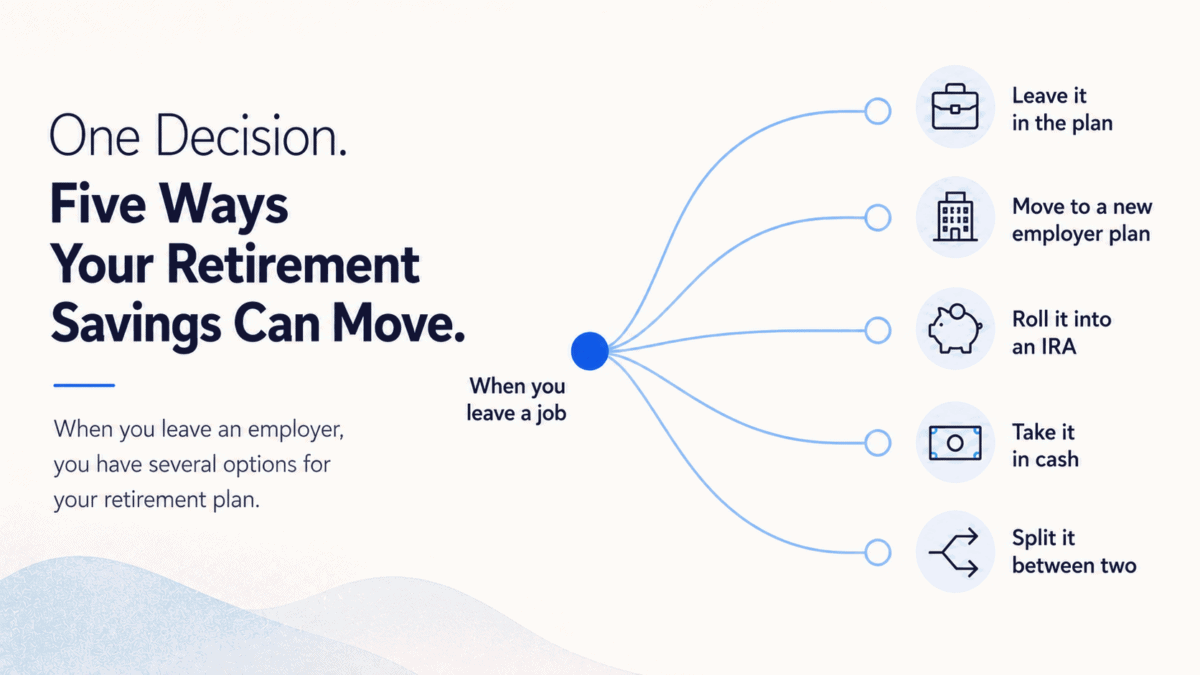
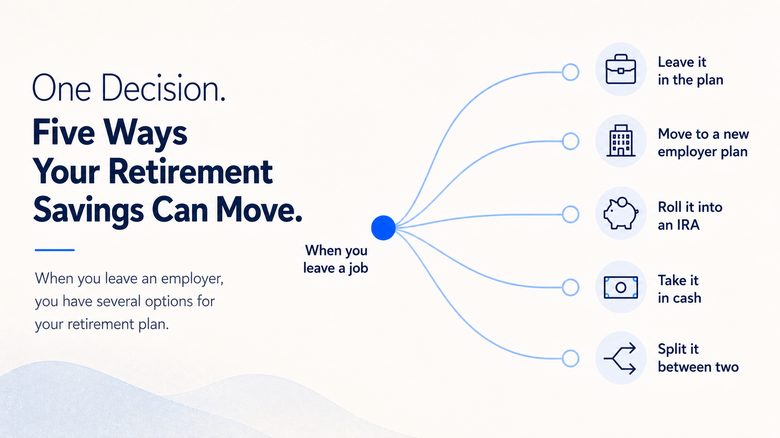
Five Things You Can Do With the Money
Most conversations about this present two choices: move the money here, or move it there. For most plan types there are actually five.
1. Leave it in your former employer’s plan.
2. Move it into your new employer’s plan, if that plan accepts transfers in.
3. Roll it into an individual retirement account, usually called an IRA.
4. Take it in cash.
5. Split it, sending part to one place and part to another.
The first one tends to get skipped past, because it looks like doing nothing. It deserves a closer look. Leaving money in a plan comes with a few advantages that are difficult to replace once they are gone. One caveat: if the balance is $7,000 or less, the plan may move it out without asking you.
Reasons Some Families Leave the Money Where It Is
Three of them come up often enough to check on any account before it moves.
Large Plans Can Be Less Expensive
Big plans buy investments in bulk. A fund may cost noticeably less to own inside a plan with thousands of participants than it would cost you to buy on your own.
That is not true of every plan, and small plans are often the opposite. Look it up rather than assume. If you worked for a large employer, start here.
Stable Value Funds Only Exist Inside Plans
A stable value fund is a conservative option that aims to hold a steady value while paying interest. There is no exact equivalent you can buy in an IRA.
When short-term interest rates are higher, as they have been, some of these funds have been paying rates that compare well with other conservative choices. If your plan has one and you use it, that is a real thing you would give up.
Company Stock May Qualify for Special Tax Treatment
If your plan holds shares of your employer’s stock and those shares are worth much more than what was paid for them, a rule called net unrealized appreciation may apply.
In plain terms, the growth on that stock may be taxed at long-term capital gains rates instead of as ordinary income. That only works if the distribution is handled a particular way.
Handled the wrong way, the option is gone for good. This one deserves a conversation with a tax professional before any form is signed.
Those three apply to almost anyone. The next one applies to a narrower group, but for the people it fits, it may be the most valuable item on the list.
The Age 55 Rule
Money taken out of a retirement account before age 59 and a half usually carries a 10% additional tax on top of regular income tax. There is an exception most people have never heard of.
Say you leave your employer in or after the calendar year you turn 55. That plan may then let you take withdrawals without the 10% additional tax, even though you are under 59 and a half.
Move that money into an IRA and the exception generally does not come with it. For someone retiring at 56 who may need income before 59 and a half, that is a significant difference. Qualified public safety employees may reach this exception earlier, at age 50 or after 25 years of service.
A Rule That Matters if You Worked in Government
This applies to a large number of public sector workers, and it almost never appears in the distribution paperwork.
If you have a governmental 457(b) plan, withdrawals after you leave that job are generally not subject to the 10% additional tax for early withdrawal, no matter your age. Not just at 55. Generally at any age.
Move that money into an IRA and it typically becomes subject to the same early withdrawal rules as everything else. The exception does not travel with the money.
For someone retiring from state, county, or municipal service in their early fifties, that may be the single most valuable feature of the account.
Reasons Some Families Move the Money
There are good reasons on this side too, and they tend to get stronger the closer you are to retirement.
Fewer moving parts. Four old plans mean four statements, four websites, four sets of passwords, and four beneficiary forms to keep current. Combining them reduces the number of things that can quietly go wrong.
More investment choices. Most plans offer somewhere between fifteen and thirty options. An IRA opens the field considerably. Whether that helps depends entirely on how those choices get used.
Room for Roth conversion planning. A Roth conversion means moving money from a pre-tax account into a Roth account and paying tax on it now, so that qualified withdrawals later may come out tax free. Conversions are generally simpler to carry out inside an IRA.
Charitable giving straight from the account. Beginning at age 70 and a half, a qualified charitable distribution lets money go directly from an IRA to a qualifying charity, excluded from taxable income. This option is generally available from IRAs and not from workplace plans.
One beneficiary form instead of four. Beneficiary designations override your will. Combining accounts means one form to keep current instead of several scattered across employers you left years ago.
What Taking the Cash Actually Costs
Cashing out is one of the five choices. For a small balance or a real emergency it may be reasonable. Here is what it involves.
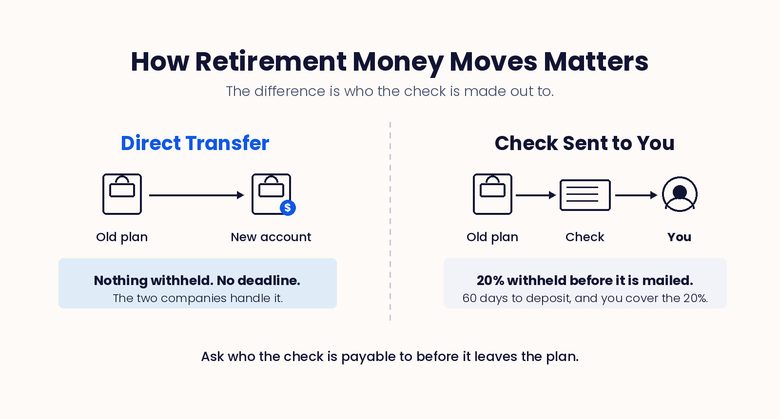
When a workplace plan sends money directly to you, federal law generally requires the plan to hold back 20% for taxes before the check goes out. You then have 60 days to put the money into another retirement account if you want to avoid tax on it.
Here is the part that surprises people. To move the full amount, you would need to deposit everything, including the 20% that was held back, using money from somewhere else.
You get that 20% back later through your tax return, not at the time you make the deposit. On top of that, any amount you do not put back is generally taxed as income. A 10% additional tax may also apply if you are under the applicable age and no exception fits.
The Option Almost Nobody Mentions: Splitting It
By now you may have noticed something. Some reasons to leave money in a plan and some reasons to move it can both apply to the same person. When that happens, you do not have to pick one side.
Here is a hypothetical illustration, provided for educational purposes only. Someone retires at 57 with a meaningful share of their plan invested in company stock that has grown a great deal.
They may have reason to leave part of the balance in the plan, both to keep the age 55 access described above and to handle the company stock carefully. At the same time, they may have reason to move the rest into an IRA to simplify their accounts and open the door to conversion planning later.
That is not a recommendation and would not fit every situation. It makes one point. The question is not always which one, but sometimes how much of each.
Where Transfers Go Wrong
Even when the decision is clear, the paperwork can go sideways. These are the issues that come up most often.
An outstanding loan against the plan. If you leave the job still owing a balance, that balance may be treated as a taxable withdrawal. Current rules generally let you replace the amount with other money and roll it over as late as the due date of that year’s tax return, including extensions.
Spousal consent. Some plans require a spouse’s notarized signature before money moves. Finding that out on a Friday afternoon is a common source of delay.
After-tax money already in the account. If some contributions were made with money that had already been taxed, that portion needs to be tracked so it is not taxed a second time. When the records are thin, piecing it back together takes work.
Roth clocks that do not carry over. A Roth account has a holding period before earnings can come out tax free. The clock on a Roth account inside a workplace plan does not simply transfer to a Roth IRA.
Older 403(b) annuity contracts. Some 403(b) accounts, especially those opened decades ago, sit inside annuity contracts that may carry surrender charges for a period of time. Identify those charges before the transfer rather than after.
A check made out to the wrong party. A direct transfer, where money moves institution to institution, avoids the 20% withholding and the 60-day deadline entirely. A check made payable to you personally does not, even if you deposit it the same day.
Who Is Responsible for What
Three parties touch this decision: your former employer, you, and whoever you talk to about it. The lines between them are blurrier than most people assume, and one of those lines moved this spring.
What Your Former Employer Handles
Employers that sponsor a retirement plan have duties under federal law for choosing and monitoring the plan’s investments and service providers. They also have to give you certain notices, including a written explanation of your rollover options before a distribution is made.
The Internal Revenue Service updated the standard language for those notices in early 2026, so your packet may read differently from one a coworker received two years ago.
What the employer is generally not responsible for is your personal decision about where the money goes after you leave, or coordinating anything with a different employer’s plan.
What Sits With You
Three things fall to you, mostly because nobody else can see them. Your address needs to stay current with every former plan so the notices actually reach you. Your beneficiary designations need to reflect your family as it is today rather than as it was the year you filled out the form.
And if money ever passes through your hands on the way from one account to another, the 60-day deadline is yours to watch.
There is a fourth item that is simple to handle once you know about it. If you work for two employers in the same calendar year, the annual contribution limit applies to you. It does not apply to each plan separately, and neither payroll department can see the other. Mentioning the job change to whoever helps with your planning is usually all it takes.
Which Standards Apply to the Advice You Receive
The point of this section is simple: not all financial advice is governed by the same rulebook, and which rulebook applies is something you can ask about directly.
In March of 2026, federal courts vacated a 2024 rule that would have expanded when advice about rollovers counts as fiduciary advice under federal retirement law. The Department of Labor published a conforming notice, effective in April, restoring the standard that had been in place since 1975.
Under that restored standard, a one-time recommendation to move money from a plan into an IRA is generally not fiduciary advice under federal retirement law. Other rules still apply.
The Securities and Exchange Commission’s Regulation Best Interest covers recommendations made to retail customers by broker-dealers. Investment advisers owe duties to advisory clients under separate federal securities law.
We are reporting the change rather than taking a position on it. What it means in practice is that the standard governing a conversation depends on the capacity the person is acting in at the time. That is a reasonable question to ask before money moves.
How This Works on Our End
Depending on the account and the service being provided, we may act in different capacities, and the standards that apply differ. Compensation can also differ depending on what you decide, including the option of leaving money in your existing plan.
That is exactly why the reasons to leave money alone appear above, in writing, ahead of any reason to move it. Many families have never had that explained to them, and most have never thought to ask. It is a fair question to raise before anything moves.
Four Questions That Usually Get You to an Answer
If you are holding a packet right now, start here.
1. What does the old plan cost you each year, and how does that compare with the alternative?
2. Does the plan hold anything you could not get elsewhere, such as a stable value fund or appreciated company stock?
3. What year did you turn 55, or when will you, and what year did you leave that employer?
4. Who is the named beneficiary on that account right now, and is that still what you want?
Four answers will not settle everything. They will tell you whether this is simple or whether it deserves a real conversation.
Talk Through All Five Options Before You Decide
Some of these choices can be revisited later and a few cannot, and the packet does not tell you which is which. Bring your statements and we will go through every account together. What it costs, what it holds that you could not get elsewhere, and what the age 55 and 457 rules mean for you. The consultation is complimentary and carries no obligation.
Schedule a Free ConsultationOr call 717-288-1880
Not sure how many old accounts you have, or where they are? That is far more common than most people realize, and there are established ways to track them down. Start with How to Find Old Retirement Accounts From Former Employers.
Common Questions
Can I leave my 401(k) with my former employer?
Usually yes, if the balance is above $7,000. Below that, the plan may move it out without your consent. Leaving it can make sense if the plan has low costs, holds a stable value fund, or if you left that job in or after the year you turned 55.
Can I roll a 457 plan into an IRA?
It depends on the type. A governmental 457(b) generally can be rolled into an IRA. A non-governmental 457(b), the kind offered by nonprofit employers, generally cannot, and neither can a 457(f). The IRS treats an attempted rollover as an excess contribution that may be subject to an excise tax.
What is the age 55 rule?
If you leave your employer in or after the calendar year you turn 55, that employer’s plan may let you take withdrawals without the 10% additional tax that normally applies before age 59 and a half. The exception generally stays with the plan and does not follow the money into an IRA.
How long do I have to decide what to do with an old retirement plan?
In most cases there is no deadline. A 60-day clock only starts if the plan sends a check made payable to you personally. A direct transfer between institutions has no deadline at all.
What happens if I cash out my retirement plan when I leave a job?
The plan generally withholds 20% for taxes before the check goes out. Any amount you do not deposit into another retirement account within 60 days is generally taxed as income. A 10% additional tax may also apply if you are under the applicable age and no exception fits.
Sources
Internal Revenue Service, Non-Governmental 457(b) Deferred Compensation Plans
Internal Revenue Service, Issue Snapshot: 457(b) Plan of Tax-Exempt Entity, Tax Consequences of Noncompliance
Internal Revenue Service, Comparison of Tax-Exempt 457(b) Plans and Governmental 457(b) Plans
Internal Revenue Service, Rollover Chart
Internal Revenue Service, Publication 575, Pension and Annuity Income
Internal Revenue Service, Publication 590-A and 590-B, Individual Retirement Arrangements
Internal Revenue Service, Notice 2026-13, Safe Harbor Explanations for Eligible Rollover Distributions
Internal Revenue Service, Retirement Topics: Exceptions to Tax on Early Distributions
Federal Register, Retirement Security Rule: Definition of an Investment Advice Fiduciary, Notice of Court Vacatur, March 20, 2026
U.S. Department of Labor, Employee Benefits Security Administration
U.S. Securities and Exchange Commission, Regulation Best Interest
About the Financial Author

Alexander Langan, J.D., is the Chief Investment Officer at Langan Financial Group. In this role, he manages investment portfolios, acts as a fiduciary for group retirement plans and consults with clients regarding their financial goals, risk tolerance and asset allocation.
With a focus on ERISA Law, Alex graduated cum laude from Widener Commonwealth Law School. He then clerked for the Supreme Court of Pennsylvania and worked in the Legal Office of the Pennsylvania Office of the Budget, where he assisted in directing and advising policy determinations on state and federal tax, administrative law, and contractual issues.
Alex is also passionate about giving back to the community and has helped establish The Foundation of Enhancing Communities’ Emerging Philanthropist Program, volunteers at his church, and serves as a board member of Samara: The Center of Individual & Family Growth. Outside of work and volunteering, Alex enjoys his time with his wife Sarah and their three children, Rory, Patrick, and Ava.
About Langan Financial Group
For everything you’ve built.
Your savings. Your business. Your family’s future. Each deserves thoughtful planning that starts with what matters to you.
Langan Financial Group provides financial planning and investment management for individuals, families, and business owners. With offices in Camp Hill and York, Pennsylvania, we serve clients throughout Central Pennsylvania.
We help you work through questions about retirement income, investment decisions, Social Security, and how taxes may affect your financial plan. Our approach starts with understanding your goals, your financial picture, and your comfort with investment risk. From there, we help you evaluate your options and develop a plan that can evolve as your life changes.
We also help businesses and organizations evaluate workplace retirement plans and understand their responsibilities as plan sponsors.
Disclosures
The information in this material is not intended as tax or legal advice. Please consult legal or tax professionals for specific information regarding your individual situation. The opinions expressed and material provided are for general information.