
TAX STRATEGIES
By Alex Langan, JD, Chief Investment Officer
Langan Financial Group · 6 min read
In August a reader asked us a question we have been answering in two parts: what if the rules change before you get there? In September we looked at Social Security, including how past Social Security reforms treated people near retirement. This article covers Roth account rules.
The question matters because a Roth conversion is one of the planning decisions with no deadline. Worry about future tax law is one reason it tends to wait.
A future Congress could change the rules. What we can look at is what the rules say today and what has changed before.
What Current Roth Account Rules Say
A Roth account is a retirement account funded with money that has already been taxed. A Roth conversion moves money from a traditional account, where the tax was deferred, into a Roth account. The amount converted is generally taxed as ordinary income in that year.
- Qualified withdrawals are generally tax free. Qualified generally means you are 59 and a half or older and the Roth has been open at least five years.
- Withdrawals are generally not required during your lifetime. That applies to Roth IRAs and, starting in 2024, to Roth accounts inside workplace plans. Beneficiaries follow different rules.
- A conversion is permanent under current rules. Since 2018, the tax rules do not allow a conversion to be reversed.
- Timing follows the calendar year. A conversion generally has to be completed by December 31 to count for that tax year.
These rules sit alongside how retirement withdrawals are taxed from traditional accounts, which is generally as ordinary income.
How Roth Account Rules Have Changed Since 1997
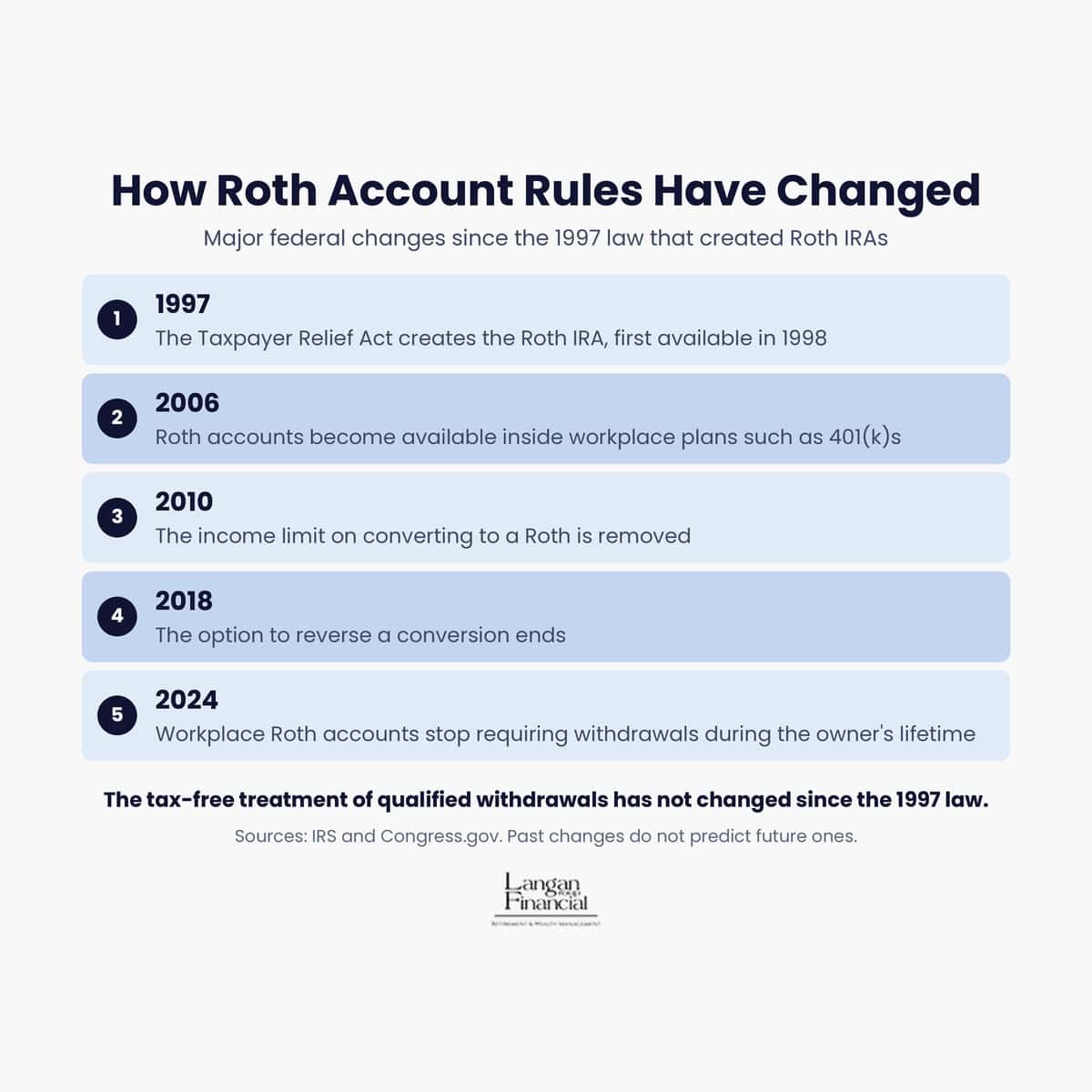
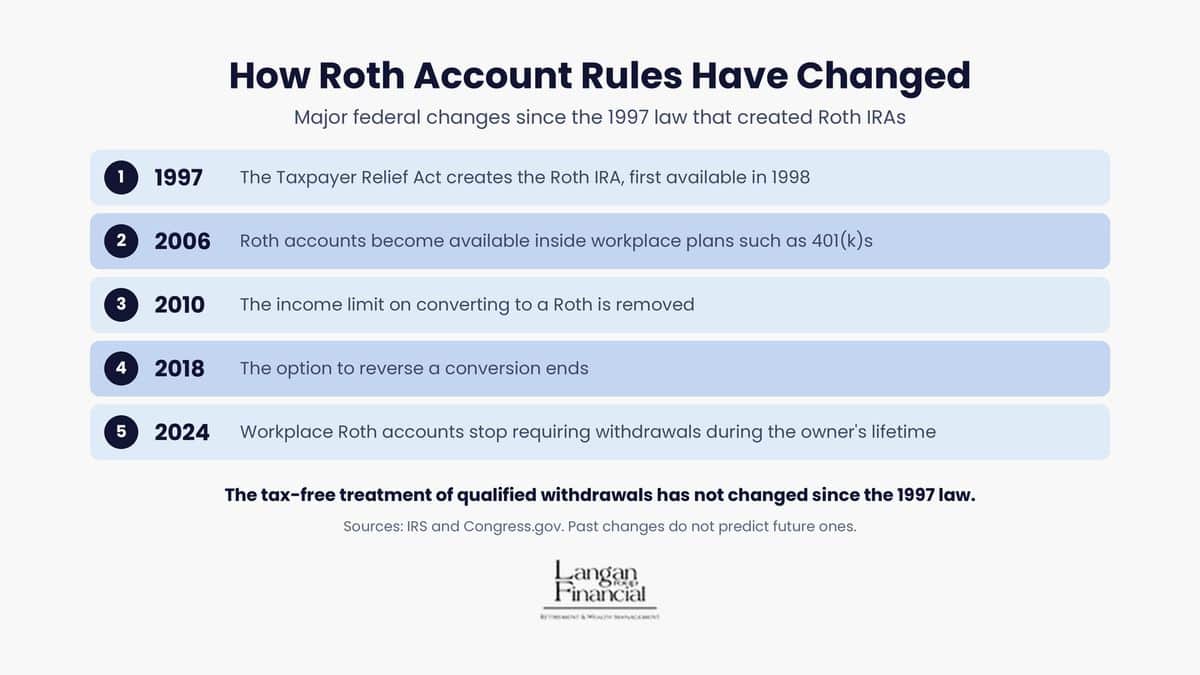
Congress has changed Roth rules several times since the Taxpayer Relief Act of 1997 created the Roth IRA. The major federal changes are:
- 1997. The Taxpayer Relief Act creates the Roth IRA, first available in 1998.
- 2006. Roth accounts become available inside workplace plans such as 401(k)s.
- 2010. The income limit on converting to a Roth is removed.
- 2018. The option to reverse, or recharacterize, a conversion ends.
- 2024. Roth accounts inside workplace plans stop requiring withdrawals during the owner’s lifetime.
Proposals to limit Roth accounts have also come up. In 2021 the House passed the Build Back Better Act, which would have restricted conversions for high-income households starting in 2032. That provision was not enacted.
What That History Suggests, and What It Does Not
The tax-free treatment of qualified Roth withdrawals has not changed since the 1997 law that created Roth IRAs. Most of the changes since then have affected how money gets into Roth accounts, such as who can convert and whether a conversion can be reversed.
That history is precedent, not a promise. A future Congress can change course, and a future change could take a form that has not been tried before. What the record does offer is some context for weighing the worry against the rest of the decision.
What a Roth Conversion Changes
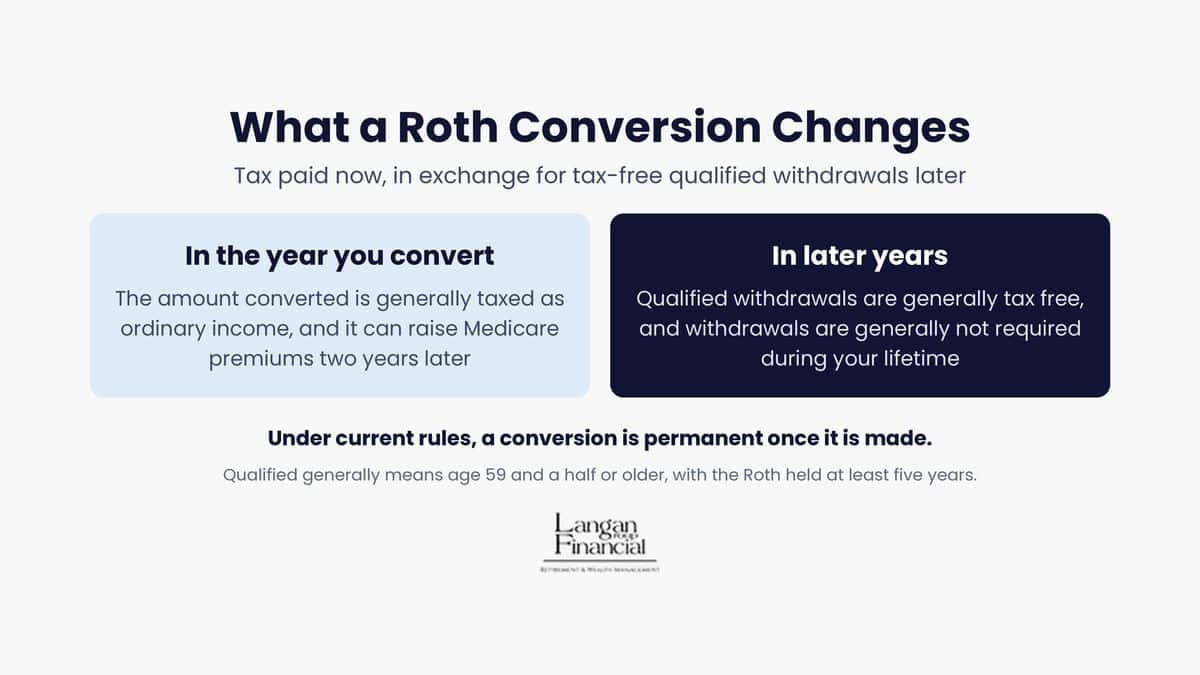
A conversion shifts when the tax is paid. You pay it in the year you convert, and qualified withdrawals later are generally tax free.
The added income can have effects beyond the tax itself. It counts as income when Medicare sets premiums two years later, which we explained in how Medicare sets premiums. It can also raise the taxable share of your Social Security that year.
Still working: a conversion adds to your taxable income on top of your salary. Some households look at the years between retiring and required withdrawals, when income may be lower. Required withdrawals begin at 73 for those born from 1951 through 1959, and at 75 for those born in 1960 or later.
Already retired: the Medicare and Social Security effects belong in the math alongside the tax. Spreading conversions across several years is one approach some households consider.
Four Questions Before a Roth Conversion
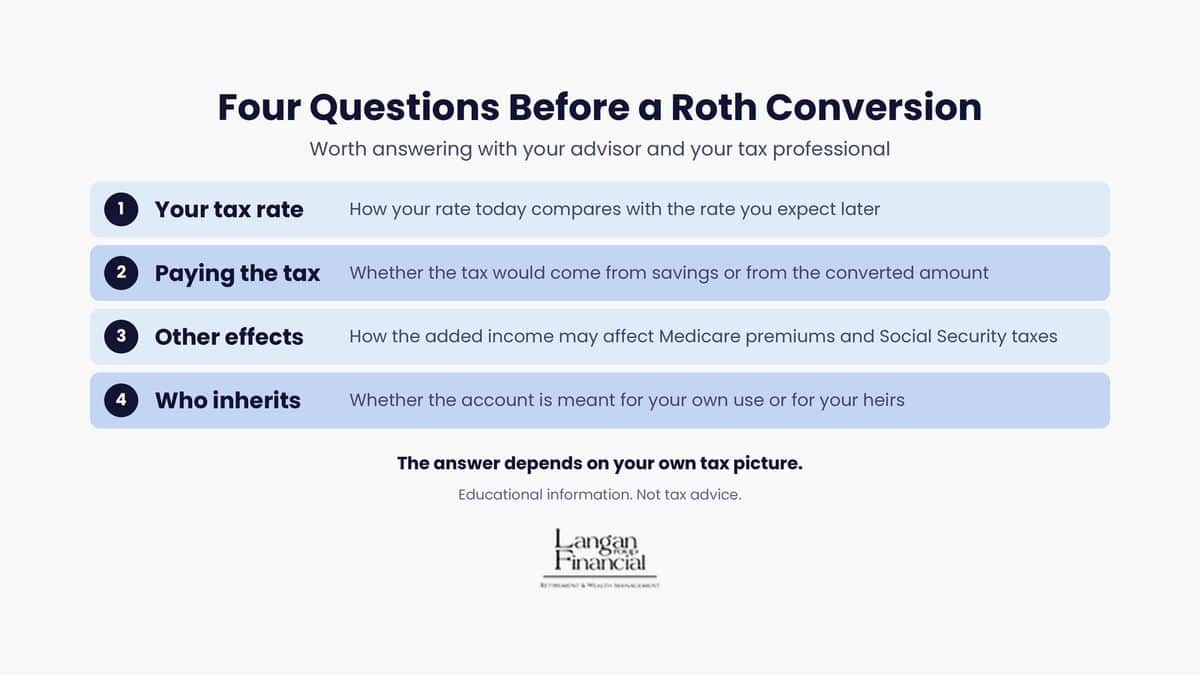
- How does your tax rate today compare with the rate you expect later? Comparing the two rates is usually the starting point for the decision.
- Would the tax be paid from savings or from the converted amount? Paying from the converted amount leaves less in the Roth, and it may trigger a penalty if you are under 59 and a half.
- How might the added income affect Medicare premiums and Social Security taxes? Those effects can arrive in the conversion year or two years later.
- Is the account meant for your own use or for your heirs? Heirs who inherit a Roth account generally still have to withdraw it within a set period, though qualified withdrawals are generally tax free to them.
Our Roth conversion calculator can help you see rough numbers, and our free guide, Planning Decisions to Review Each Year, has space to write down your answers.
A Question Worth Asking Each Year
Whether a conversion fits can change from one year to the next as income, tax rates, and health change. That makes it a natural item for a yearly review, alongside the rest of your retirement income plan.
Speak With an Advisor Today
We can look at how a Roth conversion might fit your income, your taxes, and your Medicare premiums, and note where a tax professional belongs in the decision.
Or call 717-288-1880
Common Questions About Roth Account Rules
Are Roth withdrawals tax free?
Qualified withdrawals from a Roth account are generally tax free under current federal law. Qualified generally means you are 59 and a half or older and the Roth has been open at least five years.
Could Congress change how Roth accounts are taxed?
Congress can change tax law, and a future Congress can change course from a prior one. Since 1997, the changes Congress has made have mostly affected how money gets into Roth accounts. Qualified withdrawals have remained tax free during that time.
Do Roth accounts have required minimum distributions?
Roth IRAs generally do not require withdrawals during the owner’s lifetime. Starting in 2024, Roth accounts inside workplace plans such as 401(k)s do not either. Beneficiaries who inherit a Roth account are generally subject to withdrawal rules.
Can I undo a Roth conversion?
Under current rules, no. Since 2018, the tax rules do not allow a conversion from a traditional account to a Roth account to be reversed, or recharacterized.
Does a Roth conversion affect Medicare premiums?
It can. The amount converted counts as income in the year of the conversion. Medicare generally uses income from two years earlier to set Part B and Part D premiums. It can also affect how much of your Social Security is taxed that year.
Sources
Internal Revenue Service, Retirement Topics: Required Minimum Distributions (RMDs)
Internal Revenue Service, Instructions for Form 8606, Recharacterizations
Internal Revenue Service, Topic No. 309, Roth IRA Contributions
Congress.gov, H.R. 2014, Taxpayer Relief Act of 1997
Congress.gov, H.R. 5376, Build Back Better Act (2021)
This article is provided for informational and educational purposes only and does not constitute investment advice, financial planning advice, tax advice, or legal advice. All investing involves risk, including potential loss of principal. Past performance is not a guarantee of future results. Individual results will vary based on specific financial circumstances. Tax rules referenced are current as of the date of publication and are subject to change. A Roth conversion is a taxable event, and current tax rules do not allow it to be reversed. Legal documents and their requirements vary by state and should be prepared by a qualified attorney. Please consult a qualified financial, tax, or legal professional before making any financial decisions. Securities offered through PKS Securities, Inc., a Broker-Dealer, Member FINRA/SIPC. Advisory services offered through Langan Financial Group, LLC, a Registered Investment Adviser. Registration does not imply a certain level of skill or training.
STILL HAVE QUESTIONS?
See How These Decisions Fit Together in Your Own Plan
A twenty-minute conversation can help you understand your options.
Or call 717-288-1880