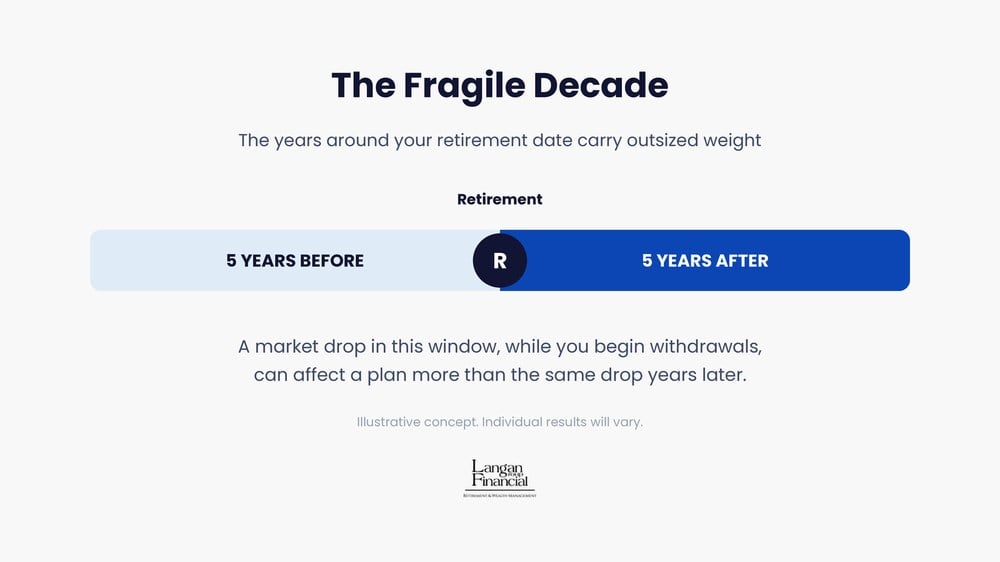
There is a stretch of years that shapes retirement more than almost any other. Researchers call it the fragile decade, and most people pass through it without realizing how much weight it carries. It is the decade around your retirement date: roughly the five years before you stop working and the five years after.
The financial industry has long called the same window the retirement red zone, a term coined by Prudential. Whatever the name, the idea is the same. What happens to your savings during these years can matter more than what happens in any other decade of your financial life.
What the Fragile Decade Is, and Why It Matters
The reason comes back to a single shift: you move from adding money to your savings to taking money out. That change quietly rewires how market ups and downs affect you.
The contrast is stark.
Still working: a market drop can be a buying opportunity. Your paycheck keeps flowing in, you keep investing, and time is on your side.
Already retired: that buffer fades. You are no longer adding much, and soon you are withdrawing. A sharp drop can force you to sell at low prices.
That is the mechanism behind sequence-of-returns risk, and the fragile decade is when it bites hardest.
Still working: if you are 50 or older, your retirement date sets the window. It moves with you. Someone planning to stop at 65 is looking at roughly age 60 to 70. Someone planning to work to 70 sees the whole span shift later.
Already retired: if you stopped working within the last five years, you are in it now. That is not a reason for alarm. It is a reason to know which levers you still have.
How Much Do the First Years of Retirement Matter?
Enough that researchers single the period out. Prudential coined the Retirement Red Zone term. Its research describes the real returns a portfolio earns over the first decade of retirement as a key indicator of whether it can sustain someone through the whole of it. Two people who make identical decisions can land in very different places simply because of the market they happened to retire into.
That is a sobering thought, but it is also a useful one. It tells you exactly where to focus your attention: on coordinating your retirement income through these years.
The Risk of Retiring Into a Weak Market
Consider what a downturn can do at the wrong moment. A sharp drop just before or early in retirement can draw a portfolio down faster than the same drop later on. That holds even when the long-term average return works out the same. The reason is arithmetic rather than bad luck. Selling shares at low prices to cover living costs removes them permanently, so they are absent for whatever recovery follows.
This does not mean a weak market ruins retirement. It means the early years deserve extra care, and that decisions like when you claim Social Security carry more weight here. The same market drop that would be a minor bump at age 80 can be a genuine setback at age 65. Withdrawals are just beginning then, and the portfolio has the longest road ahead.
The Number Worth Knowing Before You Start
How much you draw in the first year sets the tone for everything after it. For decades the 4 percent rule was the common starting point, from research William Bengen published in 1994. Morningstar’s research for 2026 puts the figure at 3.9 percent for someone just beginning a 30 year retirement. That was modeled on a portfolio holding 30 to 50 percent in stocks.
That stock range is an assumption inside the research, not a suggested mix for you. The horizon matters too. Published work on time horizons shows how much that matters. The sustainable rate has been estimated as high as 5 to 5.5 percent over roughly 20 years, and closer to 3.5 percent over 40. A figure built for a new retiree is not a ceiling for someone already well into retirement.
Three Signs Your Plan May Be Exposed
You do not need a crystal ball to gauge your exposure. A few honest questions can tell you a lot.
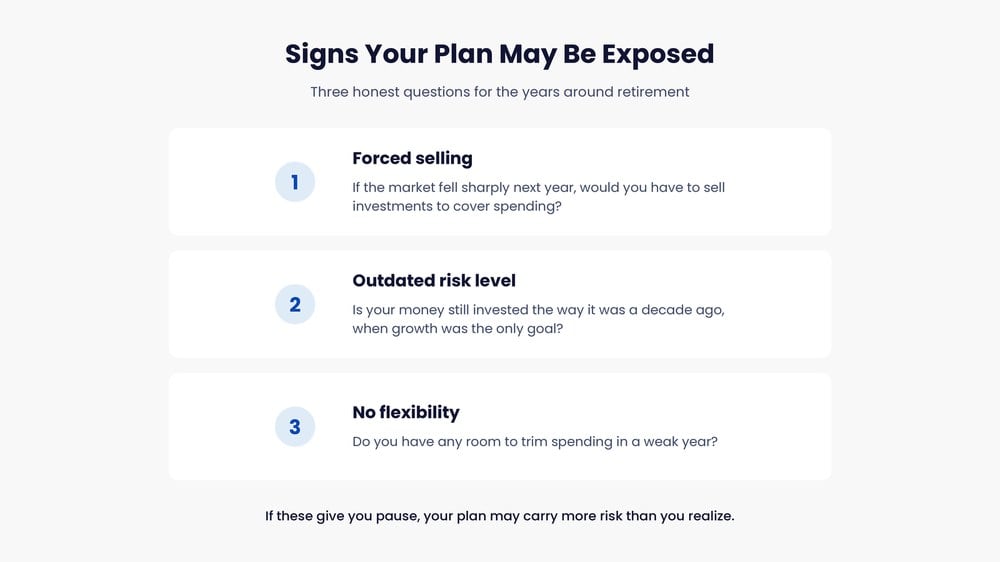
Ask yourself these three questions:
- If the market fell sharply next year, would you be forced to sell investments to cover your spending?
- Is your money still invested the way it was a decade ago, when growth was the only goal?
- Do you have any flexibility to trim spending in a weak year?
If those questions give you pause, your plan may be carrying more risk than you realize as you enter this window. Reviewing your mix through thoughtful investment planning is a good next step.
Four Ways to Steady the Fragile Decade
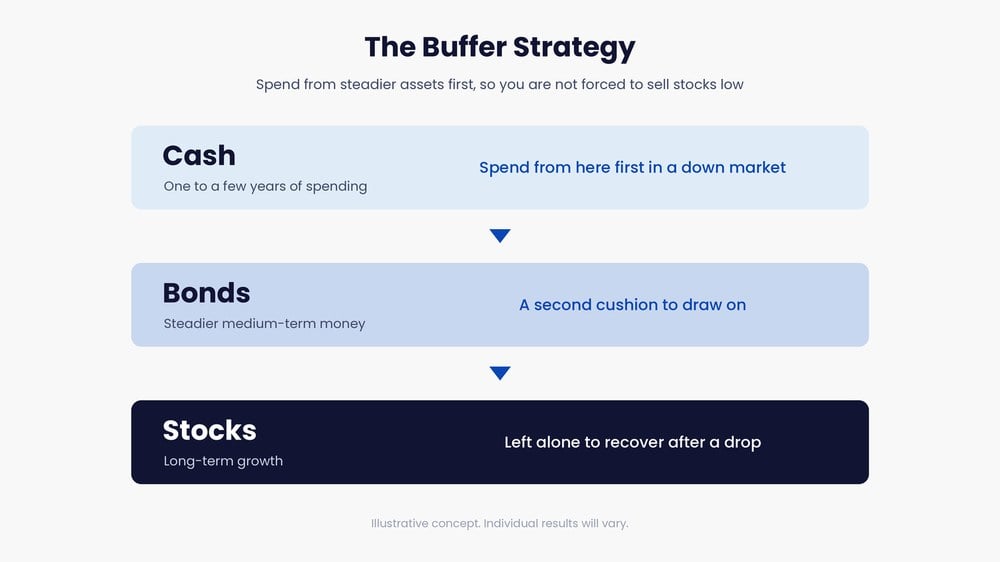
The encouraging part is that this is a risk you can prepare for. You cannot choose the market you retire into, but you can help prepare a plan for a rough start. One common approach is a buffer, where you spend from steadier assets first and leave your growth investments alone to recover.
A Buffer Built Before You Need It
Setting aside one to a few years of spending in cash and bonds can mean you are not forced to sell stocks in a down market. You draw from the buffer and let your growth investments recover. Schwab describes a larger version of the same idea. That is about a year of expenses in cash, plus another three to five years in high-quality short-term bonds and cash equivalents. The right size depends on your own spending and income.
Timing helps here. Required withdrawals begin at age 73 for those born from 1951 through 1959, and at age 75 for those born in 1960 or later. Those retirement gap years, after you stop working but before required withdrawals begin, are often the most flexible ones for building a buffer.
A Risk Level That Still Fits
The years approaching retirement are a natural time to ask whether your investment mix still fits. Shifting from a growth-first mindset toward a balance of growth and stability is a common move in this window. It also pairs naturally with a look at your estate and legacy plans.
The opposite error is real too. A mix that turns too conservative can leave a retirement lasting 25 or 30 years short on the growth it needs to keep up with rising costs.
Still working: in your early fifties the question is when to begin shifting, not whether. Your date is far enough off to ride out a rough patch.
Already retired: if your first years have gone well, it is worth asking whether your mix still matches where you are now.
Spending With Some Flex in It
A plan with built-in flexibility, where some expenses can wait in a weak year, takes pressure off your portfolio when it is most vulnerable. Even a small amount of give can help.
Income Sources That Work Together
Your withdrawals, Social Security timing, and estate plans all interact. A tax-efficient approach to withdrawals ties it together. Looking at them as one picture, rather than one at a time, is how you find the steadiest path through these years.
Not sure if your plan is ready for the fragile decade?
Whether you are five years out or recently retired, a short conversation can help you see where you stand. It can also show where a small adjustment might help. There is no pressure, just a clear second opinion.
Or call 717-288-1880
Common Questions About the Fragile Decade
What is the fragile decade or retirement red zone?
It is the roughly ten-year window spanning the five years before and five years after you retire. During this period, your savings are especially vulnerable to market drops because you are shifting from saving to withdrawing.
Why is a market drop worse early in retirement?
Because you may have to sell investments at low prices to cover living costs, and those shares cannot take part in the recovery. The same drop later in retirement usually does less damage.
Can I do anything if I am already in the fragile decade?
Yes. You can review your cash and bond cushion, revisit your risk level, build flexibility into your spending, and coordinate your income sources. These steps can help whether you are five years out or already retired.
Should I delay retirement if the market is weak?
It depends on your situation. For some people, working a bit longer or reducing early withdrawals can ease the pressure. For others, adjusting the plan is enough. A professional can help you weigh the trade-offs.
A Steady Hand Through the Fragile Decade
The fragile decade can sound alarming, but the takeaway is calm. These years carry weight, which is precisely why they reward a little extra planning. The families who move through this window with confidence are not always the ones with the most money. Often they are the ones who saw it coming and prepared.
If you are anywhere near this window, it is a good time to check how ready your plan is. That is true whether you are five years out or recently retired. A conversation with our team can help you see where you stand before decisions become permanent. If you would rather start by reading, our weekly retirement newsletter covers one planning question like this every Wednesday.
Sources
Prudential, “The Retirement Red Zone.” prudential.com
Morningstar, The State of Retirement Income, 2026 base-case safe withdrawal rate research — morningstar.com
William P. Bengen, “Determining Withdrawal Rates Using Historical Data,” Journal of Financial Planning, October 1994.
Charles Schwab, “Timing Matters: Understanding Sequence of Returns Risk,” Schwab Retirement Plan Services — workplace.schwab.com
Internal Revenue Service, Required Minimum Distribution rules; SECURE 2.0 Act of 2022 — irs.gov
Michael Kitces, “Adjusting Safe Withdrawal Rates to the Retiree’s Time Horizon,” summarizing time-horizon research including Blanchett (2007) and Pfau (2012) — kitces.com
This article is provided for informational and educational purposes only and does not constitute investment, tax, or legal advice. It is not a recommendation to buy or sell any security or to adopt any investment strategy. Any examples are hypothetical and for illustration only. Individual results will vary. Past performance is not a guarantee of future results. Figures referenced are current as of the date of publication and are subject to change. Please consult a qualified professional about your specific situation.
Securities offered through Cambridge Investment Research, Inc., a Broker-Dealer, Member FINRA/SIPC. Advisory services through Cambridge Investment Research Advisors, Inc., a Registered Investment Adviser. Langan Financial Group and Cambridge are not affiliated.
Talk it through with an advisor
If you would like a second opinion on how this applies to your own plan, we are glad to walk through it with you.