HEALTH CARE
Medicare helps with some care after an illness or injury, but it generally does not pay for ongoing help with daily living.
Medicare pays for some short-term care after an illness or injury, and it generally does not pay for ongoing help with daily living. So, does Medicare pay for long-term care? It depends on the kind of care, why you need it, and the plan you have.
Key Takeaways
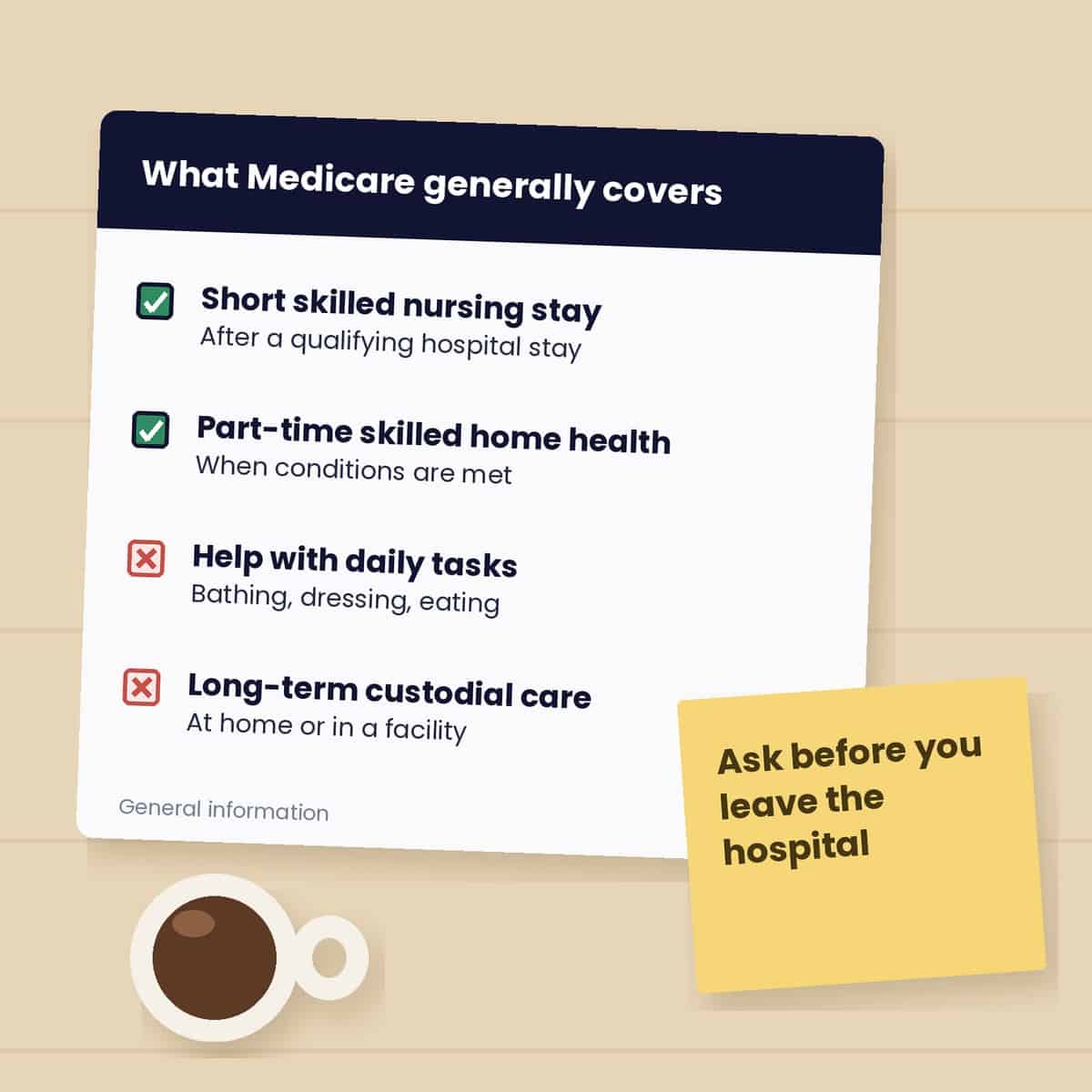
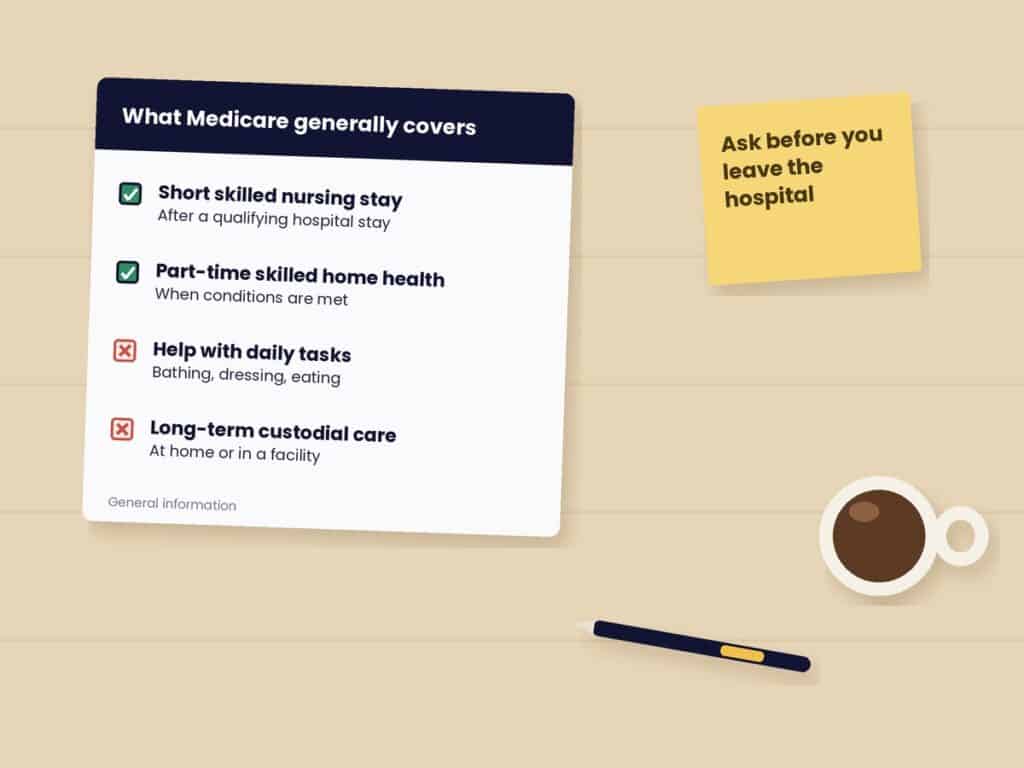
✓ Medicare may cover a limited stay in a skilled nursing facility after a qualifying hospital stay.
✓ Medicare does not pay for long-term care, which often means help with daily tasks like dressing, bathing and using the bathroom.
✓ Medicare and Medicare Supplement Insurance (Medigap) do not pay for long-term care services, so your own plan documents matter.
✓ Pennsylvania offers free Medicare counseling through PA MEDI.
Does Medicare pay for long-term care?
Start with a plain definition. Long-term care often means help with activities of daily living, such as dressing, bathing and using the bathroom. Medicare says long-term care is also called custodial care. It includes medical and non-medical care for people who have a chronic illness or disability.
Long-term care can include help with personal care such as dressing, bathing and using the bathroom. It can also include home-delivered meals, adult day health care and transportation. Care can happen at home, in the community, in assisted living or in a nursing home. See the Medicare long-term care page for how Medicare describes it.
To make this concrete, we follow a couple through the article. Hypothetical example: Tom and Amy are a made-up couple, not clients, used only to illustrate the questions this topic raises.
If you have not checked what your coverage says about care at home or in a facility, this is a reasonable time to look. Our Medicare open enrollment article covers that process.
Short-term skilled care Medicare generally covers
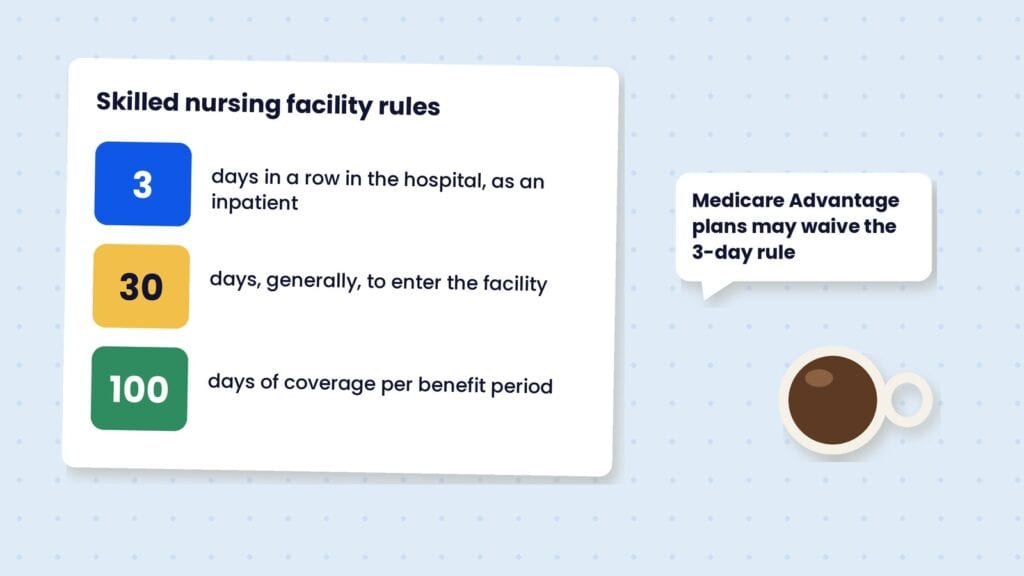
Medicare Part A (Hospital Insurance) covers skilled nursing facility care for a limited time. That care needs to follow a medically necessary inpatient hospital stay of at least 3 days in a row. Medicare explains the rules on its skilled nursing facility care page.
Three rules shape that coverage:
- The hospital stay needs to be medically necessary and last at least 3 days in a row.
- You generally enter the facility within 30 days of leaving the hospital.
- Part A limits coverage to 100 days per benefit period.
Medicare Advantage plans may waive the 3-day rule.
Medicare suggests asking your doctor or hospital staff whether Medicare would cover a skilled nursing facility stay. That question is worth asking before you leave the hospital.
Medicare may also cover part-time or intermittent skilled home health care when conditions are met. Medicare describes this on its home health services page.
Whether coverage applies to one person depends on the facts and the plan terms.
Custodial care and other care Medicare generally does not cover
Medicare does not pay for long-term care. That means the daily help with dressing, bathing and using the bathroom is generally not covered.
The same is true of the other services that can be part of long-term care. Home-delivered meals, adult day health care and transportation are on Medicare’s list of what long-term care can include. You pay all costs for services Medicare does not cover.
Medicare and Medigap do not pay for long-term care services. Medicare calls this supplement coverage Medicare Supplement Insurance (Medigap).
You may be eligible for Medicaid if you meet your state’s requirements. You can also buy private long-term care insurance.
Medicare also encourages planning for non-medical long-term care. The goal it names is to help you maintain your independence and get care in the setting you want.
What Medicare generally covers and what it generally does not
| Kind of care | Medicare generally |
|---|---|
| Skilled nursing facility care after a qualifying hospital stay | Covers for a limited time under Part A |
| Part-time or intermittent skilled home health care | May cover when conditions are met |
| Long-term care, such as help with dressing, bathing and using the bathroom | Does not pay, and Medigap does not either |
Source note: each row rests on medicare.gov pages listed in Sources. Coverage for a particular person depends on facts and plan terms.
What might this look like for one couple?
Hypothetical Example
Hypothetical example: Tom and Amy are not real clients, and this example predicts nothing about any person.
Suppose Tom is hospitalized after a fall and his doctor orders therapy afterward. Before Tom leaves the hospital, he and Amy could ask hospital staff whether Medicare would cover a skilled nursing facility stay.
They could also ask whether his hospital stay lasted the 3 days in a row that Part A requires.
Amy could ask what Tom’s plan documents say about the limits on that coverage. If Tom has a Medicare Advantage plan, she could ask whether the plan waives the 3-day rule.
Now suppose that months later Tom needs steady help with bathing and dressing. They could ask whether any of that help is covered, and what their plan documents say about it.
They might also ask about the other services long-term care can include, such as home-delivered meals, adult day health care and transportation. Medicare says you pay all costs for services it does not cover. So they could ask who would pay for each one.
Last, they could ask what setting they would want for care, and what planning could help them get there. Medicare encourages this kind of planning for non-medical long-term care.
The point is the questions, not the answers. Their answers would depend on their situation and their plan.
This example is hypothetical and not a projection of costs or outcomes.
Your move: what to check this week and who can help for free
01
Find the sections.
Locate the care and skilled nursing sections of your current Medicare or plan documents.
02
Write down what each says.
Note what each section says about long-term care.
03
List your questions.
Keep a short list of anything unclear.
04
Ask.
Call PA MEDI or use medicare.gov to ask them.
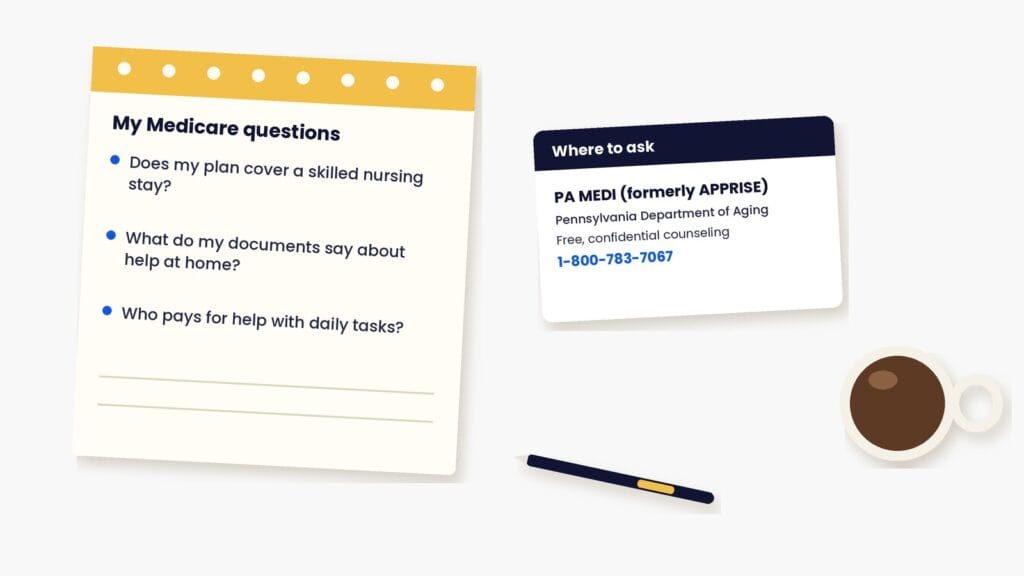
PA MEDI (formerly APPRISE) is the Pennsylvania Department of Aging’s free, confidential Medicare counseling program. You can reach it at 1-800-783-7067, Monday through Friday, 8 AM to 5 PM. The Pennsylvania Department of Aging Medicare counseling page has details.
Our free Long-Term Care Planning Checklist is a review you can use alongside your documents. For the planning side, see ways to plan for long-term care costs in retirement.
Common Questions
Does Medicare pay for a nursing home?
Medicare may cover a limited stay in a skilled nursing facility when conditions are met. Medicare does not pay for long-term care services, and long-term care can happen in a nursing home.
Does Medicare pay for help at home?
Medicare may cover part-time or intermittent skilled home health care when conditions are met. Medicare does not pay for long-term care, and long-term care can happen at home.
Does Medigap cover custodial care?
Medicare and Medigap do not pay for long-term care services. That includes the daily help with dressing, bathing and using the bathroom.
Does Medicare Advantage cover long-term care?
Medicare Advantage plans may waive the 3-day rule for skilled nursing facility care. For anything beyond that, check your own plan’s documents or ask PA MEDI.
What happens if I need care and Medicare does not cover it?
Families pay for care in different ways, and our article on ways to plan for long-term care costs walks through the general options. You may be eligible for Medicaid if you meet your state’s requirements, or you can buy private long-term care insurance. For eligibility questions, an elder law attorney can help. If you would like to talk through how this fits your own plan, our team is here to help. Schedule a consultation
Sources
- Medicare.gov, Long-term care
- Medicare.gov, Skilled nursing facility (SNF) care
- Medicare.gov, Home health services
- Pennsylvania Department of Aging, Medicare counseling (PA MEDI)
This article is provided for informational and educational purposes only and does not constitute investment advice, financial planning advice, tax advice, legal advice, or insurance advice. Langan Financial Group does not sell Medicare plans and is not connected with or endorsed by the federal government or the Medicare program. All investing involves risk, including potential loss of principal. Past performance is not a guarantee of future results. Individual results will vary based on specific financial circumstances. Medicare rules, premiums, deductibles, plan terms, and enrollment dates are set by law and by each plan, and can change. Figures shown are those published for the years named. Please consult a qualified financial, tax, or legal professional, and medicare.gov or 1-800-MEDICARE for coverage questions, before making decisions. Securities offered through PKS Securities, Inc., a Broker-Dealer, Member FINRA/SIPC. Advisory services offered through Langan Financial Group, LLC, a Registered Investment Adviser. Registration does not imply a certain level of skill or training. Hypothetical examples are for illustration only and do not represent any specific investment or client. The firm does not present hypothetical performance, so examples never include projected returns.
Alex Langan is a licensed attorney. Langan Financial Group is not a law firm. Neither he nor the firm provides legal advice or practices law for the firm or its clients, and no attorney-client relationship is created.
STILL HAVE QUESTIONS?
See How These Decisions Fit Together in Your Own Plan
A twenty-minute conversation can help you understand your options.
Or call 717-288-1880