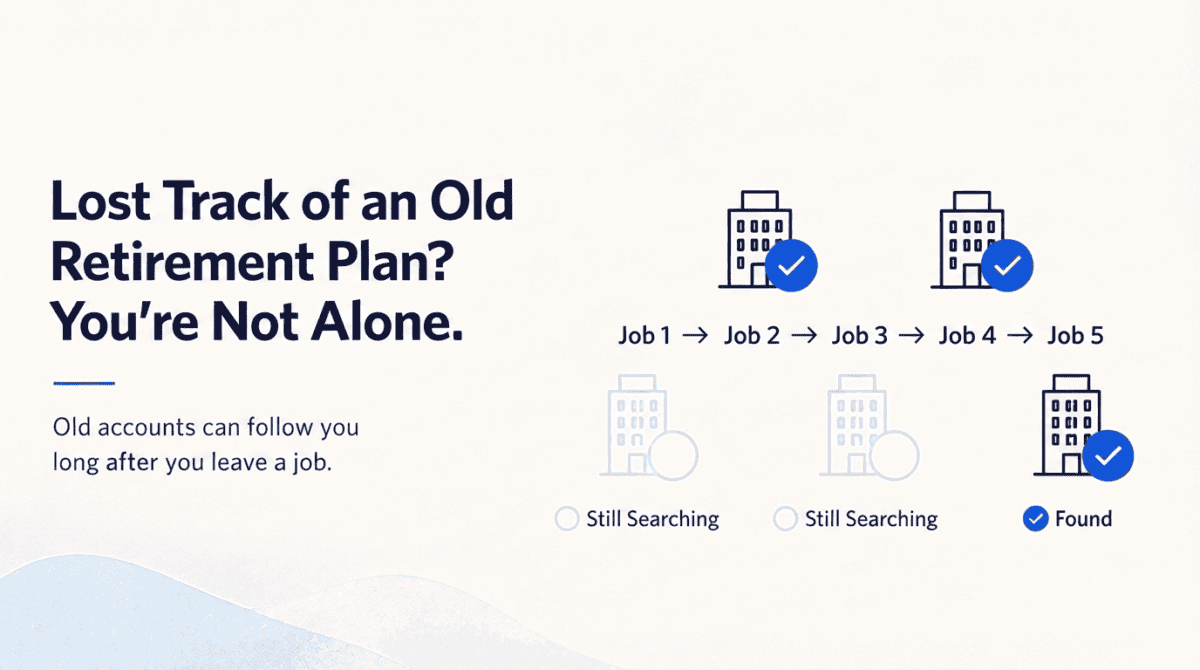
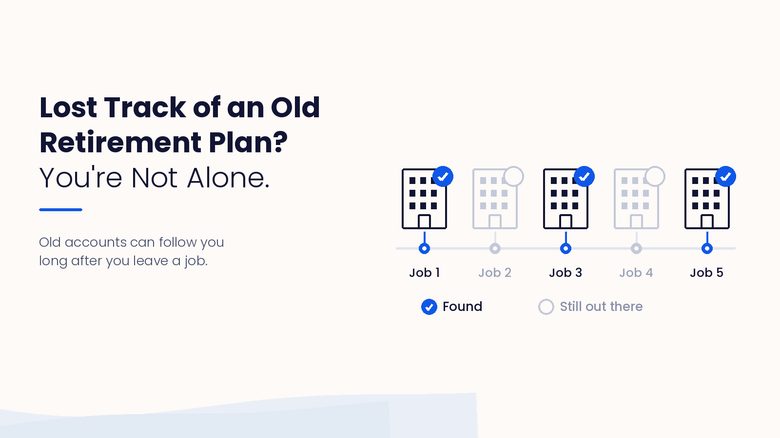
Over a thirty-year career, most people work for four or five employers. Each of those jobs may have come with a retirement plan that is still holding money in their name today.
Here is the part worth knowing up front. That money does not expire, and it does not belong to the old employer. It is still yours.
Federal databases, public filings, and state records all exist for exactly this purpose, and most of them are free to search. An hour with your own paperwork and a few of those searches is a reasonable place to start.
Why Accounts Go Quiet
A workplace retirement account does not close when you leave the job. It stays open, usually invested in whatever you last selected, until someone does something about it.
Staying connected to that account depends on two things holding true for decades. Your former employer has to be able to reach you, and the account has to stay somewhere in your memory.
Both give way for ordinary reasons. Employers merge, close, or switch plan providers, and the new provider may never receive current contact information for everyone on the list. Households move. And mail from a company you left in 2009 rarely looks urgent, because most of the time it is not.
Federal researchers and industry analysts have estimated that millions of workplace retirement accounts have been left behind, holding a very large amount of money in total. Whatever the exact number, the practical point holds. If you think you might have one, there is a good chance you do.
Where to Look
Start with what you already have at home, then work through whichever of the public searches apply to you. Some return an answer right away. Others take a phone call or two.
Start With Your Own Records
Old W-2 forms show retirement plan contributions. Old tax returns can point to plans you were in. Separation paperwork often names both the plan and the company that ran it.
A file drawer or an old email archive is the cheapest place to begin, and it often answers the question without any searching at all.
The Federal Retirement Savings Lost and Found
The government launched a searchable database for exactly this problem at the end of December 2024. You can find it at lostandfound.dol.gov.
It requires a verified Login.gov account, which means confirming your identity with something like a driver’s license. Setting that up takes a few minutes.
One honest caveat. Plans report to this database voluntarily, so coverage is incomplete, especially for smaller employers. A blank result does not mean nothing is out there. Treat it as one search among several.
The National Registry of Unclaimed Retirement Benefits
A separate, privately operated database. You can search by Social Security number for employers that have reported an unclaimed account in your name. Free to use.
If the Employer No Longer Exists
The Department of Labor keeps an Abandoned Plan database showing whether a plan was closed down and who handled it.
If the employer had a traditional pension that was terminated, the Pension Benefit Guaranty Corporation runs a separate search for unclaimed pension benefits.
Form 5500 Filings
Most workplace plans file an annual report with the federal government called a Form 5500. Those filings are public and searchable on the Department of Labor’s website.
If you remember the employer’s name and nothing else, the filing usually names the company that ran the plan and gives you somewhere to call.
State Unclaimed Property
If an account was closed out and the company could not locate the owner, the money may have gone to the state. Pennsylvania residents can search the Pennsylvania Treasury’s unclaimed property system. If you have lived in more than one state, search each of them.
The Small Balance Problem
There is one rule worth knowing here, and it changed recently.
A plan may move a former employee’s small account out of the plan without that person’s consent. The threshold for doing so is now $7,000.
That money usually goes into an individual retirement account chosen by the plan, where it often sits in a low-yielding cash option that may carry an annual fee.
So a modest balance from an old job may no longer be where you last saw it. It may not be invested the way you would choose, and it may be losing a little ground each year. Look for it specifically.
Three Things to Check on Each Account
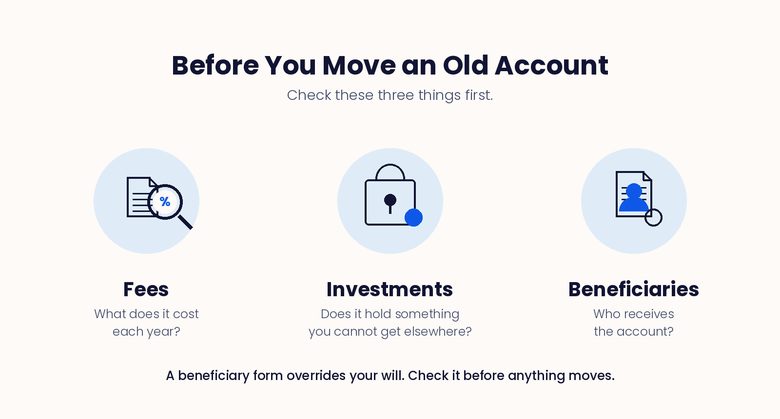
Write down every account you find. Then answer three questions about each one before deciding anything.
1What Does It Cost You Each Year?
Two numbers matter. The first is the yearly fee charged by each investment you own, usually shown as a percentage and called an expense ratio. The second is any separate charge for running the plan itself. Both appear on your statement or in a document the plan sends called a fee disclosure. Some large plans are inexpensive. Some small ones are not. If you cannot find the numbers, the plan’s phone number is on the statement and they are required to tell you.
2Does It Hold Anything You Cannot Buy Elsewhere?
Two things come up most often. One is a stable value fund, a conservative option that aims to hold a steady value while paying interest. There is no exact equivalent outside a workplace plan. The other is shares of your former employer’s own stock. Those may qualify for a special tax break if the shares are worth much more than what was paid for them. Both are reasons to slow down before moving anything.
3Who Is Named as the Beneficiary?
Not who you believe it is. Who the form actually says. Log in and look. The form controls where the money goes. So if the account was opened before a marriage, a divorce, or a death in the family, this is the most important question on the list.
What You Can Do Next Depends on the Plan Type
Finding an account and moving it are two different problems. Most workplace plans can be combined, but a few cannot, and the labels look almost identical.
Check the Plan Type Before You Plan a Transfer
If a plan is labeled 457, confirm whether it is governmental or non-governmental. According to the IRS, distributions from a non-governmental 457(b), the kind offered by nonprofit hospitals and charities, are not eligible for rollover to an IRA. The same is true of a 457(f). An attempted rollover may be treated as an excess contribution and subject to an excise tax.
Also ask for the pre-tax and Roth balances separately. Pre-tax dollars generally belong in a traditional IRA and Roth dollars in a Roth IRA. Many statements show only a single total, and sending one type into the wrong account can create an avoidable tax bill.
A traditional pension works differently again, since it promises monthly income rather than holding a balance in your name.
For the full set of options, read What Happens to Your Retirement Plan When You Leave a Job. It also covers the reasons some families are better off leaving money exactly where it is.
Two Ways the Money Can Move
If you decide to combine accounts, everything comes down to one question on the paperwork. Who is the check made out to?
Same account, same amount of money, two very different outcomes. When you call the plan, ask for a direct transfer and confirm who the check will be payable to before it goes out.
One Last Step After the Transfer Clears
Combining accounts creates a new account, and a new account needs its own beneficiary form. The names from the old accounts do not carry over.
This matters more than it sounds, because a beneficiary form overrides your will. A form completed in 1998 controls where that money goes in 2026, whatever your estate documents say.
So make it part of the same project rather than a separate one. When the transfer confirms, fill out the beneficiary form that same week while the paperwork is still in front of you.
Once You Know What You Have
Having a complete list changes the situation. You can see every account in one place and compare what each one costs. You can confirm the right people are named on each form. And you can stop wondering whether something is out there that you have forgotten.
From here, everything is a choice rather than a search, and choices keep. There is rarely a deadline on any of this, so you can take the time to get it right.
Bring Your List to an Advisor
Seeing every account side by side is the part that is genuinely hard to do alone. Bring whatever you turn up and we will go through each one together. What it costs you, what it holds that you could not get elsewhere, who is named on it, and what makes sense to do with it. The consultation is complimentary and carries no obligation.
Schedule a Free ConsultationOr call 717-288-1880
Common Questions
How do I find an old 401(k) from a former employer?
Start with your own W-2 forms, tax returns, and separation paperwork. Then search the Department of Labor’s Retirement Savings Lost and Found at lostandfound.dol.gov and the National Registry of Unclaimed Retirement Benefits. If the employer no longer exists, check the Abandoned Plan database and Form 5500 filings.
What happens to a small balance left in an old plan?
A plan may move a former employee’s account out without consent if the balance is $7,000 or less. The money usually goes into an IRA chosen by the plan, often in a low-yielding cash option that may carry an annual fee.
Is the Department of Labor’s Lost and Found database complete?
No. Plans report to it voluntarily, so coverage is incomplete, especially for smaller employers. A blank result does not mean nothing is out there. Treat it as one search among several.
Can I find a retirement account if the company went out of business?
Often yes. The Department of Labor keeps an Abandoned Plan database, and the Pension Benefit Guaranty Corporation runs a search for unclaimed pension benefits. Form 5500 filings are public and usually name the company that ran the plan.
Should I combine old retirement accounts?
Not always. It depends on what each account costs, what it holds, and which plan type it is. Some plans hold options you cannot get elsewhere, and a non-governmental 457(b) generally cannot be rolled into an IRA at all.
Sources
U.S. Department of Labor, Retirement Savings Lost and Found Database, lostandfound.dol.gov
U.S. Department of Labor, Employee Benefits Security Administration, Abandoned Plan Program and Form 5500 filings
Pension Benefit Guaranty Corporation, Unclaimed Pensions search
National Registry of Unclaimed Retirement Benefits
Internal Revenue Service, Non-Governmental 457(b) Deferred Compensation Plans
Internal Revenue Service, Issue Snapshot: 457(b) Plan of Tax-Exempt Entity, Tax Consequences of Noncompliance
Internal Revenue Service, Notice 2026-13, Safe Harbor Explanations for Eligible Rollover Distributions
Internal Revenue Service, Publication 575, Pension and Annuity Income
Pennsylvania Treasury, Unclaimed Property
About the Financial Author

Alexander Langan, J.D., is the Chief Investment Officer at Langan Financial Group. In this role, he manages investment portfolios, acts as a fiduciary for group retirement plans and consults with clients regarding their financial goals, risk tolerance and asset allocation.
With a focus on ERISA Law, Alex graduated cum laude from Widener Commonwealth Law School. He then clerked for the Supreme Court of Pennsylvania and worked in the Legal Office of the Pennsylvania Office of the Budget, where he assisted in directing and advising policy determinations on state and federal tax, administrative law, and contractual issues.
Alex is also passionate about giving back to the community and has helped establish The Foundation of Enhancing Communities’ Emerging Philanthropist Program, volunteers at his church, and serves as a board member of Samara: The Center of Individual & Family Growth. Outside of work and volunteering, Alex enjoys his time with his wife Sarah and their three children, Rory, Patrick, and Ava.
About Langan Financial Group
For everything you’ve built.
Your savings. Your business. Your family’s future. Each deserves thoughtful planning that starts with what matters to you.
Langan Financial Group provides financial planning and investment management for individuals, families, and business owners. With offices in Camp Hill and York, Pennsylvania, we serve clients throughout Central Pennsylvania.
We help you work through questions about retirement income, investment decisions, Social Security, and how taxes may affect your financial plan. Our approach starts with understanding your goals, your financial picture, and your comfort with investment risk. From there, we help you evaluate your options and develop a plan that can evolve as your life changes.
We also help businesses and organizations evaluate workplace retirement plans and understand their responsibilities as plan sponsors.
Disclosures
The information in this material is not intended as tax or legal advice. Please consult legal or tax professionals for specific information regarding your individual situation. The opinions expressed and material provided are for general information.