
Most retirement advice is written for people who are either decades away or already finished. Pre-retirement planning gets less attention than either.
The last five working years are where pre-retirement planning happens. They are also the years when a number of changes land close together.
What changes before you retire is not the goal. It is the number of rules that suddenly apply to you. That is what makes pre-retirement planning different from saving.
Still working: several of these open windows you can use, and a couple close windows you may not know are closing.
Already retired: the withdrawal and appeal points still apply, and what changes before you retire may still apply to a spouse who is working.
If you have not mapped your dates yet, start with the four ages that change your options before you retire. Knowing which year each one lands in is what makes the rest of this useful.
Pre-Tax, Roth, or Taxable: Where the Money Goes
The last five working years can be the highest-earning of a career. Mortgages are often paid off, children are usually independent, and the amount available to save peaks.
It is also when a housing decision often surfaces, which we covered in whether to downsize before retirement.
That makes the mix worth as much attention as the total. Pre-tax accounts, Roth accounts, and ordinary taxable accounts behave very differently once you draw on them.
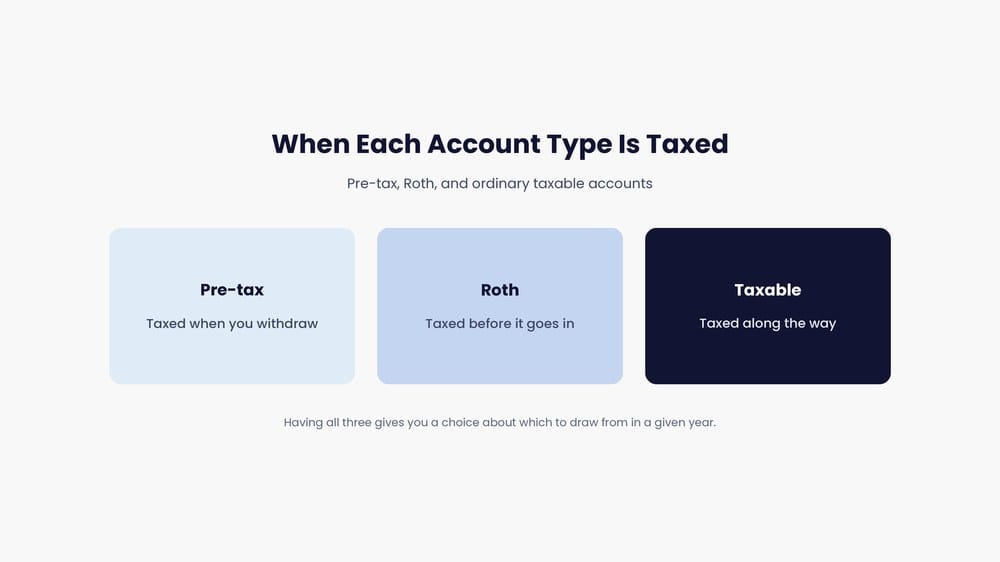
A household with all three can choose which account to draw from in a given year.
A household with everything in one place has fewer choices, and every withdrawal shows up as income.
That matters more near retirement than it did earlier, because the same income figure now drives both your tax bracket and, two years later, your Medicare premium.
A Four-Year Window to Save More
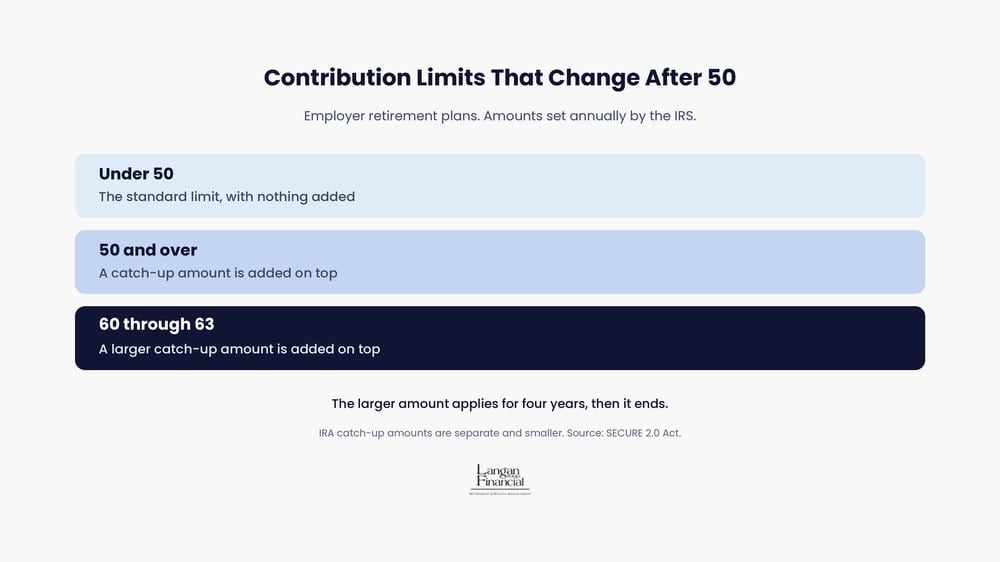
A catch-up contribution is an extra amount you are allowed to put in above the standard limit. Anyone 50 or over can already use one.
Under the SECURE 2.0 Act, a 2022 retirement law, a larger catch-up amount applies to employer retirement plans at ages 60 through 63.
The amounts are set annually by the IRS and change most years, so it is worth confirming the current figure rather than working from an older one.
Still working: this is a window you can use, and it closes at 64.
Already retired: if a spouse is still working and in that age band, it may still apply to your household.
Why the timing matters: this window falls in the years when earnings can be highest and fixed costs are often lowest. It is the stretch when the extra room is easiest to actually use.
The Coverage Gap Between Your Last Day and Medicare
For anyone considering stopping before 65, this moves from a detail to the thing that decides whether the date works.
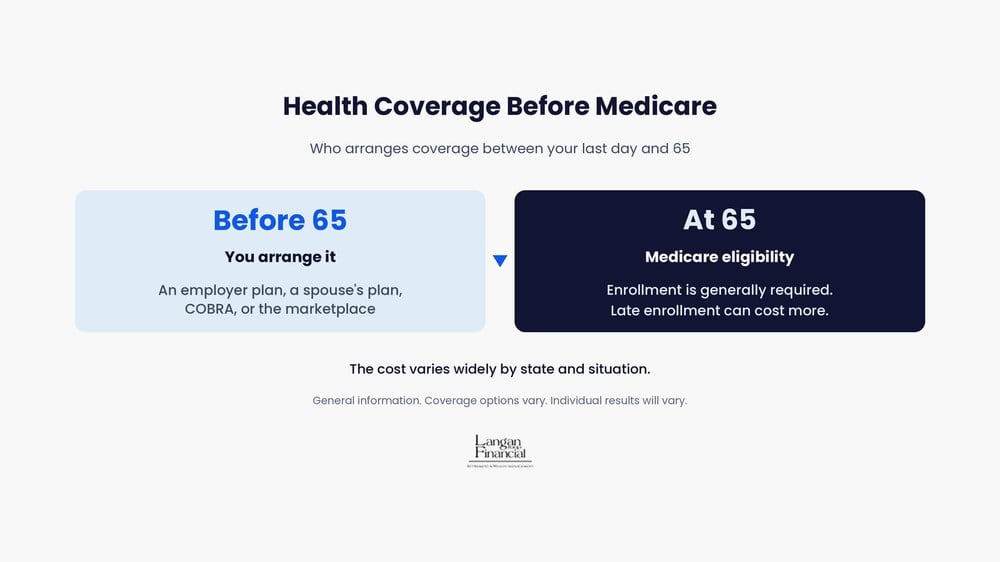
Between your last working day and Medicare eligibility at 65, coverage is yours to arrange. Enrollment in Medicare is generally required at that point unless you are already receiving Social Security.. Enrollment is generally required unless you are already receiving Social Security.
An employer plan, a spouse’s plan, COBRA, or the marketplace are the usual routes. The cost varies widely by state and situation.
For a couple retiring at 62, that stretch can run three years. It is one of the most common gaps we see in an otherwise sound plan: the savings number works, and the coverage number was never priced. It belongs in the same conversation as the rest of your retirement income plan.
The Income Year Medicare Uses to Set Your Premium
This is the change people least expect, and it is the reason the last working years deserve specific attention.
Medicare sets Part B and Part D premiums using income from two years earlier. Premiums in 2026 are based on income reported for 2024. Someone enrolling at 65 is priced on the year they turned 63, which for most people is a full year of salary.
Above certain income levels, Medicare adds a surcharge on top of the standard premium. It carries an acronym, IRMAA, for the income-related monthly adjustment amount. In plain terms, it is a higher Medicare premium for higher earners.
It applies per person, so a married couple above a threshold pays it twice.
If your income has dropped since then, stopping work is a qualifying life-changing event. Form SSA-44 asks Social Security to use a more recent year. A Roth conversion or a one-time capital gain does not qualify.
For couples, the surcharge applies to each spouse separately, which is one more reason to ask whether the plan still works for one person.
What Changes Before You Retire, Taken Together
What changes before you retire is rarely dramatic taken piece by piece. Taken together, they explain why the last five working years feel busier than the decade before them.
The decade before retirement asks one question, which is whether you are saving enough — the last five working years ask several, and they arrive close together.
Still working: the useful exercise is writing down two dates, the year you expect to stop and the year you turn 63, then pricing coverage for any gap.
Already retired: the live decisions are withdrawal order and the appeal route, if your income has dropped since the year Medicare priced you on.
Our free readiness guide, What to Handle Before You Retire, puts the dates and the numbers on the same page.
Speak With an Advisor Today
We can map your dates against each other and price the pieces that are easy to miss, so the last working years do the work you need them to.
Or call 717-288-1880
For a weekly planning question like this one, our retirement newsletter goes out every Wednesday.
Common Questions About What Changes Before You Retire
What changes before you retire?
More than most people expect. A larger catch-up contribution becomes available at 60, and the early withdrawal penalty ends at 59 and a half. The income year behind your first Part B and Part D premiums usually falls in this stretch. Health coverage becomes a live question if you plan to stop before 65.
Should I be saving differently in the last five years?
The instinct to save more is right. What often gets missed is the mix. Money in pre-tax, Roth, and ordinary taxable accounts behaves differently once you draw on it, and having all three gives you choices about which to use in a given year.
How much can I contribute at age 60?
More than at 50 in an employer retirement plan, under the SECURE 2.0 Act. IRA catch-up amounts are separate and smaller. The specific amounts are set annually by the IRS and change most years, so the figure worth checking is the current one rather than a number from a previous year.
What if I want to retire before 65?
Health coverage becomes the first question rather than a detail. Between your last working day and Medicare eligibility, coverage is yours to arrange through an employer plan, a spouse’s plan, COBRA, or the marketplace. Costs vary widely and are worth pricing early.
Does my income right before retiring affect anything afterward?
Yes, in one specific way people rarely anticipate. Medicare sets premiums using income from two years earlier, so a high-earning year shortly before you enroll can raise your first premiums. Retirement itself is a qualifying event for an appeal using Form SSA-44.
What should I do first?
Write down two dates: the year you expect to stop working and the year you turn 63. Then price health coverage for any gap between stopping and 65. Those three figures surface most of what needs attention.
Sources
Centers for Medicare and Medicaid Services, 2026 Medicare Parts A and B Premiums and Deductibles
Social Security Administration, Medicare Premiums: Rules for Higher-Income Beneficiaries, and Form SSA-44
Internal Revenue Service, Retirement Topics: Catch-Up Contributions
SECURE 2.0 Act of 2022, Section 109
This article is provided for informational and educational purposes only and does not constitute investment advice, financial planning advice, tax advice, or legal advice. All investing involves risk, including potential loss of principal. Past performance is not a guarantee of future results. Individual results will vary based on specific financial circumstances. Tax rules referenced are current as of the date of publication and are subject to change. Please consult a qualified financial, tax, or legal professional before making any financial decisions. Securities offered through PKS Securities, Inc., a Broker-Dealer, Member FINRA/SIPC. Advisory services offered through Langan Financial Group, LLC, a Registered Investment Adviser. Registration does not imply a certain level of skill or training.